
Introduction: If You’re Doing SEO but Still Not Getting Results
You’ve published dozens of articles, optimized your pages, worked on keywords, improved your website, and perhaps even invested in backlink, but the results still aren’t where they should be. Your important service pages aren’t ranking, organic traffic is stagnant, or the traffic you do receive isn’t turning into enquiries. At that point, it’s natural to ask: “Why is my SEO not working?”
The problem is that SEO rarely fails because of one isolated issue. A website can have excellent content but poor technical architecture, strong rankings but weak conversion paths, or thousands of organic visitors but almost no commercially valuable traffic. In other cases, the SEO strategy itself is targeting keywords that have little relationship with what the business actually sells.
This is why simply doing “more SEO” isn’t always the answer. Publishing another 50 articles won’t fix a website where important pages aren’t indexed. Building more backlinks won’t solve a search-intent mismatch. Improving Core Web Vitals won’t suddenly make an irrelevant service page rank for a highly competitive commercial query.
The right approach is to identify where the SEO funnel is breaking and then prioritize the problems according to business impact. If you’re wondering why your SEO not working, identifying the specific stage where performance is falling short is the first step toward fixing it.
The complete SEO journey looks like this:
Search Visibility → Rankings → Qualified Traffic → Engagement → Enquiries → Sales → Revenue
If your website is failing at any point in this chain, SEO can appear to be ineffective even when another part of the system is working. This guide explains 15 real SEO problems and solutions, how to diagnose each problem, what should be fixed first, and how to determine whether your SEO strategy needs optimization, or a fundamental change in direction.
What Does “SEO Is Not Working” Actually Mean?
Before fixing SEO, you need to define what “not working” actually means. Different businesses use the phrase to describe completely different website SEO problems. A startup might say SEO isn’t working because it isn’t ranking for competitive keywords. An established company might rank well but complain that organic traffic isn’t generating leads. An ecommerce business might receive substantial organic traffic but see very little revenue from it.
These are not the same SEO problem. If you are asking why SEO not working, the answer usually depends on whether the issue is visibility, traffic quality, rankings, or conversions.
Scenario 1: Your Website Is Not Ranking
Your important pages aren’t appearing on Google for the keywords that matter to your business, leaving your website not ranking on Google for important searches. If your website not ranking on Google, start by checking whether the affected pages are technically accessible and properly targeted.
This can indicate problems with technical SEO, keyword targeting, content quality, search intent, authority, or competition. When SEO not getting traffic, these areas should be reviewed together rather than focusing only on keyword rankings.
Scenario 2: Your Website Has Impressions but Few Clicks
Google is showing your pages, but users aren’t clicking them. Possible causes include poor ranking positions, weak title tags, unattractive search snippets, incorrect intent targeting, or competition with stronger SERP features.
Scenario 3: Your Website Gets Traffic but No Leads
This is often misdiagnosed as an SEO problem. If your SEO not generating leads, review whether the traffic is reaching relevant pages with clear conversion paths.
The real issue may be:
- irrelevant traffic
- weak landing pages
- poor CTAs
- unclear positioning
- weak trust signals
- poor mobile experience
- difficult enquiry forms
Scenario 4: You Get Leads, but They’re Poor Quality
Your SEO may actually be generating visibility successfully, but targeting the wrong audience. For example, ranking for broad informational searches can generate traffic from students, researchers, job seekers, competitors, or people outside your service area.
Scenario 5: Your Rankings Used to Be Better
A decline can result from:
- stronger competitors
- algorithm changes
- content becoming outdated
- technical changes
- website migrations
- lost backlinks
- search-intent changes
- internal competition between pages
The first step is therefore not to ask: “How do we do more SEO?” Ask: “At which stage is our SEO performance breaking down?”
Why SEO Is Important Even When Results Are Slow
One reason businesses become frustrated with SEO is that they compare it directly with channels that can generate traffic almost immediately. Paid advertising can put a business in front of searchers as soon as campaigns become active. SEO operates differently because search engines need to discover, crawl, understand, evaluate, and compare your pages against competing results.
However, the fact that SEO takes time doesn’t mean poor performance should be ignored. A successful SEO strategy can build an asset that continues generating visibility after the initial content and optimization work has been completed. Strong Google rankings can help a well-ranked commercial page attract qualified prospects repeatedly without requiring the business to pay for every individual click.
SEO can contribute to:
- long-term organic visibility
- brand discovery
- qualified search traffic
- topical authority
- commercial-intent traffic
- lower marginal acquisition costs
- stronger brand credibility
- visibility across traditional and AI-powered search experiences
But SEO only creates those benefits when the strategy is correctly aligned with the business. So when someone asks “why SEO is important”, the better answer isn’t simply “because organic traffic is free.” Organic traffic isn’t truly free. SEO requires investment in strategy, content, technical development, expertise, authority, measurement, and ongoing optimization.
The real value is that SEO can create a compounding acquisition channel when the underlying strategy is strong. This is also why SEO is important for businesses looking to build sustainable organic visibility rather than relying entirely on short-term traffic sources.
The 15 Reasons Your Website SEO May Not Be Working
There are four broad categories of SEO problems:
Foundation Problems
1. Technical SEO foundation is broken
2. Important pages aren’t being indexed
3. Website architecture is weak
4. Performance and page experience problems
Strategy Problems
5. Wrong keyword targeting
6. Search-intent mismatch
7. Keyword cannibalization
8. Lack of topical authority
9. Competitors have stronger authority
Content & Authority Problems
10. Content is too generic
11. Content doesn’t demonstrate genuine expertise
12. Internal linking is weak
13. Backlink profile is weak or irrelevant
Conversion Problems
14. You’re ranking for keywords with little commercial value
15. Organic traffic isn’t reaching pages that convert
Now let’s examine each problem in detail. Understanding why SEO fails in different situations helps businesses focus on the actual cause instead of simply increasing SEO activity.
1. Your Technical SEO Foundation Is Broken
Technical SEO is the infrastructure that allows search engines to access, understand, index, and evaluate your website. A page can contain excellent content and still struggle to rank if Google has difficulty accessing the page or understanding which version should be indexed.
Common technical SEO problems include:
- accidental noindex directives
- incorrect canonical tags
- robots.txt blocking
- broken internal links
- redirect chains
- redirect loops
- server errors
- duplicate URLs
- incorrect XML sitemaps
- JavaScript rendering problems
- poor mobile implementation
- orphan pages
- incorrect status codes
The important point is that not every technical warning has the same importance. A common SEO audit mistake is producing a spreadsheet containing hundreds of warnings and treating all of them as equally urgent. That creates activity without necessarily improving organic performance.
A better approach is to ask: Does this technical issue affect an important page, important user journey, or important search-engine process? For example, a minor HTML warning on an unimportant page may have virtually no commercial impact. A noindex directive on your primary service page can be catastrophic.
How to Diagnose Technical SEO Problems
Start with Google Search Console and inspect:
- Page Indexing
- URL Inspection
- Sitemaps
- Core Web Vitals
- HTTPS
- manual actions, where applicable
- crawl and indexing patterns
Then crawl the website to identify:
- broken links
- redirect chains
- canonical inconsistencies
- duplicate URLs
- missing metadata
- orphan pages
- incorrect status codes
The goal isn’t to create the longest technical audit possible. The goal is to identify technical barriers that prevent strategic pages from performing.
What to Fix First
Prioritize:
- Important pages accidentally blocked from indexing.
- Incorrect canonicalization.
- Major server or rendering failures.
- Broken internal links to important pages.
- Incorrect redirects.
- Major duplicate URL problems.
- Mobile and performance problems affecting important templates.
Once these are resolved, move toward strategic and content-related issues.
2. Google Is Not Indexing the Pages That Matter
Indexation is frequently misunderstood. A website may contain 500 pages and have hundreds of URLs known to Google, but that doesn’t mean every strategically important page is properly indexed and eligible to rank. Google can discover URLs that it ultimately chooses not to index for various reasons, including duplication, quality, canonicalization, crawl patterns, or the nature of the URL.
The important question isn’t: “How many pages are indexed?” It is: “Are the pages that matter to our business indexed and eligible to rank?”
Consider a company with:
- 10 important service pages
- 100 supporting articles
- 300 tag/category URLs
- 50 outdated pages
If the service pages have indexation or canonical problems while hundreds of low-value URLs remain accessible, the site can have plenty of indexed URLs while still performing poorly commercially.
How to Diagnose Indexing Problems
Take your most important URLs and inspect them individually.
For every strategic page, verify:
- Is the URL accessible?
- Does it return HTTP 200?
- Is it indexable?
- Is there an unintended noindex?
- Does the canonical point to itself or the correct preferred URL?
- Is it included in the XML sitemap where appropriate?
- Is it internally linked?
- Can Google discover it naturally?
- Does Search Console show it as indexed?
This page-by-page validation is often more useful than looking only at the total indexed URL count.
What to Fix
Prioritize commercial and strategic pages first.
Then address:
- duplicate pages
- orphan pages
- unnecessary parameter URLs
- outdated URLs
- thin pages
- weak taxonomy structures
Indexation should be treated as a business-priority problem, not merely a technical metric.
3. Your Website Architecture Is Weak
Website architecture determines how content is organized and how authority flows between pages. A website with 100 excellent pages can still underperform if those pages are disconnected from each other.
Weak architecture often creates:
- orphan pages
- excessive click depth
- unclear topical relationships
- weak internal linking
- duplicate categories
- confusing URL structures
- disconnected supporting content
A stronger structure establishes clear relationships between commercial pages and supporting information.
For example:
├── SEO Services
├── SEO Pricing
├── Technical SEO
├── Local SEO
├── Enterprise SEO
├── SEO Audit
├── SEO Strategy
└── Supporting Guides
This is more useful than publishing dozens of unrelated SEO articles that don’t reinforce the primary service page.
Why Architecture Matters for SEO
Search engines need to understand:
- which pages are most important
- which pages belong to the same topic
- how information is organized
- which pages are supporting resources
- which pages represent commercial offerings
Users need the same clarity.
- A visitor reading a technical SEO article should be able to discover the relevant SEO service naturally.
- A visitor reading a pricing guide should be able to move toward the appropriate service page.
This creates both a better user journey and a stronger internal linking structure.
4. Your Website Has Performance or Page Experience Problems
A website can have technically correct SEO but still provide a poor experience.
Performance problems may come from:
- oversized images
- inefficient JavaScript
- excessive third-party scripts
- slow hosting
- poor caching
- inefficient APIs
- database bottlenecks
- poorly optimized frontend code
- mobile performance issues
The first step is identifying whether performance is actually affecting important pages and user journeys.
Review:
- Core Web Vitals
- mobile performance
- server response time
- image loading
- JavaScript execution
- third-party scripts
Don’t Confuse Performance Scores With SEO Strategy
A common mistake is treating a perfect technical score as the definition of successful SEO. Improving performance is valuable, but a fast website with irrelevant content will not suddenly outrank a slower but substantially more relevant competitor for every query. Performance should therefore be treated as part of the SEO foundation.
The hierarchy is:
Technical Accessibility → Relevance → Quality → Authority → User Experience → Conversion
All of these need to work together.
5. You’re Targeting the Wrong Keywords
This is one of the most expensive SEO mistakes because an organization can spend months producing content for keywords that were never commercially valuable. Keyword volume alone isn’t enough. One common reason why SEO fails is that businesses focus heavily on search volume without considering relevance, intent, and commercial value.
A keyword should be evaluated based on:
- relevance
- search intent
- business value
- competition
- geographic relevance
- conversion potential
- relationship to the buyer journey
For example, a software development company might receive significant traffic from: “what is software development?”
But the commercial opportunity may be much stronger for: “software development company in Mumbai”
The first query can support awareness. The second is much closer to a buying decision. A successful SEO strategy needs both, but they should not be treated as equally valuable.
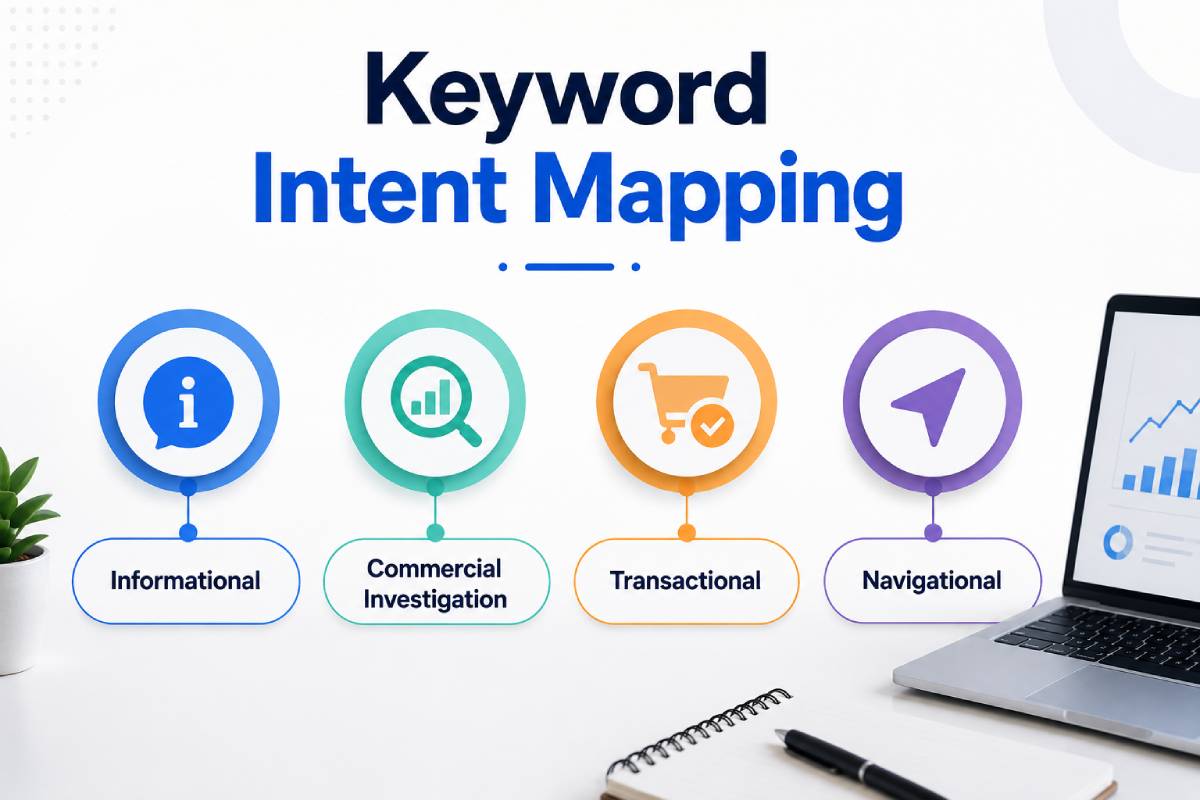
Keyword Intent Mapping
Map keywords according to intent.
Informational
The user wants to understand something.
Examples:
- what is SEO
- how does SEO work
- what is enterprise software
Commercial Investigation
The user is evaluating options.
Examples:
- best SEO agency
- SEO agency vs freelancer
- enterprise website development company
Transactional
The user is ready to take action.
Examples:
- SEO services Mumbai
- Google Ads management services
- enterprise website development services
Navigational
The user is looking for a specific brand or website.
Examples:
- company name SEO services
- company name pricing
Each intent should have an appropriate page type.
6. Your Content Doesn’t Match Search Intent
Even when the keyword itself is correct, the page can fail because it answers the wrong question. Consider: “Google Ads cost in India.”
Someone searching this is likely looking for:
- advertising budget
- CPC
- management fees
- pricing models
- cost factors
- examples
- agency pricing
If you send that user to a generic Google Ads service page that mainly says “we manage Google Ads campaigns,” the page doesn’t satisfy the intent. The keyword may be correct. The page is wrong.
How to Identify Search Intent
Search the target query and examine the results.
Look at:
- page types
- content formats
- topics covered
- SERP features
- commercial vs informational results
- geographic focus
If most results are detailed pricing guides and your page is a short service description, there is likely an intent mismatch.
How to Fix Intent Mismatch
You may need to:
- rewrite the page
- change the page format
- create a new page
- consolidate existing pages
- change the keyword mapping
Don’t force a service page to rank for a query that clearly requires an informational guide.
7. Multiple Pages Are Competing for the Same Keyword
Keyword cannibalization occurs when multiple pages on the same website target substantially overlapping search intent and compete for similar queries.
For example:
- /seo-services/
- /seo-agency/
- /seo-company/
- /professional-seo-services/
If all four pages essentially communicate the same service and target the same intent, Google may have difficulty determining which page should be the primary result.
How to Diagnose Cannibalization
Look at:
- Google Search Console queries
- pages receiving impressions
- ranking URLs
- content overlap
- keyword mapping
- internal links
If multiple URLs repeatedly appear for the same important query, investigate whether they genuinely serve different search intents.
How to Fix It
Possible solutions include:
Consolidation
Combine overlapping content into one stronger page.
301 Redirect
Redirect a redundant page to the primary version when appropriate.
Differentiation
Change the pages so they serve clearly different intents.
Internal Linking
Make the relationship between the pages explicit.
Keyword Reassignment
Give each page a distinct primary topic.
The goal is not to eliminate every instance where multiple pages rank for related terms. The goal is to prevent your own pages from unnecessarily competing for the same commercial intent.
8. You Don’t Have Enough Topical Authority
Publishing one article about a subject does not necessarily demonstrate comprehensive expertise. Suppose you want to rank for: performance marketing services
A stronger topical structure might include:
- Performance Marketing Services
- Performance Marketing Cost
- PPC vs SEO vs Performance Marketing
- Google Ads vs Meta Ads
- Performance Marketing ROI
- Performance Marketing for B2B
- Performance Marketing for Ecommerce
- Performance Marketing Strategy
- Common Performance Marketing Mistakes
These pages address different questions while collectively covering the subject.
Topical Authority Is More Than Publishing Volume
The objective isn’t to publish 100 articles because “more content is better.” The objective is to cover the subject comprehensively and logically.
A topical cluster should contain:
- Pillar Page
→ broad commercial topic
- Supporting Guides
→ specific problems and questions
- Comparison Content
→ commercial investigation
- Pricing Content
→ cost intent
- Case Studies
→ proof
- Service Pages
→ conversion
These pages should be connected with meaningful internal links.
9. Competitors Have Stronger Authority
Sometimes your website is technically sound, your content is relevant, and your keyword strategy is reasonable, but competitors still outperform you. This can happen because competing websites have accumulated stronger authority over time.
They may have:
- more relevant referring domains
- stronger brand recognition
- deeper topical coverage
- better expert content
- stronger internal linking
- more digital PR
- better first-hand evidence
- stronger industry relationships
The solution isn’t necessarily to build thousands of backlinks. First identify where the authority gap actually exists.
Competitor Gap Analysis
Compare competing pages based on:
Content
What important questions do they answer that you don’t?
Authority
Do they have relevant industry websites linking to them?
Expertise
Do they demonstrate genuine experience?
Internal Linking
How strongly is the page supported by related content?
Brand
Is the competitor more recognizable in the market?
User Experience
Does their page make it easier for users to find the information they need?
This creates a more actionable SEO strategy than simply counting competitor backlinks.
10. Your Content Is Too Generic
One of the biggest SEO problems today is content that technically answers a query but provides almost nothing distinctive. Consider this: “SEO helps businesses increase organic traffic and improve search rankings.”
It’s correct. But it doesn’t demonstrate expertise. Thousands of websites can publish the same statement. A stronger page should answer: What does the reader learn here that they couldn’t easily get from ten other websites?
That could come from:
- original frameworks
- real examples
- implementation details
- data
- screenshots
- case studies
- expert commentary
- industry-specific recommendations
- mistakes observed in real projects
- decision-making frameworks
How to Make SEO Content More Useful
Instead of:
“Optimize your title tags.”
Explain:
- how to identify pages with low CTR
- which pages deserve title testing
- how to align titles with intent
- how to avoid keyword stuffing
- how to distinguish brand and non-brand queries
- how to measure the result
Instead of: “Build backlinks.”
Explain:
- which pages deserve authority
- what types of links are commercially relevant
- how to identify link-worthy assets
- how digital PR can support authority
- why irrelevant links may provide little strategic value
Depth comes from specificity, not simply increasing word count. Addressing content SEO problems requires improving the usefulness, relevance, and specificity of the information rather than simply adding more words.
11. Your Content Doesn’t Demonstrate Real Expertise
Search engines and AI-powered search systems increasingly need to distinguish genuinely useful expertise from generic content
A page becomes more credible when it demonstrates:
- actual experience
- subject knowledge
- transparent methodology
- specific examples
- original analysis
- identifiable authorship
- professional credentials where relevant
For a B2B SEO agency, for example, don’t just explain that technical SEO matters.
Explain the types of technical problems your team actually encounters:
- CMS migration issues
- JavaScript rendering
- enterprise URL structures
- faceted navigation
- canonical conflicts
- international SEO
- indexation management
This turns theoretical content into practical expertise. Addressing content SEO problems also requires showing genuine expertise through specific examples and practical insights.
Add Evidence Where Appropriate
Strong commercial content can include:
- first-hand observations
- anonymized case examples
- before/after metrics
- screenshots
- processes
- checklists
- original research
The purpose isn’t to manufacture authority. It is to demonstrate it.
12. Your Internal Linking Is Weak
Internal linking is one of the most underused mechanisms for building a logical website architecture. Strong internal linking is an important part of SEO optimization because it connects related content and strategic pages. Imagine publishing 50 blog posts around SEO but none of them links to your main SEO service page. You have created content, but you haven’t created a meaningful topical network.
A better structure might be:
SEO Services
│
┌───────────┼───────────┐
↓ ↓ ↓
SEO Pricing SEO Audit Technical SEO
│ │ │
└───────────┼───────────┘
↓
Supporting Guides
Relevant supporting articles should naturally link toward the commercial page.
What Makes a Good Internal Link?
A useful internal link:
- is contextually relevant
- helps the user
- describes the destination
- supports topical relationships
- isn’t excessively repeated
- appears where it makes sense
For example: Businesses experiencing persistent technical SEO problems should consider a comprehensive SEO audit before continuing to publish new content.
The anchor should lead to a genuinely relevant audit page.
13. Your Backlink Profile Is Too Weak or Irrelevant
External authority still matters for competitive search queries. But the number of backlinks alone doesn’t tell you whether your backlink profile is strong. A website with 500 low-quality links may be less authoritative than a website with 50 highly relevant links from credible industry sources.
Evaluate:
- referring domain quality
- topical relevance
- authority
- link placement
- editorial context
- naturalness
- destination page
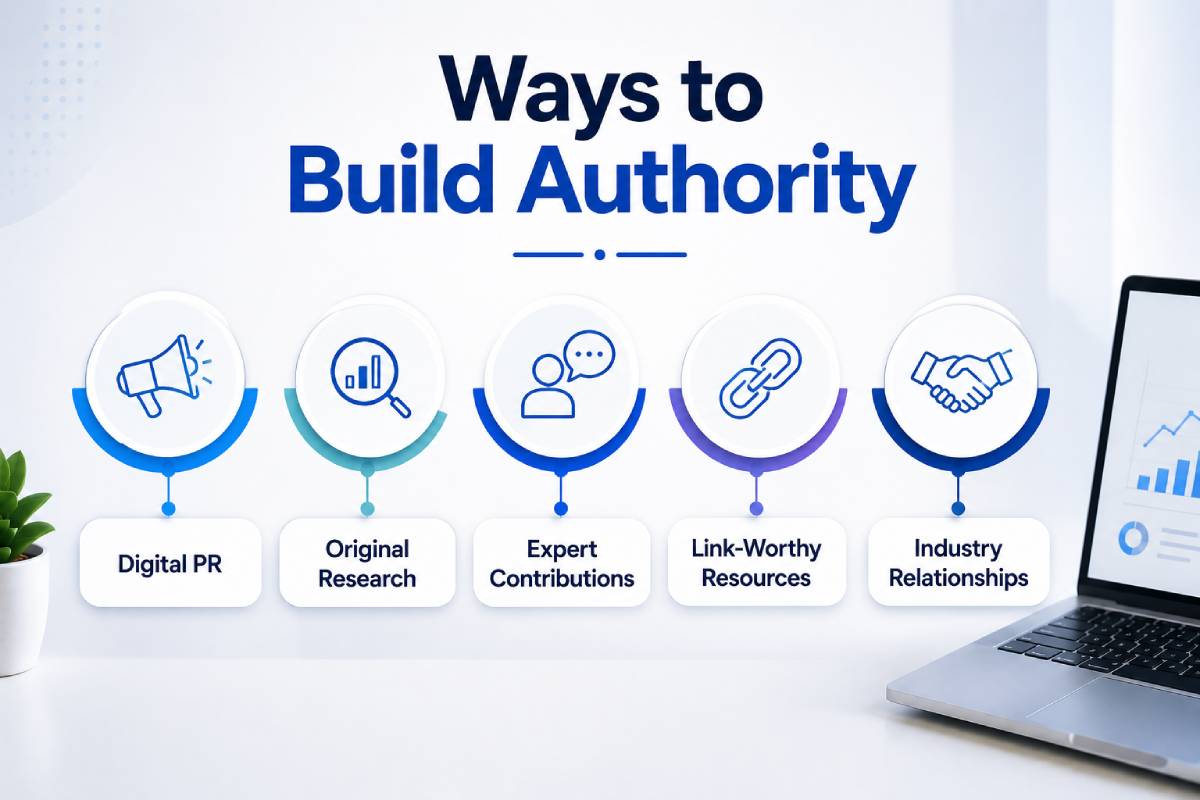
Better Ways to Build Authority
Instead of mass link acquisition, consider:
Digital PR
Create newsworthy research, insights, or expert commentary.
Original Research
Publish data that industry websites genuinely want to reference.
Expert Contributions
Provide valuable expertise to relevant publications.
Link-Worthy Resources
Build:
- calculators
- research reports
- frameworks
- comprehensive guides
- original datasets
Industry Relationships
Relevant partnerships and professional relationships can naturally create legitimate references.
The objective should be relevant authority, not an arbitrary backlink count.
14. You’re Ranking for Keywords That Don’t Have Commercial Value
This is a major reason businesses say: “SEO is working, but we’re not getting customers.” The rankings may actually be improving. The problem is that the strategy is measuring the wrong outcomes.
For example: “What is SEO?” can have substantially different commercial intent from: “SEO agency in Mumbai.”
The first can help establish awareness. The second is much closer to a buying decision. Both may be valuable, but they serve different stages of the funnel.
Build an SEO Funnel
TOFU – Awareness
Informational searches.
Examples:
- what is SEO
- how does SEO work
- SEO benefits
MOFU – Evaluation
Commercial investigation.
Examples:
- SEO agency vs freelancer
- best SEO agency
- SEO pricing
- SEO audit checklist
BOFU – Purchase
Transactional searches.
Examples:
- SEO services
- SEO agency Mumbai
- enterprise SEO services
A mature SEO strategy should deliberately create content for each stage. But if the business needs leads today, commercial and transactional pages should not be neglected in favour of publishing only informational content.
15. Your SEO Traffic Is Reaching Pages That Don’t Convert
This is the point where SEO becomes a revenue problem. SEO not generating leads can indicate a gap between organic traffic quality and the conversion experience.
Suppose your website generates: 10,000 organic visitors/month but only: 10 enquiries/month
It would be easy to conclude that SEO isn’t working. But the real problem may be conversion. Monitoring the SEO conversion rate can help determine whether organic visitors are taking meaningful actions after reaching the website.
Common Organic Conversion Problems
Weak Value Proposition
The visitor doesn’t understand why they should choose your company.
Poor CTA
There is no obvious next step.
Generic Landing Page
The page doesn’t address the visitor’s specific intent.
Weak Trust Signals
The page lacks:
- testimonials
- case studies
- credentials
- client examples
- process transparency
Difficult Forms
Too many fields or unclear expectations can reduce enquiries.
Wrong Traffic
The page ranks for keywords that don’t represent potential customers.
Poor Mobile UX
Users struggle to navigate or submit enquiries on mobile.
The SEO Conversion Funnel
Think of the journey as:
Keyword
↓
Google Result
↓
Click
↓
Landing Page
↓
Trust + Relevance
↓
CTA
↓
Enquiry
↓
Sales Qualification
↓
Customer
An SEO strategy should examine every stage. Tracking the SEO conversion rate helps connect organic search performance with actual enquiries and customer actions. If rankings improve but leads don’t, don’t automatically publish more content. Investigate the conversion path.
How to Diagnose Why SEO Is Not Working
A systematic diagnostic process is much more effective than making random changes to address website SEO problems. Understanding why SEO fails can help businesses move from making random changes to addressing the specific issues affecting their organic performance.
Step 1: Analyze Google Search Console
Review:
- impressions
- clicks
- CTR
- average position
- queries
- landing pages
- indexing
- page-level trends
Look for patterns.
For example:
- High impressions + low CTR: may indicate a SERP positioning or title/snippet problem.
- High clicks + low conversions: may indicate an intent or landing-page problem.
- Low impressions + low rankings: may indicate a relevance, authority, technical, or keyword-targeting problem.
If your SEO not getting traffic, low impressions can help identify where the visibility problem begins.
Step 2: Segment Your Keywords
Separate keywords into:
- branded
- non-branded
- informational
- commercial
- transactional
- local
- geographic
- product/service-specific
This tells you whether your SEO visibility actually corresponds to your business objectives. A 100% increase in branded searches may indicate stronger brand awareness, but it doesn’t necessarily demonstrate successful non-brand SEO acquisition.
Step 3: Analyze Landing Pages
Identify:
- pages gaining traffic
- pages losing traffic
- pages with high impressions
- pages with low CTR
- pages ranking positions 4–20
- pages generating conversions
- pages receiving traffic but no conversions
The pages ranking between positions 4 and 20 can be particularly useful optimization candidates because relatively small improvements may move them into stronger visibility.
Step 4: Compare Competitors
Don’t compare only domain authority.
Compare:
- page intent
- content depth
- content structure
- expertise
- internal links
- backlinks
- UX
- conversion elements
- topical coverage
The objective is to discover the specific competitive gap.
Step 5: Review the Conversion Funnel
Connect SEO data to business data.
Ask:
- Which organic pages generate enquiries?
- Which queries generate qualified leads?
- Which landing pages convert?
- Which pages generate traffic but no commercial action?
- What percentage of leads become opportunities?
- Which organic customers generate revenue?
This transforms SEO from a traffic channel into a measurable acquisition channel.
SEO Problems and Solutions: Quick Reference
| SEO Problem | Likely Cause | What to Fix |
| No rankings | Technical, relevance or authority problem | Full SEO diagnosis |
| Pages not indexed | Indexation/canonical/crawl issue | Fix indexation |
| Impressions but few clicks | Low ranking/weak SERP presentation | Improve positioning and snippets |
| Rankings but little traffic | Low-volume or wrong keywords | Re-map keywords |
| Traffic but no leads | Conversion or intent problem | Improve landing pages |
| Rankings declining | Competition/content/technical change | Diagnose decline |
| Multiple URLs rank for same term | Cannibalization | Consolidate or differentiate |
| Content doesn’t rank | Weak relevance/depth | Improve intent and usefulness |
| New content doesn’t gain visibility | Weak authority/internal links | Strengthen cluster |
| Lots of backlinks but no improvement | Poor relevance/quality | Improve authority strategy |
| High bounce/low engagement | Poor UX or intent | Improve page experience |
| Organic traffic is irrelevant | Wrong keyword strategy | Rebuild keyword map |
| Traffic grows, but revenue doesn’t | Poor commercial targeting | Prioritize BOFU queries |
What Should You Fix First?
Not every SEO problem deserves equal attention. Use a priority framework based on: Business Impact × SEO Impact × Implementation Effort
Priority 1: Critical Technical and Indexing Problems
Fix immediately if:
- important pages aren’t indexed
- robots.txt blocks strategic sections
- critical pages have incorrect canonical tags
- migrations created major errors
- important pages return errors
- rendering prevents meaningful content from being accessed
These issues can prevent other SEO work from producing results.
Priority 2: Keyword and Search Intent Problems
Once the technical foundation is healthy, determine whether your most important pages are targeting the correct searches.
Review:
- primary keyword
- secondary keywords
- intent
- geography
- commercial relevance
- competing pages
A wrong keyword strategy can waste months.
Priority 3: Important Content Gaps
Next, determine whether your strategic pages actually satisfy the searcher’s needs.
Improve:
- depth
- structure
- examples
- expertise
- differentiation
- commercial information
- FAQs
Don’t rewrite every page at once. Start with pages closest to revenue.
Priority 4: Internal Linking and Authority
Once the content is strong, strengthen the relationships between pages. Then identify authority gaps against competitors. This ensures external authority is being directed toward pages that already deserve to rank.
Priority 5: Conversion Optimization
If qualified traffic is already arriving, improve the conversion experience. Conversion-focused SEO optimization helps ensure that valuable organic traffic has a clear path toward becoming enquiries or customers.
Review:
- headlines
- value propositions
- CTAs
- forms
- trust signals
- case studies
- testimonials
- mobile UX
- enquiry flow
SEO should ultimately contribute to business growth, not simply an analytics dashboard full of sessions.
How Long Should You Wait Before Deciding SEO Isn’t Working?
There is no universal number of days or months after which SEO should automatically be declared successful or unsuccessful.
The timeline depends on:
- domain history
- competition
- industry
- existing authority
- technical condition
- content quality
- keyword difficulty
- geographic targeting
- publishing consistency
- website changes
A new website competing for highly competitive commercial queries may require substantially more time than an established site targeting less competitive terms. But businesses should not use “SEO takes time” as a substitute for measurement. When SEO not working after a reasonable period, reviewing measurable performance indicators can help identify whether the strategy needs adjustment.
What Should Improve Before Revenue Does?
There are several leading indicators of SEO progress, including improvements in Google rankings
You may see:
- More important pages being indexed.
- More impressions for target queries.
- Keywords entering the top 50.
- More keywords entering the top 20.
- Existing rankings moving toward the top 10.
- Higher CTR.
- Increased non-branded traffic.
- More qualified organic visitors.
- More enquiries.
- More organic revenue.
Not every business will experience these in exactly this order. But if nothing meaningful improves over a reasonable period, the strategy deserves investigation.
When Should You Run an SEO Audit?
An SEO audit becomes particularly valuable when:
- organic traffic has declined
- rankings have stagnated
- important pages aren’t indexed
- traffic is growing, but leads aren’t
- a website redesign has launched
- the website migrated to a new CMS
- URLs changed
- several agencies have worked on the website
- content has been published without meaningful results
- you don’t know which SEO activities are producing results
A useful audit should not simply produce a 100-page list of warnings.
It should answer:
- What is wrong?
- Why is it happening?
- Which problems matter most?
- What should be fixed first?
- Who needs to fix it?
- What result should we expect?
That turns an audit into an actionable growth roadmap.
SEO Audit Priority Matrix
A useful framework is to classify problems based on impact and effort.
| Category | Example | Recommended Action |
| High Impact / Low Effort | Incorrect title, broken internal link | Fix immediately |
| High Impact / High Effort | Architecture problem | Plan and implement carefully |
| Low Impact / Low Effort | Minor metadata issue | Fix when practical |
| Low Impact / High Effort | Cosmetic technical warning | Usually deprioritize |
This prevents teams from spending weeks fixing low-value technical issues while high-value service pages remain poorly optimized.
SEO Is Not Working vs Your SEO Strategy Is Wrong
This distinction deserves special attention. Sometimes the SEO channel is capable of producing results, but the strategy is fundamentally misaligned. Consider a business that has published 100 articles. The marketing team says: “We’ve invested heavily in SEO, and it’s not working.”
But an audit reveals:
- 80 articles target informational queries.
- Only three pages target commercial services.
- Those service pages have weak content.
- Internal links are inconsistent.
- No conversion tracking exists.
- Most traffic comes from people outside the target geography.
The business doesn’t necessarily have an SEO problem. It has a strategy problem. When an SEO strategy not working, the first step is to determine whether the problem is targeting, content, authority, or conversion.
Publishing another 100 articles won’t fix it.
The solution may involve:
Keyword Re-Mapping → Commercial Landing Pages → Topical Clusters → Internal Linking → Authority → Conversion Optimization
The Right SEO Strategy for 2026
SEO is increasingly becoming a broader search visibility discipline. This broader role also explains why SEO is important for maintaining visibility across changing search behaviours and customer journeys. A modern strategy should include several interconnected layers. If your SEO strategy not working, these interconnected areas should be evaluated rather than treated as separate activities.
1. Technical Foundation
Ensure search engines can efficiently discover, crawl, render, and understand important content.
2. Search Intent
Map each important query to the page type that best satisfies the user’s objective.
3. Topical Authority
Create meaningful depth around subjects that matter to the business.
4. Content Quality
Provide information that is genuinely useful, differentiated, and demonstrably knowledgeable.
5. Internal Linking
Connect supporting content with strategic commercial pages.
6. External Authority
Earn relevant references from credible websites, publications, organizations, and industry sources.
7. Conversion Optimization
Make sure organic visitors have a clear path toward becoming leads or customers.
8. AI Search Visibility
Search behaviour increasingly includes AI-generated answers and conversational discovery.
Your website should therefore make it easy for search systems to understand:
- who your company is
- what services you provide
- where you operate
- which industries you serve
- what problems you solve
- who your experts are
- what evidence supports your expertise
This requires clear entity information, structured content, strong topical relationships, trustworthy authorship, and consistent brand information. The goal isn’t to create content “for AI” separately from SEO. The goal is to build content and website architecture that are easy for both traditional search engines and AI-powered systems to understand and evaluate.
Why Hiring an SEO Agency Can Help When SEO Is Stuck
When SEO performance is stagnant, the biggest challenge isn’t always execution. It is often diagnosis.
A business may spend months:
- publishing content
- changing titles
- building links
- improving speed
- adding keywords
without knowing which problem is actually limiting growth.
An experienced SEO team can examine the complete system:
- Technical SEO
- Keyword Strategy
- Search Intent
- Content
- Internal Linking
- Authority
- Competitors
- Search Console
- Analytics
- Conversions
The value of professional SEO isn’t simply having someone perform SEO tasks.
It’s having a structured process that determines: What is wrong → Why it is happening → What should be fixed → What should be measured next
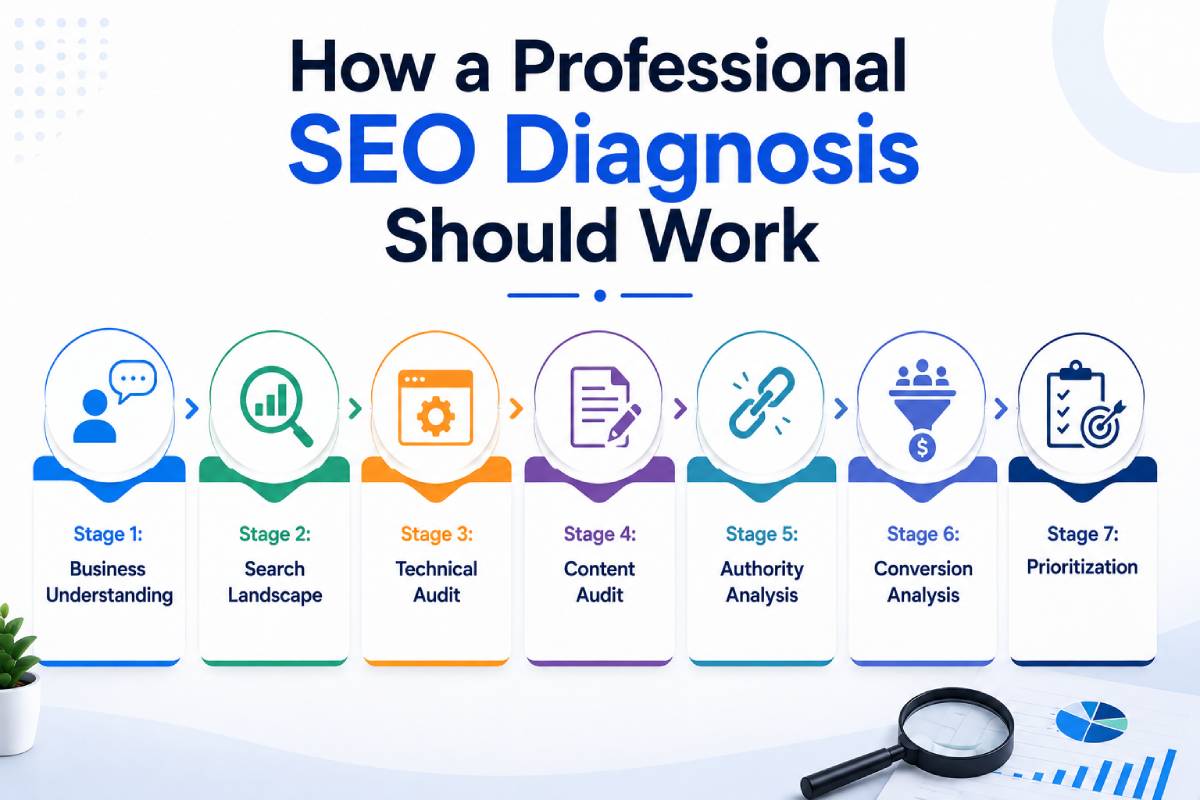
How a Professional SEO Diagnosis Should Work
A strong SEO engagement should start with a baseline.
Stage 1: Business Understanding
Understand:
- products/services
- target customers
- geography
- sales cycle
- average customer value
- business priorities
Stage 2: Search Landscape
Analyze:
- target queries
- competitors
- search intent
- SERP features
- commercial opportunities
Stage 3: Technical Audit
Review:
- crawling
- indexation
- architecture
- performance
- rendering
- canonicalization
Stage 4: Content Audit
Review:
- quality
- relevance
- duplication
- intent
- topical coverage
- content gaps
Stage 5: Authority Analysis
Review:
- backlinks
- referring domains
- competitor authority
- digital PR opportunities
Stage 6: Conversion Analysis
Review:
- landing pages
- CTAs
- forms
- trust signals
- lead tracking
Stage 7: Prioritization
Convert findings into: Critical → High → Medium → Low
with owners and recommended implementation order.
This is considerably more useful than receiving a generic SEO checklist.
A Practical 90-Day SEO Recovery Framework
If your SEO performance is stagnant, a structured 90-day approach can help organize the recovery process.
Days 1–30: Diagnose and Fix the Foundation
Focus on:
- technical audit
- indexation
- important URLs
- keyword mapping
- search intent
- competitor analysis
- conversion tracking
- critical technical fixes
Don’t begin by producing dozens of new articles. First establish what is preventing the existing website from performing.
Days 31–60: Improve Strategic Pages
Prioritize:
- money pages
- service pages
- high-potential existing pages
- pages ranking positions 5–20
- high-impression pages
- pages with strong commercial intent
Improve:
- content depth
- search intent
- internal linking
- titles
- FAQs
- trust signals
- conversion paths
Days 61–90: Build Authority and Expand Coverage
Once the foundation is healthy, expand:
- topical clusters
- supporting articles
- digital PR
- relevant backlinks
- comparison content
- commercial guides
- case studies
Then evaluate which areas are producing measurable progress.
This sequence is much more effective than treating SEO as an endless content publishing exercise.
15 SEO Problems: What to Fix First
If you want the shortest possible diagnostic framework, use this order:
1. Check Indexation
Can Google access and index your important pages?
2. Check Technical Health
Are there major crawl, rendering, canonical, redirect, or server problems?
3. Check Keyword Strategy
Are you targeting searches that potential customers actually use?
4. Check Search Intent
Does each page satisfy what the searcher wants?
5. Check Architecture
Are important pages supported by logical internal links?
6. Check Content Quality
Does the page provide more useful information than competing results?
7. Check Topical Coverage
Have you built enough depth around the subject?
8. Check Authority
Does the website have sufficient relevant external credibility?
9. Check CTR
Are people clicking when your pages appear?
10. Check Conversion
Are qualified visitors turning into enquiries?
This prioritization prevents SEO teams from confusing activity with progress. Knowing why SEO fails makes it easier to prioritize meaningful improvements instead of measuring success by the amount of SEO work completed.
Frequently Asked Questions
Why is my SEO not working?
SEO can underperform because of technical problems, poor keyword targeting, search-intent mismatch, weak content, insufficient topical authority, poor internal linking, weak external authority, or conversion problems. The first step is determining whether the issue is rankings, traffic quality, or conversion rather than assuming SEO itself is ineffective.
Why does my website not rank on Google?
If your website not ranking on Google, the issue may be caused by important pages not being properly accessible or indexed, content not satisfying search intent, stronger competitors, or keywords that are too competitive or poorly aligned with your business. A technical and strategic audit can identify which factor is most important.
How long does SEO take to work?
There is no fixed SEO timeline. Results depend on the website’s existing authority, technical condition, competition, keyword difficulty, content quality, industry, and implementation speed. Instead of relying on an arbitrary deadline, monitor leading indicators such as impressions, keyword movement, qualified traffic, and conversions.
Why am I getting SEO traffic but no leads?
The problem may be traffic quality or conversion performance. Review whether the keywords represent potential customers, whether visitors land on relevant pages, whether your value proposition is clear, whether trust signals are strong, and whether the enquiry process works properly on mobile and desktop.
What are the most common SEO problems?
Common website SEO problems include indexation issues, poor technical architecture, weak keyword targeting, search-intent mismatch, duplicate content, keyword cannibalization, thin or generic content, weak internal linking, poor authority, slow pages, and poorly optimized conversion paths.
How do I find SEO problems on my website?
Use Google Search Console, analytics, a technical crawler, keyword-ranking data, competitor research, and conversion data. The important part is not simply finding every possible warning; it is determining which problems are preventing important commercial pages from achieving visibility and generating business.
Can publishing too many blogs hurt SEO?
Publishing frequently isn’t automatically harmful, but large quantities of repetitive, overlapping, low-value, or poorly targeted content can create problems. It may cause keyword cannibalization, dilute internal linking, increase maintenance requirements, and consume resources that could have been used to improve more valuable pages.
Why are my competitors ranking higher than me?
Competitors may have stronger topical coverage, more relevant backlinks, better content, stronger internal architecture, greater brand authority, better search-intent alignment, or a more established domain. Competitor analysis should identify the specific gaps rather than assuming that backlinks alone explain the difference.
Is technical SEO enough to improve rankings?
No. Technical SEO creates the foundation required for search engines to access and understand a website, but competitive rankings also depend on relevance, search intent, content quality, authority, internal linking, and other factors. Technical fixes should therefore be integrated with a broader SEO strategy.
Why do my Google rankings keep changing?
Ranking fluctuations can occur because of algorithm changes, competitor activity, changes to search results, content updates, technical changes, search demand, and Google’s ongoing evaluation of pages. Short-term movement is normal, but persistent declines should be investigated by comparing the affected queries, pages, competitors, and website changes.
Should I create more content if my SEO isn’t working?
Not automatically. First identify whether the problem is technical, strategic, content-related, authority-related, or conversion-related. If existing service pages aren’t properly targeted or optimized, producing more blog posts may increase traffic without improving commercial performance.
What should I fix first when SEO isn’t working?
Start with critical technical and indexation problems. Then review keyword targeting and search intent for important commercial pages. After that, improve content quality, internal linking, topical authority, external authority, and conversion paths based on the specific weaknesses identified in the audit.
Final Conclusion: Don’t Do More SEO, Fix the Right SEO Problems
When a website’s SEO isn’t producing results, the instinct is often to increase activity.
- Publish more blogs.
- Build more links.
- Add more keywords.
- Change more titles.
- Run another audit.
- But more activity doesn’t automatically produce better SEO.
If the underlying problem is incorrect keyword targeting, publishing more content can make the problem larger. If important pages aren’t indexed, building backlinks to them may have limited value. If traffic doesn’t match search intent, increasing organic traffic won’t necessarily increase revenue.
The correct approach is to diagnose the complete system. When an SEO strategy not working, this systematic approach helps identify the specific weakness before more resources are invested.
Technical Foundation
↓
Indexation
↓
Website Architecture
↓
Keyword Strategy
↓
Search Intent
↓
Content Quality
↓
Topical Authority
↓
Internal Linking
↓
External Authority
↓
Qualified Organic Traffic
↓
Conversion Optimization
↓
Revenue
This is the difference between doing SEO and having an SEO strategy. If your website has rankings but no leads, the problem may be commercial intent or conversion. If it has impressions but no clicks, investigate SERP positioning and page titles. If it has no meaningful impressions, investigate keyword targeting, relevance, technical accessibility, and authority. SEO not getting traffic should therefore be investigated from both technical and strategic perspectives.
If rankings are declining, investigate what changed rather than immediately publishing more content. And if your website has been receiving SEO investment for months without measurable improvement, don’t accept “SEO takes time” as the complete explanation. Find out why.
Get an SEO Audit & Growth Roadmap
If you’ve invested in SEO but aren’t seeing enough rankings, qualified traffic, enquiries, or revenue, the first step should be a structured diagnosis of your website. A professional SEO audit should identify not just what’s wrong, but what to fix first and why.
The audit can evaluate:
- Technical SEO
- Indexation
- Website architecture
- Keyword strategy
- Search intent
- Content quality
- Topical authority
- Competitor gaps
- Internal linking
- Backlink profile
- Organic traffic
- Commercial landing pages
- Conversion opportunities
- AI search visibility