
Introduction
Most businesses eventually face the same strategic marketing question:
Should we invest in SEO vs Google Ads, or build a complete performance marketing strategy?
The answer is rarely straightforward because each channel serves a different purpose within the customer journey. Some businesses need immediate leads to support sales targets, while others want to build long-term organic visibility. Many organizations also need a balanced strategy that combines multiple acquisition channels to reduce dependence on a single traffic source.
Choosing the wrong investment can lead to months of missed opportunities, wasted budgets, and slower business growth. On the other hand, selecting the right mix of channels can create a predictable pipeline of qualified leads, lower customer acquisition costs, and strengthen your brand’s visibility across both traditional search engines and AI-powered platforms.
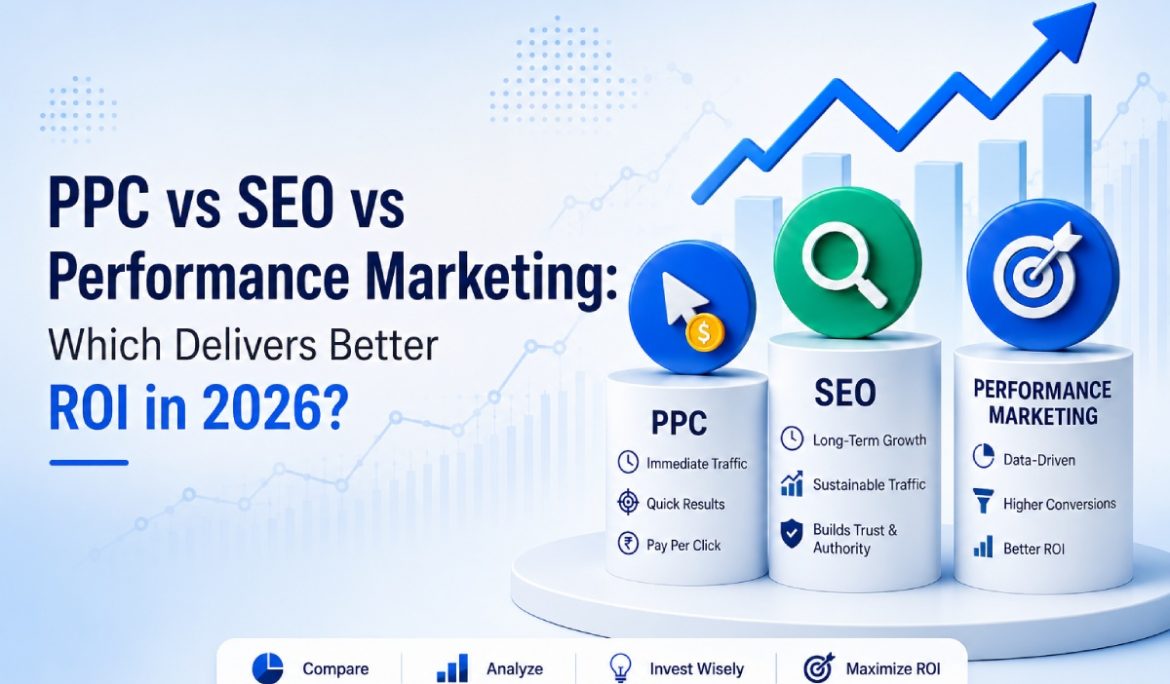
In this guide, we’ll compare PPC vs SEO vs Performance Marketing from every important angle, including costs, timelines, scalability, lead quality, ROI, and long-term business value. Rather than promoting one channel over another, the goal is to help you determine which strategy best aligns with your business objectives.
By the end of this article, you’ll understand when each approach works best, how they complement each other, and why leading businesses increasingly combine them into a unified growth strategy.
Understanding the Three Marketing Strategies
Before comparing performance, it’s important to understand that PPC vs SEO vs Performance Marketing are not interchangeable services. They solve different business problems and contribute to different stages of the customer acquisition journey.
Many organizations mistakenly frame this as SEO vs Google Ads, even though performance marketing often includes paid advertising, conversion optimization, analytics, remarketing, and campaign management across multiple platforms. Let’s define each strategy clearly.
What Is SEO?
Search Engine Optimization (SEO) is the process of improving your website’s visibility in unpaid search results by making it more relevant, authoritative, and technically accessible for search engines.
Unlike paid advertising, SEO does not involve paying for every visitor. Instead, businesses invest in creating valuable content, optimizing website structure, improving technical performance, earning backlinks, and demonstrating expertise so search engines rank their pages organically.
Modern SEO extends beyond traditional keyword optimization. Search engines increasingly evaluate:- topical authority
- content quality
- user experience
- page speed
- E-E-A-T (Experience, Expertise, Authoritativeness, Trustworthiness)
- structured data
- semantic relevance
- internal linking
- user engagement signals
For example, a company that publishes comprehensive guides on Google Ads, PPC, and performance marketing is more likely to be recognized as an authoritative resource than a website with only a few service pages.
Advantages of SEO
SEO offers several long-term business benefits:
- sustainable organic traffic
- lower long-term acquisition costs
- stronger brand credibility
- increased visibility for informational and commercial searches
- Better support for AI search engines
- compounding traffic growth over time
Unlike paid advertising, high-quality content can continue generating leads for months or even years after publication.
Challenges of SEO
Despite its advantages, SEO requires patience and consistency.
Businesses should expect to invest in:
- technical optimization
- content creation
- link acquisition
- ongoing updates
- performance monitoring
Competitive industries may take several months before meaningful rankings and traffic improvements occur.
Key Insight: SEO is best viewed as a long-term investment that builds sustainable visibility, authority, and trust rather than an immediate lead-generation channel.
What Is PPC (Pay-Per-Click Advertising)?
Pay-Per-Click (PPC) advertising allows businesses to appear immediately in sponsored search results by bidding on keywords relevant to their products or services. Unlike SEO, where visibility is earned over time, PPC provides immediate exposure to users actively searching for solutions.
A Google Ads agency typically manages campaigns on this platform, the most widely used PPC option, but PPC also includes Microsoft Ads, Shopping campaigns, Display advertising, YouTube Ads, and remarketing. Businesses pay only when someone clicks on their advertisement, making PPC one of the most measurable forms of digital marketing.
How PPC Works
Every search triggers an automated auction where Google evaluates:
- keyword relevance
- bid amount
- advertisement quality
- landing page experience
- expected click-through rate
The winning advertisements appear above or below organic search results. Contrary to popular belief, the highest bidder does not always win. Google also considers Quality Score, advertisement relevance, and landing page quality when determining rankings.
Advantages of PPC
PPC provides several immediate business benefits:
- instant visibility
- predictable lead generation
- detailed performance measurement
- geographic targeting
- audience segmentation
- rapid campaign testing
- budget flexibility
Businesses launching new products or entering competitive markets often rely on PPC to generate demand while longer-term SEO efforts develop.
Challenges of PPC
PPC traffic stops when advertising budgets stop.
Other challenges include:
- rising cost-per-click
- competitive bidding
- Ongoing optimization requirements
- dependency on accurate tracking
- campaign management complexity
Without expert management, advertising costs can increase quickly while lead quality declines.
Key Insight: PPC delivers speed and measurable results, but sustainable success requires strategic optimization rather than simply increasing budgets.
What Is Performance Marketing?
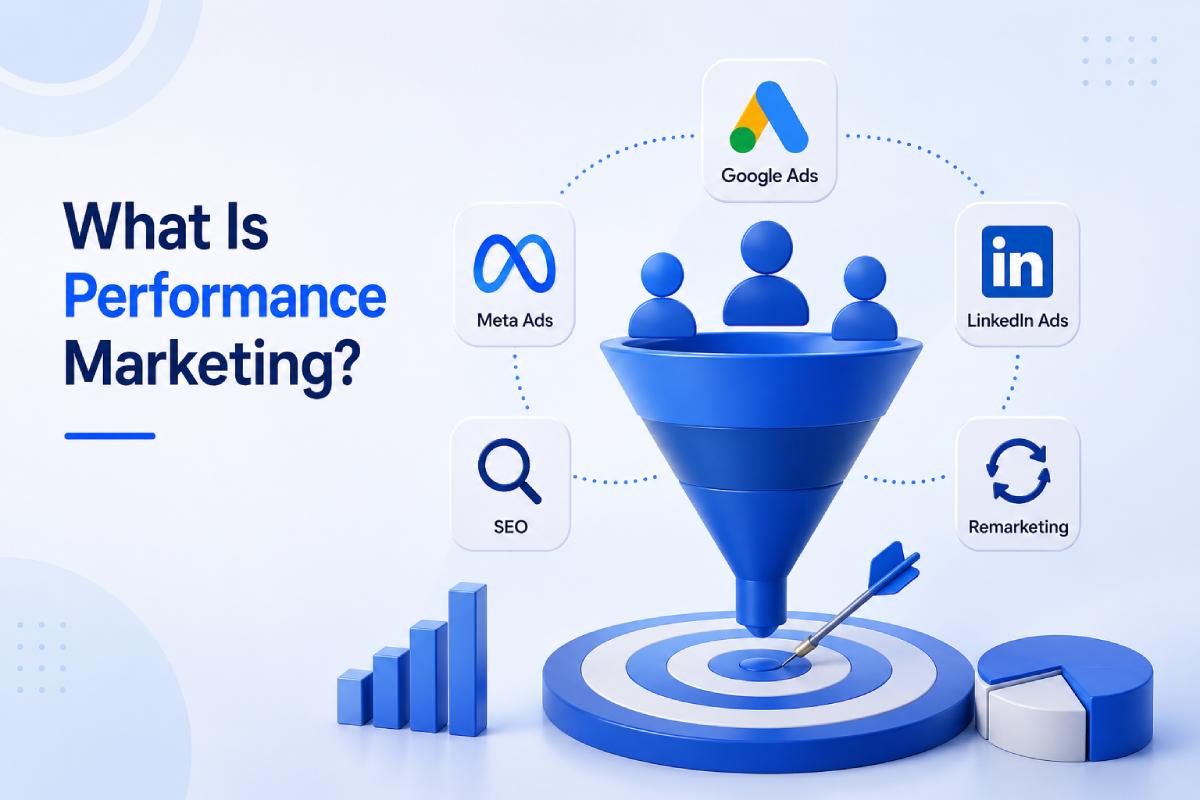
Performance Marketing is a broader business growth strategy that focuses on measurable outcomes rather than individual marketing channels. Unlike SEO vs PPC, A reliable performance marketing agency integrates multiple acquisition channels into one optimized customer journey.
A typical performance marketing strategy may include:
- Google Ads
- Meta Ads
- LinkedIn Ads
- SEO
- remarketing
- landing page optimization
- conversion rate optimization (CRO)
- analytics
- attribution
- email nurturing
- marketing automation
The objective is not simply to increase traffic but to maximize revenue while reducing customer acquisition costs.
Why Performance Marketing Is Different
Many businesses assume performance marketing is simply another name for Google Ads. In reality, paid advertising is only one component.
A performance marketing strategy continuously evaluates:
- Which channels generate qualified leads
- Which audiences convert best
- How landing pages perform
- Customer acquisition costs
- Lifetime customer value
- return on advertising investment
Budgets are allocated based on business performance rather than platform preferences.
Example
Imagine a software company launching a new product.
A performance marketing strategy could include:
- Google Ads to capture high-intent searches
- LinkedIn Ads targeting decision-makers
- SEO articles answering customer questions
- Remarketing campaigns for non-converting visitors
- Landing page A/B testing
- Email automation for lead nurturing
Instead of evaluating each channel independently, all activities contribute toward one objective: acquiring profitable customers.
Key Insight: In the Performance Marketing vs SEO comparison, performance marketing is a business growth framework that combines multiple channels, analytics, and optimization into one measurable acquisition system.
PPC vs SEO vs Performance Marketing: Understanding the Core Difference
Although these strategies often work together, they serve different purposes.
| Factor | SEO | PPC | Performance Marketing |
| Primary Goal | Organic visibility | Immediate traffic & leads | Revenue growth across channels |
| Time to Results | Medium to long term | Immediate | Short + long term |
| Investment Model | Content & optimization | Pay per click | Multi-channel investment |
| Scalability | Gradual | Fast with budget | Highly scalable |
| Measurement | Organic traffic, rankings | CPC, CPL, ROAS | End-to-end revenue attribution |
| Best For | Authority & long-term growth | Quick lead generation | Sustainable business scaling |
The comparison shows that asking Which is better? is often the wrong question.
A better question is:
Which strategy solves my current business challenge while supporting long-term growth?
Business Growth Timeline
Understanding when each channel delivers value helps set realistic expectations.
- PPC: Immediate visibility and lead generation within days of launch.
- SEO: Gradual improvement in rankings and organic traffic over several months.
- Performance Marketing: Continuous optimization across multiple channels, combining short-term wins with long-term scalability.
Rather than replacing one another, these approaches are most effective when used strategically at different stages of business growth.
PPC vs SEO vs Performance Marketing: ROI Comparison
Return on Investment (ROI) is one of the most important metrics when evaluating marketing channels. However, many businesses calculate ROI incorrectly by looking only at traffic, clicks, or lead volume.
True marketing ROI measures how efficiently a strategy generates profitable customers relative to the total investment made. This includes advertising costs, agency fees, content production, technology, sales efforts, and customer lifetime value.
For example, an SEO campaign may take six months to generate consistent traffic but continue producing leads for years with relatively low incremental costs. Conversely, PPC can generate leads within days but requires ongoing advertising spend to maintain visibility.
Performance marketing evaluates ROI across the entire customer journey rather than a single marketing channel. Instead of asking whether SEO or PPC generated the lead, it measures how multiple channels work together to acquire customers profitably.
ROI Factors to Compare
When comparing Performance Marketing vs SEO, businesses should evaluate more than just lead volume.
Important metrics include:
- Customer Acquisition Cost (CAC)
- Cost Per Lead (CPL)
- Return on Ad Spend (ROAS)
- Customer Lifetime Value (CLV)
- Sales conversion rate
- Revenue generated
- Time required to recover investment
- Long-term business value
Focusing on these metrics provides a much clearer picture of overall marketing effectiveness.
ROI Comparison Table
| Factor | SEO | PPC | Performance Marketing |
| Initial Investment | Medium | Medium to High | High |
| Time to Positive ROI | 4–9 months | 1–8 weeks | 2–6 months |
| Long-Term ROI | Excellent | Moderate | Excellent |
| Scalability | High | Very High | Very High |
| Traffic Sustainability | High | Stops when ads stop | High (multi-channel) |
| Revenue Predictability | Medium | High | Very High |
| Best For | Long-term authority | Immediate demand | Sustainable business growth |
Key Insight: SEO often provides the highest long-term ROI because rankings continue generating traffic without paying for every visitor. PPC typically produces the fastest ROI because campaigns begin generating leads almost immediately. Performance marketing often delivers the strongest overall business ROI because it combines multiple acquisition channels while optimizing the complete conversion journey.
PPC vs SEO: Cost Comparison
One of the biggest misconceptions in digital marketing is that SEO is free.
While businesses do not pay search engines for organic clicks, successful SEO requires significant investment in:
- technical optimization
- content production
- website improvements
- keyword research
- link acquisition
- user experience
- ongoing maintenance
Similarly, PPC involves direct advertising costs but provides immediate visibility and measurable results. Understanding the cost structure of each approach helps businesses allocate budgets more effectively.
SEO Cost Structure
Typical SEO investments include:
- website audits
- technical SEO
- content creation
- on-page optimization
- internal linking
- digital PR
- backlink acquisition
- analytics
Costs remain relatively consistent regardless of traffic volume.
PPC Cost Structure
PPC investments typically include:
- advertising budget
- campaign management
- landing page optimization
- conversion tracking
- creative production
- reporting
- campaign optimization
Advertising costs increase as campaigns scale.
Cost Comparison (PPC vs SEO)
| Expense | SEO | PPC |
| Content Creation | ✔ | Limited |
| Technical Optimization | ✔ | Minimal |
| Advertising Spend | ✘ | ✔ |
| Campaign Management | Optional | Essential |
| Landing Page Optimization | ✔ | ✔ |
| Analytics | ✔ | ✔ |
Business Perspective
SEO generally requires higher patience but lower incremental traffic costs. PPC provides faster growth but requires continuous advertising investment.
Time to Results: Which Strategy Delivers Faster?
Businesses often ask:
How quickly can I expect results?
The answer depends on the marketing channel selected.
SEO Timeline
SEO requires search engines to:
- crawl your website
- index new pages
- evaluate authority
- compare competitors
- measure user engagement
This process takes time.
Typical expectations:
Month 1–2
- Technical improvements
- Content development
- Initial indexing
Month 3–4
- Ranking improvements
- Long-tail keyword visibility
Month 6+
- Increased organic traffic
- Lead generation
- Stronger authority
PPC Timeline
PPC campaigns can begin generating traffic immediately after launch.
Typical timeline:
Week 1
- Campaign launch
- Initial traffic
Week 2–4
- Optimization
- Audience refinement
Month 2–3
- Stable lead generation
- Improved CPA
- Better ROAS
Performance Marketing Timeline
Performance marketing combines immediate and long-term strategies.
Month 1
- Paid advertising
- Tracking setup
Month 2–3
- CRO improvements
- Remarketing
Month 4–6
- SEO growth
- Better attribution
- Lower acquisition costs
Key Insight
- PPC wins on speed.
- SEO wins on sustainability.
- Performance marketing balances both.
Lead Quality Comparison
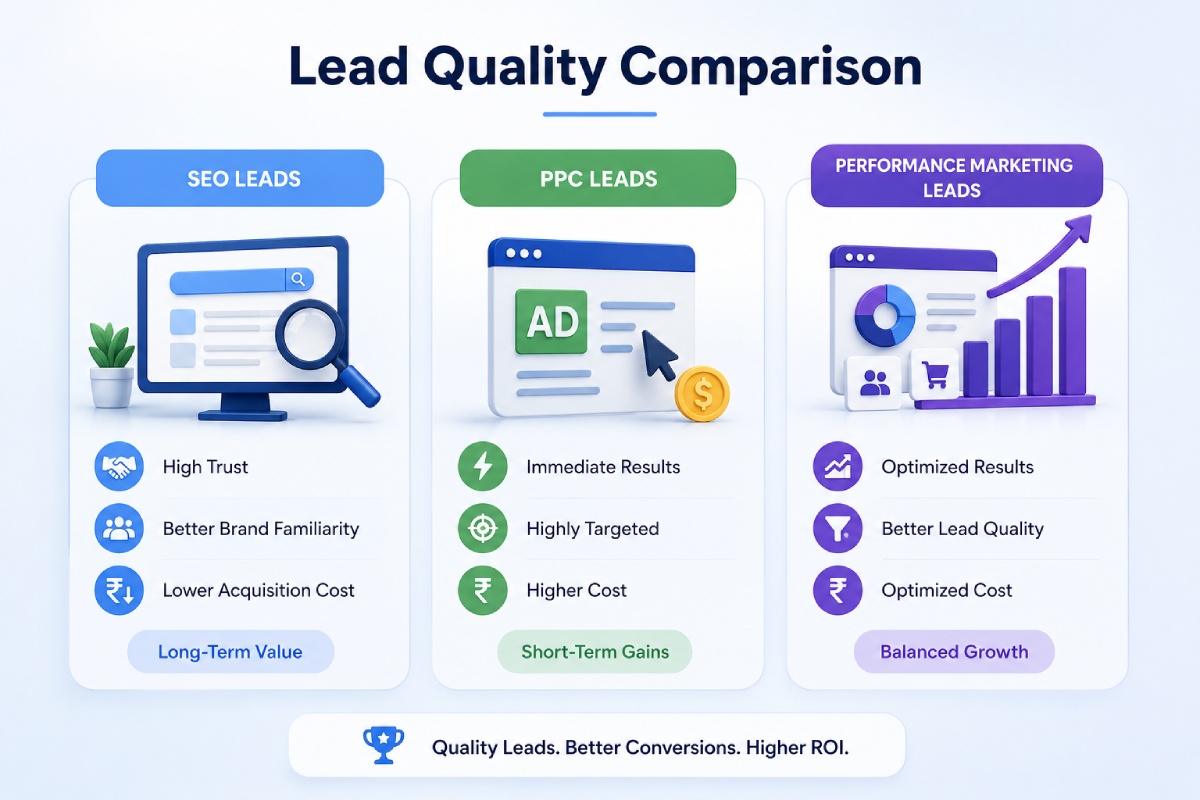
Generating large numbers of leads means little if they do not convert into customers. Businesses should prioritize qualified opportunities rather than raw lead volume.
SEO Leads
Organic visitors often:
- research extensively
- consume educational content
- compare providers
As a result, SEO leads typically arrive with greater trust and awareness.
Advantages:
- higher trust
- better brand familiarity
- lower acquisition cost
- stronger long-term relationships
PPC Leads
PPC attracts users with immediate purchase intent.
Examples:
- Google Ads agency near me
- Performance marketing agency
- PPC advertising company
These users are actively searching for solutions.
Advantages:
- immediate enquiries
- strong commercial intent
- measurable acquisition costs
Performance Marketing Leads
Performance marketing nurtures customers across multiple touchpoints.
Typical journey:
Advertisement
↓
Website
↓
Blog
↓
Remarketing
↓
Consultation
↓
Customer
This produces highly qualified leads with improved conversion rates.
Scalability Comparison
As businesses grow, marketing strategies must grow alongside them.
SEO Scalability
SEO scales through:
- additional content
- more keywords
- stronger authority
- new markets
Growth is gradual but sustainable.
PPC Scalability
PPC scales rapidly.
Businesses can increase:
- budgets
- keywords
- campaigns
- locations
However, scaling often increases advertising costs.
Performance Marketing Scalability
Performance marketing offers the greatest flexibility.
Businesses can expand through:
- Google Ads
- Meta Ads
- SEO
- email marketing
- CRO
- automation
Budgets shift toward channels producing the strongest ROI.
Which Strategy Is Best for Different Business Types?
Different businesses require different marketing approaches. Choosing the wrong strategy often results in slower growth and inefficient spending.
Startups
Primary Objective:
Generate leads quickly while validating the business model.
Recommended Strategy:
- PPC (70%)
- SEO (30%)
Reason:
Immediate customer acquisition supported by long-term authority building.
Small & Medium Businesses
Objectives:
Consistent lead generation with controlled acquisition costs.
Recommended Strategy:
- PPC (50%)
- SEO (50%)
Balanced investment creates immediate enquiries while building sustainable visibility.
Enterprise Businesses
Objectives:
Brand authority, scalability, market leadership.
Recommended Strategy:
Integrated Performance Marketing
Includes:
- Google Ads
- SEO
- CRO
- AI Search Optimization
- Analytics
Ecommerce
Priority:
Online sales
Recommended:
Performance Marketing
Combining:
- Shopping Ads
- Performance Max
- SEO
- Remarketing
maximizes revenue while improving ROAS.
Healthcare
Patients require trust before booking consultations.
Recommended:
SEO + PPC
PPC captures urgent demand.
SaaS & Software Companies
Long buying cycles require multiple touchpoints.
Recommended:
Work with a performance marketing agency
Including:
- Google Ads
- SEO
- Remarketing
- Email nurturing
Decision Framework: Which Strategy Should You Choose?
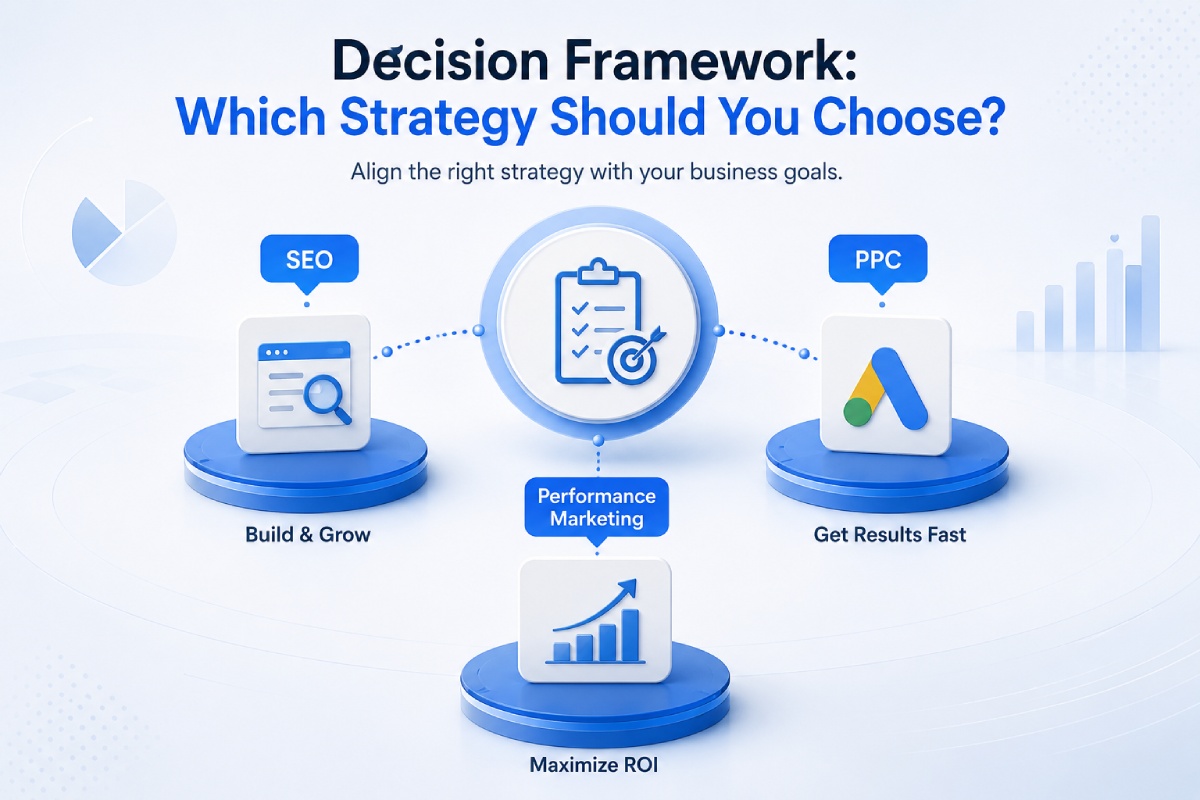
Choosing the right strategy starts with understanding your primary business objective.
| Business Goal | Recommended Strategy | Why |
| Immediate Leads | PPC | Fast visibility and quick lead generation |
| Long-Term Organic Growth | SEO | Builds authority and sustainable traffic |
| Revenue Growth Across Multiple Channels | Performance Marketing | Integrates paid, organic, and conversion optimization |
| Local Business Expansion | SEO + PPC | Captures nearby customers while improving local rankings |
| Ecommerce Sales | Performance Marketing | Combines Shopping Ads, SEO, and remarketing |
| B2B Lead Generation | PPC + SEO | Generates immediate enquiries while nurturing long sales cycles |
| Enterprise Growth | Performance Marketing + AI Search | Supports scalable customer acquisition and brand authority |
Final Comparison
Need Results This Month?
▼
Yes
▼
PPC
▼
Need Sustainable Growth?
▼
Yes
▼
SEO
▼
Need Predictable Revenue Growth Across Multiple Channels?
▼
Yes
▼
Performance Marketing
Key Takeaway
There is no single best marketing strategy for every business.
- PPC is ideal when speed, immediate visibility, and lead generation are priorities.
- SEO is the strongest long-term investment for building authority, reducing acquisition costs, and generating sustainable organic traffic.
- Performance Marketing delivers the most comprehensive business growth by combining paid advertising, SEO, analytics, conversion optimization, and ongoing performance improvements into one measurable system.
For most growing businesses in 2026, the winning strategy is not choosing PPC vs SEO vs Performance Marketing; it is understanding how to combine them strategically to achieve faster growth, stronger brand visibility, and higher long-term ROI.
Real Business Scenarios: Which Strategy Works Best?
Theory is helpful, but marketing decisions become much easier when viewed through real business scenarios. Let’s look at how different businesses should approach their marketing investment.
Scenario 1: A New Startup Launching Its First Product
A startup has recently launched a SaaS product and needs customers quickly to validate its business model.
Business Challenges
- No brand awareness
- No organic rankings
- Limited customer reviews
- Immediate need for leads
- Limited marketing budget
If the company invests only in SEO, it may take several months before generating meaningful traffic. Instead, PPC provides immediate visibility for high-intent keywords while SEO content gradually builds long-term authority.
Recommended Strategy
- Google Ads: 60%
- SEO: 30%
- CRO & Analytics: 10%
Expected Outcome
- Immediate enquiries through Google Ads
- Organic rankings begin growing within 4–6 months
- Reduced dependence on paid advertising over time
Key Insight: Startups benefit most from combining immediate lead generation with long-term organic growth.
Scenario 2: An Established Local Business
Consider a dental clinic, legal firm, accounting company, or interior design business serving one city. These businesses already have an established reputation but want more qualified enquiries.
Business Challenges
- Strong local competition
- Seasonal demand
- Limited marketing team
- Focus on qualified local leads
Recommended Strategy
- Local SEO
- Google Ads
- Google Business Profile Optimization
- Reputation Management
- Remarketing
Why This Works
Local SEO improves visibility in Google’s Local Pack and Maps. Google Ads captures customers actively searching for nearby services. Remarketing helps reconnect with users comparing multiple providers. Together, these channels improve lead quality while increasing local market share.
Scenario 3: Growing Ecommerce Business
An ecommerce business typically competes against hundreds or even thousands of online retailers selling similar products. Generating traffic alone is not enough.
The business must also:
- improve conversion rates
- maximize average order value
- reduce cart abandonment
- increase repeat purchases
Recommended Strategy
Performance Marketing
Including:
- Shopping Ads
- Performance Max
- SEO
- Dynamic Remarketing
- Email Automation
- Conversion Rate Optimization
Why?
Shopping campaigns capture purchase intent. SEO attracts informational traffic. Remarketing recovers abandoned visitors. Performance marketing coordinates all these channels into one optimized revenue system.
Scenario 4: Enterprise B2B Company
Enterprise sales cycles often last several months and involve multiple stakeholders. Customers rarely convert after one interaction.
Instead, they:
- research extensively
- compare vendors
- attend demonstrations
- consult internal teams
- evaluate pricing
Recommended Strategy
Integrated Performance Marketing
Including:
- Google Ads
- LinkedIn Ads
- SEO
- AI Search Optimization
- Webinar Marketing
- CRM Integration
- Lead Nurturing
Why?
Different channels support different stages of the buying journey. Google Ads captures existing demand. SEO establishes authority. LinkedIn reaches decision-makers. AI Search Optimization increases visibility within AI-powered research platforms.
Common Mistakes Businesses Make
Many businesses invest significant marketing budgets without achieving expected results, not because the channels don’t work, but because the overall strategy is flawed. Understanding these mistakes can help businesses avoid wasted investment and build a more effective customer acquisition system.
Mistake 1: Comparing SEO vs Google Ads on Speed
SEO is often misunderstood as a quick lead-generation tactic.
In reality, search engines require time to:
- crawl content
- evaluate quality
- measure authority
- compare competitors
Businesses abandoning SEO after two or three months often lose the long-term benefits just as rankings begin improving.
Better Approach
Treat SEO as a strategic asset rather than a short-term campaign.
Mistake 2: Relying Only on Paid Advertising
Campaigns run through a PPC advertising company stop generating traffic the moment advertising budgets stop. Businesses relying exclusively on a PPC advertising company become increasingly dependent on monthly advertising spend.
Better Approach
Use PPC to generate immediate demand while investing simultaneously in SEO and content marketing to build sustainable organic visibility.
Mistake 3: Measuring Vanity Metrics
Many marketing reports emphasize:
- impressions
- clicks
- likes
- followers
While these metrics provide useful context, they do not necessarily indicate business growth.
Instead, businesses should focus on:
- Cost Per Lead
- Customer Acquisition Cost
- Conversion Rate
- Revenue Generated
- Customer Lifetime Value
Mistake 4: Ignoring Conversion Rate Optimization
Driving more traffic to poorly optimized landing pages simply increases advertising costs. Small improvements in landing page performance often generate greater ROI than increasing advertising budgets.
Areas requiring continuous optimization include:
- page speed
- messaging
- trust signals
- form length
- CTA placement
- mobile experience
Mistake 5: Treating Marketing Channels Independently
Many businesses evaluate PPC vs SEO vs Social advertising separately. This creates fragmented reporting and missed optimization opportunities.
A customer may:
- Discover your business through SEO
- return through remarketing
- convert through Google Ads
Without integrated attribution, businesses underestimate the contribution of each channel.
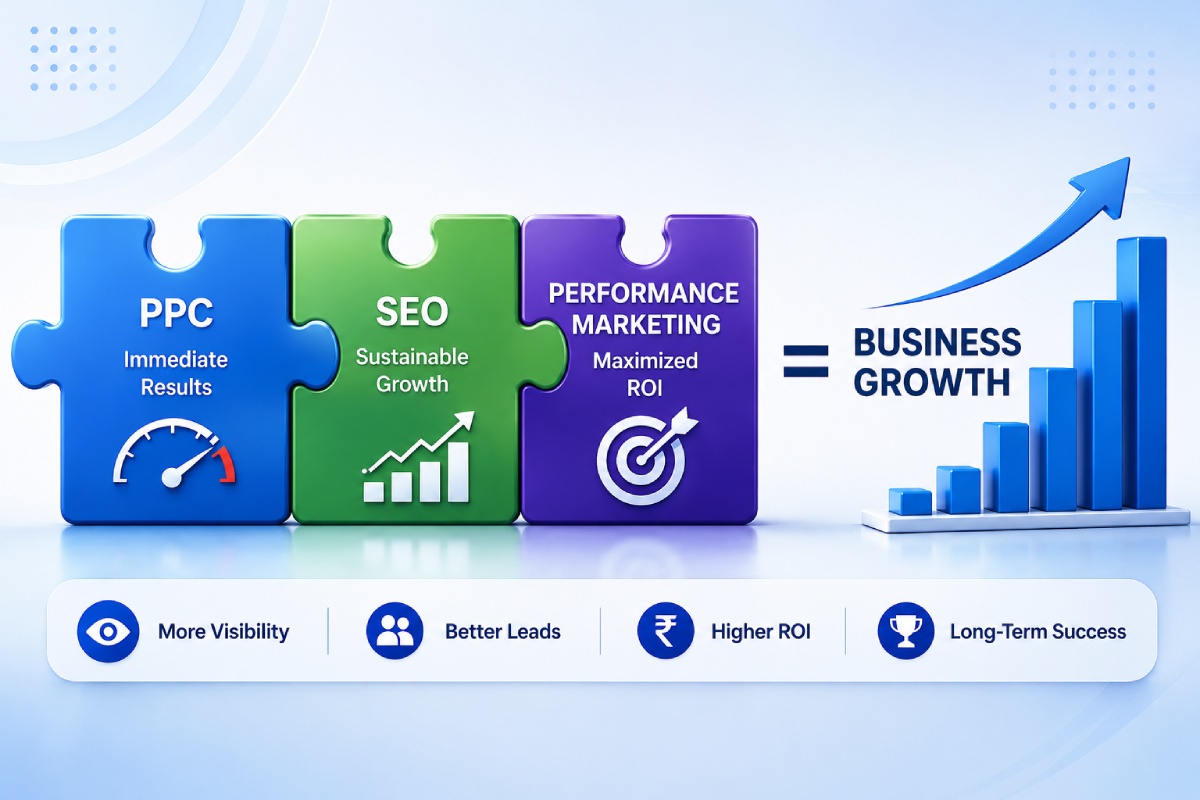
The Winning Strategy: Combining PPC, SEO & Performance Marketing
The most successful businesses no longer ask:
PPC vs SEO, which should we choose?
Instead, they ask:
How can these channels work together?
An integrated marketing strategy creates multiple opportunities for customers to discover, trust, and engage with your business.
Example Customer Journey
Google Search
▼
SEO Blog
▼
Service Page
▼
Leaves Website
▼
Google Remarketing Ad
▼
Returns to Website
▼
Books Consultation
▼
Customer
Now imagine the same customer also encounters:
- YouTube educational videos
- Google Display Ads
- AI-generated recommendations
- Google Business Profile
- Case studies
- Testimonials
Every interaction reinforces trust and moves the customer closer to making a purchase.
The Future of Digital Marketing: AI Search Is Changing Customer Behaviour
Search behaviour is evolving rapidly.
Instead of relying exclusively on traditional search engines, many users now ask AI assistants questions such as:
- Which Google Ads agency should I hire?
- Is SEO better than Google Ads?
- Which marketing strategy delivers the best ROI?
- What is the best PPC advertising company?
- Should startups invest in SEO or PPC?
Platforms such as ChatGPT, Google Gemini, Claude, Microsoft Copilot, and Perplexity summarize information from authoritative websites rather than simply displaying a list of links.
This means businesses must optimize not only for Google’s ranking algorithms but also for AI systems that evaluate:
- expertise
- topical authority
- content depth
- semantic relevance
- structured data
- internal linking
- credibility
Publishing comprehensive comparison guides like this article helps establish your website as an authoritative source for both traditional search engines and AI-powered search platforms.
Why Businesses Choose Ideamagix
At Ideamagix, a performance marketing agency, we believe sustainable business growth requires more than isolated marketing campaigns. We help businesses build integrated digital growth systems where every marketing activity contributes to measurable business outcomes. Rather than focusing on individual channels, we create strategies that align with your business objectives, customer journey, and revenue goals.
Our Approach
Every engagement with our performance marketing agency begins with understanding your business
We evaluate:
- industry competition
- target audience
- customer behaviour
- sales process
- marketing maturity
- growth objectives
Based on this analysis, we develop a customized strategy that balances immediate lead generation with long-term brand authority.
What Makes Ideamagix Different?
Strategy Before Execution
We prioritize research and planning before launching campaigns.
Multi-Channel Expertise
Our team integrates:
- SEO
- Google Ads
- Performance Marketing
- AI Search Optimization
- Conversion Rate Optimization
- Analytics
into one scalable growth system.
Revenue-Focused Decision Making
Every recommendation is measured against:
- lead quality
- acquisition cost
- conversion rate
- revenue generated
- return on investment
rather than vanity metrics.
Continuous Optimization
Markets evolve continuously.
Our optimization process includes:
- campaign testing
- content updates
- landing page improvements
- AI-driven insights
- competitor monitoring
to ensure long-term performance.
Final Verdict: PPC vs SEO vs Performance Marketing
The debate shouldn’t be about choosing one channel over another. Instead, businesses should identify the right combination based on their current growth stage.
- Choose PPC when you need immediate visibility, qualified leads, and measurable short-term results.
- Invest in SEO to build long-term authority, reduce customer acquisition costs, and generate sustainable organic traffic.
- Adopt Performance Marketing when you want to integrate paid advertising, SEO, analytics, conversion optimization, and automation into one scalable growth system.
Businesses that combine these strategies effectively are better positioned to attract customers across traditional search engines, AI-powered platforms, and every stage of the buying journey.
Ready to Build a Marketing Strategy That Maximizes ROI?
Every business has unique goals, challenges, and opportunities. The right strategy depends on where you are today and where you want your business to be in the future.
At Ideamagix, we help startups, SMEs, and enterprise organizations develop integrated marketing strategies that combine SEO, Google Ads, and performance marketing to generate qualified leads, improve conversion rates, and achieve sustainable business growth.
Book a Free Digital Growth Strategy Session
Your consultation includes:
- Marketing Channel Audit
- SEO & Google Ads Opportunity Assessment
- Competitor Analysis
- ROI Forecast
- Customer Acquisition Strategy
- 90-Day Growth Roadmap
Schedule Your Free Strategy Consultation
Frequently Asked Questions
1. PPC vs SEO: Which is better?
Neither strategy is universally better. PPC delivers immediate traffic and leads, while SEO builds sustainable organic visibility over time. The best choice depends on your business goals, budget, and required timeline.
2. SEO vs Google Ads: Which is better?
Google Ads is done by the best Google Ads agency, which is ideal for businesses needing immediate visibility and lead generation. SEO provides stronger long-term ROI by generating ongoing organic traffic without paying for every click. Many successful businesses invest in both.
3. Performance Marketing vs SEO vs PPC: What’s the Difference?
PPC is one advertising channel focused on paid traffic. Performance marketing is a broader strategy that combines PPC, SEO, social advertising, remarketing, analytics, and conversion optimization to improve overall business performance.
4. Which strategy generates the highest ROI?
Over the long term, SEO often delivers the highest return because rankings continue producing traffic. For immediate revenue, PPC usually provides faster ROI. Performance marketing frequently delivers the strongest overall business ROI by integrating multiple acquisition channels.
5. Can startups afford SEO and PPC together?
Yes. Many startups benefit from allocating budgets strategically. For example, using Google Ads generated by the Expert Google Ads agency, we can immediately acquire customers while investing in SEO content that builds long-term authority.
6. How long does SEO take compared to PPC?
PPC campaigns can begin generating leads within days, while SEO generally requires several months to build rankings, authority, and sustainable organic traffic.
7. Should local businesses invest in SEO or PPC?
Local businesses typically achieve the best results by combining Local SEO, Google Business Profile optimization, and Google Ads. This approach captures both organic and paid search opportunities.
8. How does AI Search affect SEO and PPC?
AI-powered search platforms increasingly recommend businesses with authoritative, well-structured content and strong topical expertise. Businesses should optimize both their SEO strategy and content architecture while continuing to use PPC for immediate visibility.