
Introduction: Why Ecommerce SEO Services Matter More Than Ever in 2026
Ecommerce SEO in 2026 is no longer about ranking a few category pages and hoping traffic converts. It is now a system-level discipline that connects technical architecture, content relevance, user intent, and conversion optimization into one measurable growth engine.
Across India, ecommerce brands continue to lose visibility after:
- platform migrations,
- aggressive faceted navigation,
- poor canonical control,
- thin product content,
- or over-reliance on paid traffic.
Independent audits consistently show that 30–60% of organic visibility loss happens not because of competition, but because of preventable technical SEO errors. This is why Ecommerce SEO Services have shifted from “optimization” to risk prevention and scalable growth engineering.
Brands working with an experienced ecommerce seo consultant or a specialized ecommerce seo company in Mumbai no longer treat SEO as a marketing activity. They treat it as a revenue infrastructure layer.
This guide explains how Ecommerce SEO Services must be built in 2026, starting with the foundation.
Section 1: Crawlability: The Hidden Revenue Leak in Ecommerce Sites
Why Crawlability Is the First Non-Negotiable Layer
Search engines do not rank what they cannot reliably crawl, interpret, and prioritize. Ecommerce platforms, especially those with thousands of SKUs, often fail here.
Common crawlability failures include:
- infinite URL generation via filters,
- parameter-based duplication,
- blocked JS-rendered content,
- bloated XML sitemaps,
- Incorrect pagination handling.
These issues quietly drain crawl budget and prevent high-intent pages from being indexed correctly. Professional Ecommerce SEO Services begin by mapping how search engines experience the site, not how users see it.
Crawl Budget Optimization for Large Ecommerce Catalogs
Search engines allocate crawl resources based on:
- site health,
- update frequency,
- internal linking signals,
- and historical performance.
When faceted URLs or duplicate category variants dominate crawl logs, priority product pages suffer.
An ecommerce seo consultant focuses on:
- reducing low-value crawl paths,
- consolidating duplicate URLs,
- and ensuring that high-margin SKUs receive consistent crawl attention.
For brands using ecommerce seo services in Mumbai, crawl optimization alone often leads to 10–25% indexation improvement within 60 days, without content changes.
Section 2: XML Sitemaps: From Compliance to Strategic Index Control
Why Default Sitemaps Are Not Enough
Most ecommerce platforms generate XML sitemaps automatically. These sitemaps are rarely optimized.
Common problems:
- inclusion of parameterized URLs,
- expired products,
- duplicate category paths,
- paginated URLs.
Search engines treat sitemaps as priority signals, not suggestions. A polluted sitemap misleads crawlers.
High-quality Ecommerce SEO Services restructure sitemaps to:
- include only canonical URLs,
- segment by page type (products, categories, blogs),
- update dynamically based on stock and lifecycle.
Strategic Sitemap Segmentation
Advanced ecommerce seo company in Mumbai implementations use:
- separate sitemaps for high-conversion products,
- category-only sitemaps for discovery,
- content sitemaps for authority building.
This ensures that crawl priority mirrors business priority.
Section 3: Canonical Rules: Preventing SEO Cannibalization at Scale
Why Canonical Errors Kill Ecommerce Rankings
Faceted navigation creates thousands of URL combinations. Without strict canonical discipline, ecommerce sites unintentionally compete against themselves.
Typical canonical failures:
- self-referencing canonicals on filtered URLs,
- inconsistent canonical logic across templates,
- Missing canonicals on pagination.
These lead to:
- keyword cannibalization,
- diluted ranking signals,
- unstable SERP positions.
Affordable ecommerce seo services often ignore canonical architecture. Enterprise-grade Ecommerce SEO Services do not.
Canonical Architecture Best Practices for 2026
A mature ecommerce SEO setup defines:
- one canonical category path per intent,
- canonical consolidation for filters,
- canonical mapping aligned with internal linking.
This prevents dilution and stabilizes rankings even during traffic spikes or promotions. Brands working with a skilled ecommerce seo consultant often recover lost category rankings purely through canonical correction, no new backlinks required.
Section 4: JavaScript Rendering & SEO Readiness
Why JS Frameworks Still Break Ecommerce SEO
Modern ecommerce platforms rely heavily on:
- React,
- Vue,
- headless storefronts.
When poorly implemented, these frameworks delay or block:
- content rendering,
- internal links,
- schema injection.
Search engines do render JavaScript, but not equally or reliably at scale.
Professional Ecommerce SEO Services include:
- render testing via Google’s WRS,
- hybrid SSR/CSR recommendations,
- crawl path validation for JS links.
This is critical for brands investing in ecommerce seo services in Mumbai, where mobile-first indexing dominates.
Section 5: Product URL Structure: Small Decisions, Massive Impact
Why URL Design Is Still a Ranking Lever
Despite advances in AI ranking systems, URL structure remains a strong relevance signal, especially in ecommerce.
Common issues:
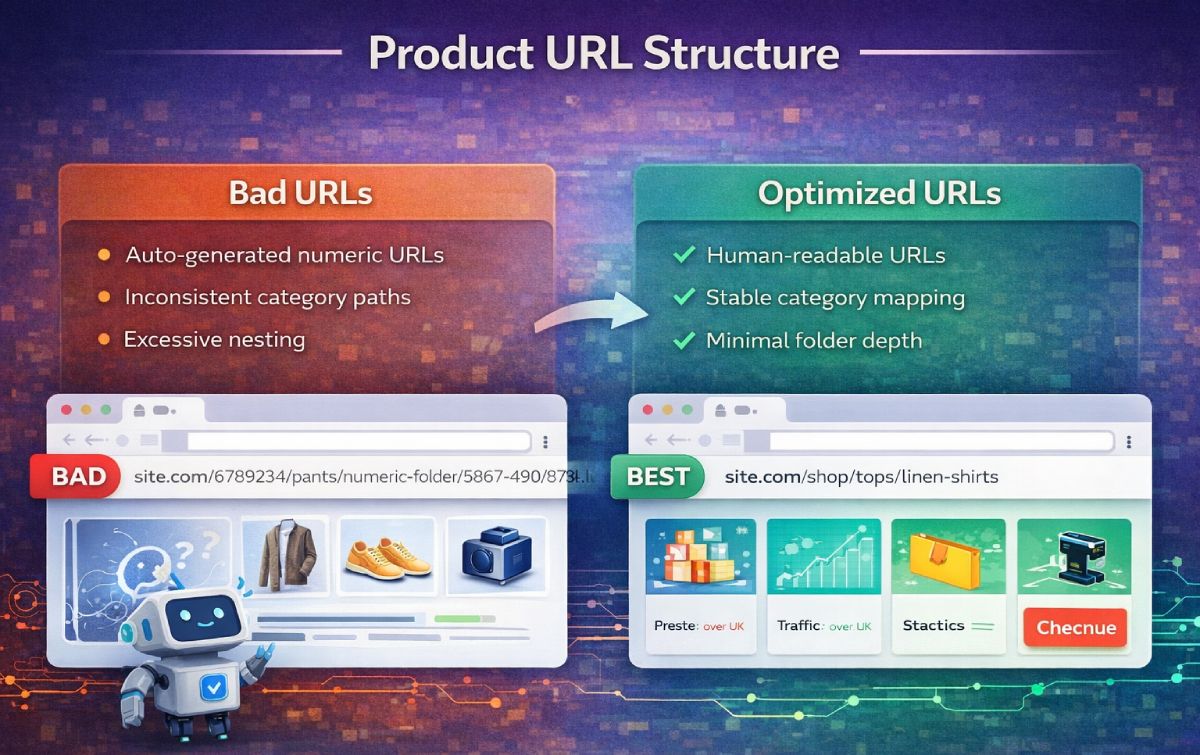
- auto-generated numeric URLs,
- inconsistent category paths,
- excessive nesting.
Best practices enforced by the top ecommerce seo company in Mumbai teams include:
- human-readable URLs,
- stable category mapping,
- minimal folder depth.
This improves:
- crawl efficiency,
- CTR from SERPs,
- internal linking clarity.
Section 6: Foundation Summary: What Most Brands Miss
By the time most brands start content or backlinks, they have already lost:
- crawl equity,
- index control,
- ranking stability.
This is why Ecommerce SEO Services in 2026 must begin with technical certainty, not creative execution.
Foundational SEO work delivers:
- faster indexation,
- ranking stability,
- protection against future platform changes.
It is also what separates:
- generic SEO vendors,
- from a strategic ecommerce seo consultant.
Category Pages & Faceted Navigation Strategy
For most ecommerce websites, category and filtered pages drive more revenue than individual product pages. Yet they are also the most common source of SEO damage. Poorly managed faceted navigation can cause index bloat, crawl budget exhaustion, duplicate content, and ranking cannibalization.
This is where professional Ecommerce SEO Services differ from generic SEO work.
A modern ecommerce SEO consultant begins by mapping which category and filter combinations deserve to rank and which must be controlled.
Not every filter should be indexable. Filters based on color, size, material, price range, brand, and availability must be evaluated individually. The goal is to surface high-intent combinations while preventing low-value URLs from entering the index.
For example:
A page like
/mens-running-shoes/nike/size-9
may have search demand and should be indexable.
But a URL such as
/mens-running-shoes?sort=price_low_to_high&view=grid
adds no SEO value and should be blocked.
Leading ecommerce seo services in Mumbai use a layered approach:
- Canonical tags for duplicate filters
- Noindex rules for non-searchable combinations
- Static SEO landing pages for high-value filter sets
- Clean, readable URLs without query strings where possible
A well-implemented faceted navigation strategy often restores 20–40% lost organic visibility within months. This is why brands that work with an ecommerce seo company in Mumbai see faster recovery after migrations or platform changes.
Internal Linking & Pillar Page Architecture
Internal linking is the backbone of scalable ecommerce SEO. Without it, even well-optimized pages struggle to rank. In 2026, search engines rely heavily on internal link context to understand product hierarchies, topical authority, and page importance. Ecommerce SEO Services must be structured around a clear pillar-cluster model.
The hierarchy usually follows:
- Pillar pages (top categories)
- Sub-categories
- Product collections
- Individual product pages
Each level must link logically downward and laterally. Category pages should link to their most important sub-categories using descriptive anchor text. Products should link back to relevant categories, buying guides, and comparison content.
This structure distributes link equity efficiently and reduces orphan pages.
For ecommerce brands with thousands of SKUs, internal linking must be automated intelligently. Manual linking does not scale. Professional ecommerce seo services in Mumbai implement rule-based linking systems tied to taxonomy, tags, and product attributes.
This approach allows:
- Faster indexation of new products
- Better crawl efficiency
- Higher category page rankings
- Improved user navigation
Internal linking is one of the strongest reasons brands invest in an experienced ecommerce seo consultant rather than relying on plugins alone.
Content Strategy for Ecommerce Acquisition
Content is no longer optional for ecommerce growth. Product and category pages alone cannot capture top-of-funnel demand.
Search behavior in 2026 shows that users research extensively before buying. They search for comparisons, alternatives, reviews, use cases, and expert opinions. Ecommerce SEO Services must support this journey.
High-performing ecommerce content includes:
- Buying guides
- Product comparisons
- “Best of” lists
- Use-case articles
- Problem-solution content
- Seasonal trend pages
For example:
- “Best running shoes for flat feet”
- “Nike vs Adidas running shoes”
- “How to choose running shoes for marathons.”
These pages attract qualified traffic and funnel users into product and category pages through internal links. An ecommerce seo company in Mumbai typically builds content hubs around each major product category. These hubs
strengthen topical authority and support rankings across the entire catalog.
Content must be:
- Search-intent driven
- Written by subject-matter experts
- Updated regularly
- Internally linked to revenue pages
When executed correctly, content contributes 30–50% of total ecommerce organic revenue over time. This is a core focus area for affordable ecommerce seo services that aim to deliver long-term ROI, not just rankings.
Backlink & Digital PR Strategies for Ecommerce Brands
Backlinks remain one of the strongest ranking factors, but ecommerce link building in 2026 looks very different from the past.
Low-quality directories and paid links no longer work. Ecommerce SEO Services now focus on relevance, authority, and brand credibility.
Effective ecommerce backlink sources include:
- Supplier and manufacturer websites
- Product review blogs
- Comparison platforms
- Industry publications
- Affiliate partners
- Marketplaces
- PR coverage for launches
For example, when launching a new product line, an ecommerce seo consultant may coordinate:
- Press outreach to industry blogs
- Early review access for influencers
- Feature placements on comparison sites
- Supplier-linked brand mentions
Each link serves both SEO and referral traffic purposes.
An ecommerce seo company in Mumbai with strong PR and outreach capabilities delivers compounding value. These links support category rankings, improve brand trust, and protect the site during algorithm updates.
Backlink acquisition must always align with content quality and site architecture. Without a strong foundation, even high-authority links underperform.
Performance Optimization & Core Web Vitals
Performance is not a technical luxury. It is a revenue driver. In ecommerce, every second of delay increases bounce rates and reduces conversions. Google’s ranking systems now heavily reward fast, stable, mobile-optimized sites.
Ecommerce SEO Services in 2026 include deep performance optimization:
- Largest Contentful Paint improvement
- Cumulative Layout Shift reduction
- Interaction with Next Paint optimization
- Image compression and next-gen formats
- Lazy loading strategies
- Critical CSS delivery
For ecommerce seo services in Mumbai, mobile performance is especially critical due to India’s mobile-first user base.
A professional ecommerce seo consultant works closely with developers to balance design, functionality, and speed. This ensures performance gains do not compromise UX or conversion flows.
Brands that prioritize performance typically see:
- Higher rankings
- Lower bounce rates
- Higher conversion rates
- Better ad efficiency
This is one of the most overlooked areas by low-cost providers offering “SEO packages” without technical depth.
KPI Framework & Reporting Dashboard
SEO without measurement is guesswork. Professional Ecommerce SEO Services rely on clear KPIs aligned with business outcomes, not vanity metrics.
Key ecommerce SEO KPIs include:
- Organic revenue
- Category-level rankings
- Product impressions and clicks
- Conversion rates from organic traffic
- Revenue per session
- Index coverage health
- Crawl efficiency metrics
Modern ecommerce seo services in Mumbai provide custom dashboards using GA4, Search Console, and business intelligence tools. These dashboards show trends, not just monthly snapshots.
Reporting should answer:
- Which categories are growing?
- Which products drive revenue?
- Where are crawl issues emerging?
- What content supports conversions?
- How does SEO impact overall ROI?
This transparency builds trust and allows smarter decision-making. It is also why experienced brands prefer working with a proven ecommerce seo company in Mumbai rather than rotating vendors.

Performance Optimization, Core Web Vitals & Page Experience
By 2026, performance is no longer a “technical bonus.” It is a direct ranking signal and conversion driver. Even the best ecommerce SEO services will fail if pages load slowly, shift visually, or respond poorly on mobile.
Why Performance Matters More for Ecommerce Than Any Other Vertical
Ecommerce users behave differently from blog readers.
They:
- Compare multiple products quickly
- Switch tabs frequently
- Abandon pages instantly if delays occur
- Expect instant interaction on mobile
A delay of even one second can reduce conversion rates by 7–12% for ecommerce websites. This is why any serious ecommerce seo consultant must address Core Web Vitals early in the strategy.
Core Web Vitals That Impact Ecommerce Rankings
Largest Contentful Paint (LCP)
- Measures how fast the main product image or title loads
- Should be under 2.5 seconds
- Affected by image optimization, server response, and CDN usage
Interaction to Next Paint (INP)
- Measures responsiveness when users click size selectors, filters, or add-to-cart
- A major issue on JavaScript-heavy ecommerce platforms
- Needs efficient script loading and event handling
Cumulative Layout Shift (CLS)
- Measures visual stability
- Common problems:
- Lazy-loaded product images without size attributes
- Promotional banners are loading late
- Reviews widgets shifting layouts
Poor CLS directly damages trust and conversion rates.
Performance Actions Used by Advanced Ecommerce SEO Services
A professional ecommerce seo company in Mumbai will typically implement:
- Image compression with next-gen formats (WebP, AVIF)
- Preloading of hero product images
- Server-side rendering for category and product pages
- JavaScript splitting and deferred execution
- CDN deployment with regional edge nodes
- Database query optimization for filters and search
Performance optimization is not a one-time task. It is monitored continuously through Search Console, Lighthouse, and real-user metrics.
Ecommerce SEO KPI Framework & Dashboard Structure
Growth without measurement leads to wasted spend. Every ecommerce SEO services engagement should include a clear KPI framework tied directly to revenue, not vanity metrics.
SEO KPIs That Matter for Ecommerce in 2026
Visibility & Indexation
- Indexed product and category pages
- Crawl budget utilization
- Faceted URL index control
- Coverage errors
Traffic Quality
- Organic sessions by intent
- Category vs product traffic split
- New vs returning users
- Geographic distribution
Engagement & Conversion
- Product page bounce rate
- Add-to-cart rate from organic traffic
- Checkout completion rate
- Revenue per organic session
Commercial Impact
- Organic revenue growth
- Cost per acquisition from SEO
- Assisted conversions
- Lifetime value of organic customers
A serious ecommerce seo consultant will align reporting with business dashboards, not just SEO tools.
What a Monthly Ecommerce SEO Dashboard Includes
Most mature ecommerce seo services in Mumbai provide:
- Search Console performance snapshots
- Product-level ranking movements
- Category traffic trends
- Revenue attribution by landing page
- Core Web Vitals performance
- Content and backlink progress
- Risk alerts (indexing drops, traffic anomalies)
This allows leadership teams to make decisions quickly and confidently.
Risk Management: Preventing Traffic Loss During Ecommerce Changes
Ecommerce sites are constantly changing:
- New products launch weekly
- Categories expand
- Filters evolve
- Platforms migrate
- URLs change
Each change introduces SEO risk.
Many brands lose 30–60% organic traffic after:
- Platform migrations
- Poor faceted navigation changes
- Theme updates without SEO review
- URL restructuring without redirects
SEO Risk Mitigation Framework
Advanced ecommerce SEO services follow strict safeguards:
Before Any Major Change
- Full crawl and URL mapping
- Baseline traffic and ranking snapshot
- Redirect plan creation
- Canonical logic review
- Staging environment SEO testing
During Deployment
- Noindex staging environments
- Controlled rollout windows
- Server log monitoring
- Immediate crawl checks
After Launch
- Index coverage review
- Traffic anomaly detection
- Ranking volatility analysis
- Fix prioritization within 72 hours
This discipline separates affordable ecommerce seo services from enterprise-ready partners.
ROI Expectations from Ecommerce SEO Services
SEO is a compounding channel.
But expectations must be realistic.
Typical Ecommerce SEO Timelines
For most ecommerce brands:
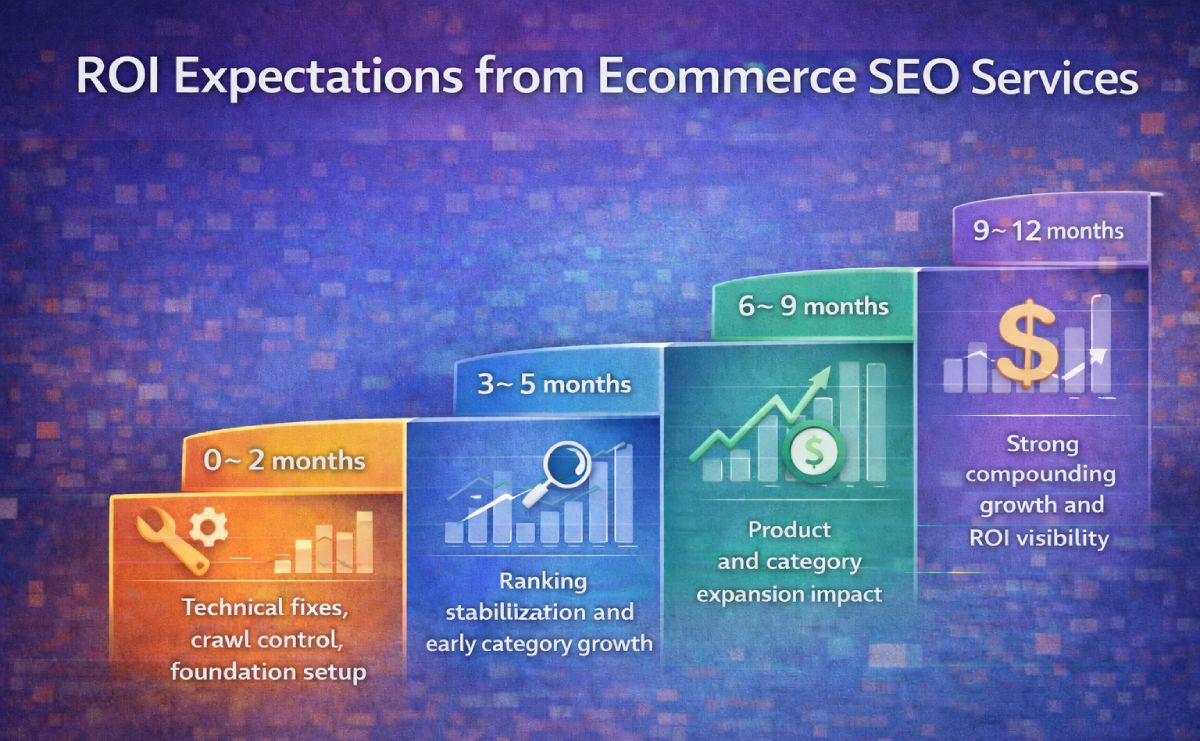
- 0–2 months: Technical fixes, crawl control, foundation setup
- 3–5 months: Ranking stabilization and early category growth
- 6–9 months: Product and category expansion impact
- 9–12 months: Strong compounding growth and ROI visibility
Aggressive promises of “first page in 30 days” are red flags.
ROI Benchmarks by Ecommerce Stage
| Ecommerce Stage | Expected Outcome |
| Early-stage store | Crawlability, indexing, and early traffic |
| Growing catalog | Category and product page rankings |
| Mature ecommerce | Revenue growth and CAC reduction |
| Enterprise brand | Market share expansion |
When executed correctly, ecommerce SEO services often deliver:
- 3–7x ROI over 12–18 months
- Lower acquisition cost than paid channels
- More stable revenue growth
This is why brands continue investing even during market downturns.
How to Choose the Right Ecommerce SEO Partner
Not all agencies understand ecommerce complexity.
When evaluating an ecommerce seo company in Mumbai or elsewhere, buyers should ask:
- Do you have experience with large product catalogs?
- How do you handle faceted navigation?
- How do you prevent index bloat?
- How do you measure SEO ROI?
- How do you manage migrations safely?
- How do you integrate CRO and UX insights?
A capable ecommerce seo consultant should answer these clearly and confidently.
Final Takeaways: What Scalable Ecommerce SEO Looks Like in 2026
Ecommerce SEO is no longer just:
- Adding keywords
- Writing product descriptions
- Building random links
Modern ecommerce SEO services are:
- Technical
- Content-driven
- UX-aware
- Performance-focused
- Revenue-aligned
Brands that treat SEO as infrastructure, not a marketing add-on, win long-term.
If your ecommerce site depends on organic traffic for growth, then:
- Crawlability is non-negotiable
- Structured data is essential
- Content must support purchase decisions
- Performance must be monitored continuously
- SEO must align with revenue goals
This is the standard expected in 2026.