

One of the first questions a business asks before investing in SEO is simple: “When will I start seeing results?” It is a reasonable question. SEO requires an ongoing investment in strategy, content, technical improvements, authority building, and measurement. Unlike paid advertising, where increasing the budget can often produce an immediate change in traffic, organic search performance develops as search engines crawl, process, and reassess your website. This gradual progress creates a realistic SEO results timeline that businesses can measure month by month.
So, how long does SEO take? For most businesses, the first 90 days should not be judged only by whether a page has reached position #1. A good SEO campaign should produce measurable progress before that point: technical problems being resolved, important pages being indexed correctly, keyword visibility expanding, impressions increasing, rankings improving, qualified organic traffic beginning to grow, and conversion opportunities becoming clearer.
The exact timeline depends on the website’s current authority, competition, technical condition, content quality, search intent, target keywords, and the amount of work being implemented each month.
A useful way to think about the first 90 days is:
- Month 1 = Diagnose and build the foundation
- Month 2 = Expand relevance and improve visibility
- Month 3 = Strengthen rankings, authority, and conversions
That is a much more realistic SEO results timeline than promising that every website will reach page one within 90 days. Businesses that invest in the Best SEO Services understand that sustainable SEO success comes from consistent optimisation rather than unrealistic guarantees.
The 90-Day SEO Timeline at a Glance
| Period | Primary SEO Work | What You May Start Seeing |
| Days 1-30 | Audit, technical fixes, keyword mapping, on-page optimisation | Indexing improvements, baseline data, early ranking movement |
| Days 31-60 | Content development, internal linking, technical refinement, authority work | More impressions, additional keyword rankings, movement toward page one |
| Days 61-90 | Content expansion, link acquisition, optimisation, CRO and performance analysis | Stronger rankings, increasing organic traffic, better-qualified enquiries |
| 90+ Days | Continuous optimisation and authority building | Compounding visibility, traffic and lead growth |
This does not mean every website follows exactly this sequence. An established website with strong authority may see meaningful ranking changes faster, while a new domain competing for difficult commercial keywords may require substantially longer.
Google itself notes that crawling and processing can take time. For example, Google says that after changes such as a site move, smaller and medium-sized websites may take several weeks for most URLs to be processed, while larger websites can take longer.
That is why professional SEO services should be measured as a progression rather than a single deadline. The focus should always be on measurable SEO services results, including improvements in rankings, impressions, qualified traffic, and conversions over time.
Days 1–30: SEO Starts with Finding Out What Is Actually Wrong
The first month is often misunderstood. A business may expect its SEO agency to immediately publish ten blogs, build backlinks and start reporting ranking increases. That approach can create activity without addressing the reasons the website is struggling in the first place. The first 30 days should establish what needs to change, which pages matter most and how success will be measured.
Comprehensive SEO Audit
The campaign should begin with an audit covering areas such as:
- Crawlability
- Indexability
- URL structure
- Canonicalisation
- XML sitemap
- Robots directives
- Meta titles
- Meta descriptions
- H1/H2 structure
- Internal linking
- Keyword targeting
- Content depth
- Search intent
- Mobile usability
- Page speed
- Image optimisation
- Structured data
- Backlinks
- Local SEO where relevant
- Conversion paths
This is not simply a checklist exercise. The objective is to identify which problems are capable of restricting organic growth and which improvements are likely to have the greatest commercial impact. This is why the Best SEO Services always begin with a comprehensive audit before implementing optimisation strategies.
What Our Audit Work Shows
Our August 2026 SEO audit for San Industries provides a useful real-world example of why this diagnostic stage matters. The audit found issues across multiple areas rather than one isolated SEO problem. The website had 257 pages, with many pages requiring review of meta titles, meta descriptions, headings, H1s, and H2s. The audit also identified thin content on several product-category pages and inconsistent keyword targeting.
Technical and performance issues were identified as well, including image optimisation concerns and canonical-tag issues. Large image files were considered a likely contributor to slower page performance and potential mobile usability problems. The audit also identified limited calls to action on product pages and a weak backlink profile, showing that SEO performance cannot be treated purely as a keyword-ranking exercise.
This is why the first month matters. If an SEO campaign starts publishing content without fixing foundational problems, the business may spend months creating new pages while existing technical, content, and authority limitations continue to restrict performance.
What Happens During the First 30 Days?
Keyword Research and Search Intent Mapping
Keyword research is more than finding phrases with high search volume. A professional SEO campaign needs to understand why someone is searching, what type of page Google is showing for that query, and which page on your website should satisfy that intent.
For example:
- “What is SEO?” is primarily informational.
- “How long does SEO take?” is informational but may indicate commercial investigation.
- “SEO services for manufacturing companies” is strongly commercial.
- “Best SEO services” is comparison-oriented and potentially close to a buying decision.
Each requires a different content and landing-page approach. The goal during this stage is to build a keyword-to-page map so that important search terms have a clear destination rather than having several pages competing for the same query.
Fixing Technical SEO Problems
Technical SEO work may not produce an impressive screenshot for a client, but it can have a significant effect on the rest of the campaign.
Depending on the website, the first month may involve:
- Fixing broken links
- Correcting indexing problems
- Reviewing canonical tags
- Improving sitemap configuration
- Resolving redirect issues
- Removing unnecessary duplicate URLs
- Optimising images
- Improving mobile usability
- Reviewing page templates
- Correcting heading structures
- Improving internal linking
- Implementing appropriate structured data
- Addressing HTTPS or security-related issues
Google explains that canonicalisation helps it determine which version of similar pages should be treated as the primary URL. These changes do not guarantee an immediate ranking jump. Their purpose is to create a cleaner environment in which search engines can discover, understand, and evaluate the site’s important pages.
Days 31-60: Turning the Foundation into Search Visibility
Once the major problems are identified and priority fixes are underway, the second month should move heavily into relevance and content. This is where SEO starts becoming more visible.
The work may include:
- Rewriting important service pages
- Expanding thin commercial pages
- Publishing strategically selected blog content
- Creating supporting topical pages
- Strengthening internal links
- Improving title tags and descriptions
- Adding relevant entities and terminology
- Creating comparison and decision-stage content
- Building location-specific pages where justified
- Developing industry-specific content
- Beginning or expanding authority-building activities
The objective isn’t to publish content simply because a content calendar says “four blogs per month.”
Every page should have a job. One page might target a commercial keyword. Another might answer a question used by prospects before contacting a provider. Another might support a service page by covering a related topic in greater depth. Together, these pages create a stronger topical structure.
Content Depth Becomes Important in Month Two
One of the findings in our San Industries audit was that several product categories had insufficient content, while existing blog content needed greater depth and stronger keyword optimisation. That distinction matters. Adding keywords to a thin page does not automatically make it competitive.
If someone searches for an industrial product, for example, a useful page may need to explain:
- What the product does
- How it works
- Where it is used
- Available configurations
- Important specifications
- Industry applications
- Selection criteria
- Maintenance considerations
- Common buyer questions
- Related products
- How to request a quotation
This is the type of information that makes a page useful to both potential customers and search systems. Google’s current Search documentation also continues to emphasise how content can be understood and surfaced across different search appearances, including structured-data-supported features.
When Do Rankings Actually Start Improving?
This is where the SEO results timeline becomes difficult to predict, as every website progresses at a different pace depending on competition, authority, and optimisation efforts. Some keywords may move within weeks. Others may take months. A page sitting at position 48 can sometimes move to page two relatively quickly after meaningful optimisation.
Moving from position 11 to the top three can be much harder because the page is competing against established results with stronger relevance, authority, and user signals. Similarly, a new website targeting a highly competitive commercial keyword should not be compared with an established website that has accumulated relevant content and links for years.
A More Useful Ranking Timeline
Instead of saying: “You will rank on page one in 90 days.”
A professional SEO report should show movement such as:
- Starting point: No meaningful visibility for target keyword.
- Early stage: Keyword enters Google’s top 100.
- Next stage: Moves into positions 50 – 30.
- Growth stage: Moves into positions 20 -11.
- Competitive stage: Moves toward the top 10.
- Final objective: Compete for top positions and qualified traffic.
This progression gives businesses a much better understanding of whether SEO is working. The Best SEO Services focus on this steady progression instead of making unrealistic ranking promises.
Days 61-90: Optimisation Starts Becoming More Data-Driven
By the third month, there should be enough performance data to make better decisions. Instead of asking only: “How many keywords are ranking?”
the SEO team should be asking:
- Which pages gained impressions?
- Which keywords improved?
- Which pages are close to page one?
- Which queries generate clicks?
- Which pages have high impressions but low CTR?
- Which content attracts irrelevant traffic?
- Which commercial pages are receiving organic visitors?
- Which pages generate enquiries?
- Which keywords have strong commercial intent?
- Where are competitors still outperforming us?
- Which content needs expansion?
- Which internal links should be strengthened?
- Where is additional authority required?
This is the transition from SEO implementation to SEO optimisation.
Pages Ranking on Page Two Are Often Valuable Opportunities
Suppose a service page moves from position 37 to position 14. It has not reached page one yet. But that can be a significant improvement. The page is now close enough to the first page that additional work may have a much better payoff than starting another page from zero.
The SEO team may then:
- Improve the page’s information architecture
- Expand missing sections
- Strengthen internal links
- Improve title and description relevance
- Add supporting content
- Improve topical coverage
- Acquire relevant external references
- Analyse competing pages
- Improve conversion elements
This is why a good SEO campaign does not treat rankings as a static report. A successful SEO results timeline is based on continuous improvements rather than one-time ranking changes. The ranking data tells you where to focus the next round of work.
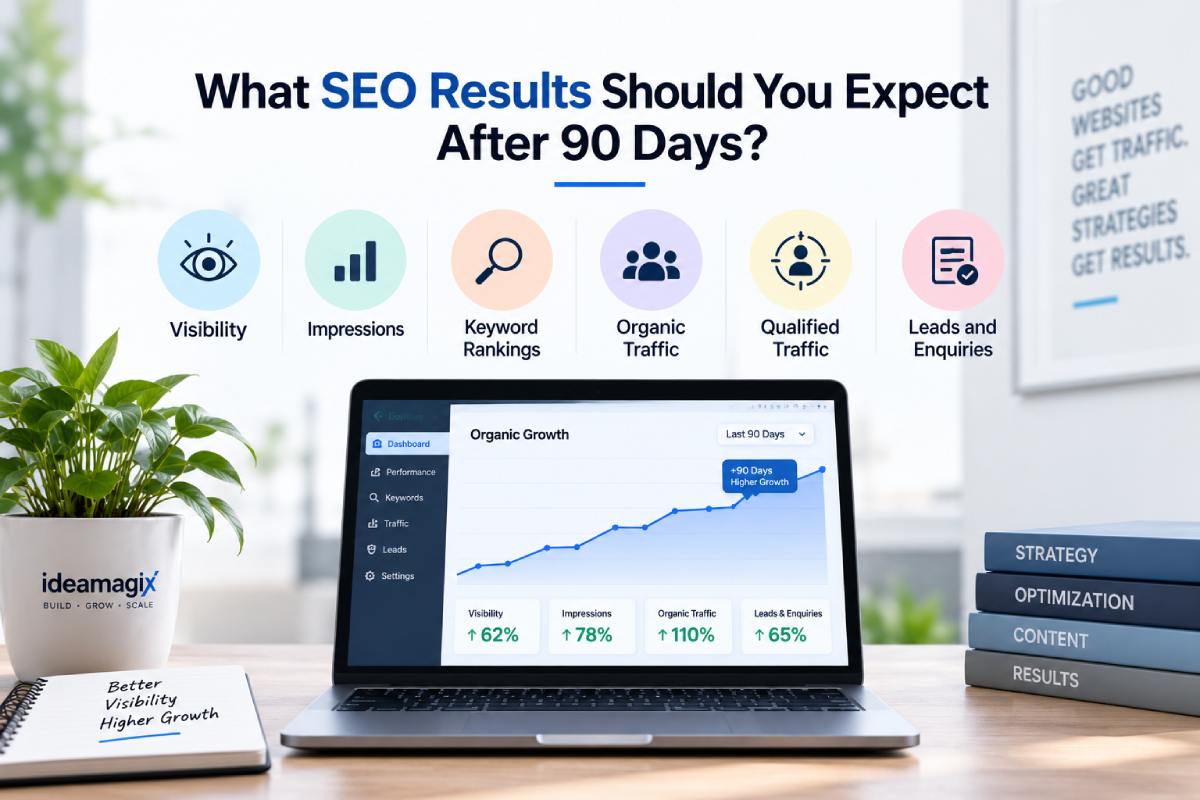
What SEO Results Should You Expect After 90 Days?
There are several levels of SEO results, and they do not all appear at the same time.
Visibility
You may see more pages appearing for relevant searches.
Impressions
Your website may begin appearing more frequently in search results even before clicks increase significantly.
Keyword Rankings
More target and long-tail keywords may enter the top 100, top 50, top 20, or top 10.
Organic Traffic
As rankings improve and more queries generate clicks, organic sessions can begin to increase.
Qualified Traffic
This is more important than raw traffic. A website receiving 10,000 visitors who have no commercial relevance is not necessarily performing better than one receiving 1,500 visitors who are actively looking for its products or services.
Leads and Enquiries
For a commercial SEO campaign, the ultimate objective is not simply traffic. It is qualified business opportunity. That means measuring: Organic visibility → relevant traffic → engagement → enquiry → qualified lead → customer
The time required to see movement through the complete chain can be longer than the time required to see ranking improvements.
Why SEO Traffic May Increase Before Leads Do
This is another area where businesses sometimes misjudge SEO. Suppose organic traffic increases by 40%, but enquiries increase by only 5%. That does not automatically mean SEO has failed. The additional traffic may be landing on informational content rather than commercial pages. The next step is to improve the connection between content and conversion.
That could mean:
- Better internal links
- Stronger service-page CTAs
- Relevant enquiry forms
- Product enquiry buttons
- Consultation CTAs
- Comparison content linking to service pages
- Clearer contact paths
- Better landing-page messaging
Our audit work identified this exact type of issue: limited CTAs on product pages were reducing opportunities to convert visitors into leads. SEO therefore cannot be separated completely from conversion optimisation.
More traffic is useful only when the website gives relevant visitors a reason and an easy path to take the next step. This stage is an important milestone in the overall SEO results timeline, where increased visibility begins contributing to real business growth.
Why Some Websites See SEO Results Faster Than Others
There is no universal “90-day SEO guarantee” because websites start from very different positions.
Existing Website Authority
An established domain with relevant backlinks and a history of publishing useful content may have an advantage over a brand-new website.
Keyword Competition
Ranking for a specific local service may require less effort than competing nationally for a highly commercial keyword.
Website Size
A 20-page website and a 2,000-page ecommerce website have very different technical and content requirements.
Technical Health
If important pages cannot be crawled, indexed, or understood properly, content and link-building efforts may not deliver their full potential.
Content Quality
Pages that genuinely answer the searcher’s question have a stronger foundation than pages written primarily to insert keywords.
Implementation Speed
SEO recommendations do not produce results until they are implemented. An agency can identify a technical problem on Monday, but if the development team does not deploy the fix for six weeks, the SEO timeline effectively changes.
Authority Building
Competitive sectors often require relevant external signals, not just on-site optimisation. Our San Industries audit, for example, identified a weak backlink profile and no apparent focused link-building strategy involving industry directories, publications, partners, guest posts, or outreach.
What If You See No Results in the First 90 Days?
“No results” needs to be defined carefully. Before judging your campaign, evaluate your overall SEO services results, including impressions, keyword visibility, organic traffic, and conversions rather than rankings alone. If there is zero movement in rankings, impressions, indexing, organic traffic or relevant visibility after three months, the campaign deserves a serious review.
Ask:
Were the recommended changes actually implemented?
An SEO strategy cannot compensate for fixes that were never deployed.
Were the right keywords selected?
High-volume keywords are not automatically the right commercial targets.
Was the content genuinely improved?
Publishing more pages is not the same as improving search relevance.
Is the website technically accessible?
Crawlability, indexing, and canonical issues can restrict visibility.
Is the competition stronger than expected?
Some keywords require considerably more authority than initially estimated.
Is link acquisition happening?
For competitive searches, publishing content alone may not be enough.
Are we measuring the right KPIs?
A page moving from position 80 to position 25 is progress even though it has not yet reached page one.
The SEO Metrics You Should Track Every Month
A good SEO services results report should go beyond “we published X blogs.”
Track:
| Metric | Why It Matters |
| Organic clicks | Measures search traffic reaching the site |
| Organic impressions | Shows search visibility |
| Average ranking position | Indicates movement across target queries |
| Top 10 keywords | Measures first-page visibility |
| Non-brand traffic | Shows growth beyond existing brand demand |
| Landing-page traffic | Identifies pages gaining visibility |
| Indexed pages | Helps identify indexing progress |
| CTR | Shows how effectively search impressions generate clicks |
| Organic leads | Connects SEO to business outcomes |
| Conversion rate | Measures traffic quality and landing-page performance |
| Referring domains | Indicates authority development |
| Technical issues | Shows whether the site’s foundation is improving |
Google’s Search documentation recommends using Search Console and other search-performance information to understand how sites perform in Search; its current documentation also recognises multiple search appearances and AI-driven search experiences.
SEO in 2026: Ranking on Google Is No Longer the Only Visibility Goal
The traditional SEO objective was straightforward: Get the website into Google’s top 10. That still matters. But search behaviour is expanding. Search results can include different formats, and Google now documents AI Overviews and AI Mode as part of its search ecosystem.
That means content should be structured so that important information is easy to understand, extract, and verify. For example, instead of writing a 2,000-word article that takes 800 words to answer a basic question, answer the question directly and then provide the reasoning.
For this article, that means: How long does SEO take? Most businesses should evaluate SEO over several months rather than expecting guaranteed page-one rankings within 90 days. The first 90 days are generally focused on fixing technical problems, improving relevance, building content and authority, and establishing measurable ranking and traffic momentum. Then explain the details. This structure is useful for humans and gives search systems clear answers to specific questions.

What “Best SEO Services” Should Actually Include
If you are comparing the Best SEO Services, don’t judge providers only by their monthly package price or the number of blogs they promise to publish. Ask what happens behind the content.
A serious SEO engagement should normally include:
Technical SEO
The agency should identify and prioritise technical problems affecting crawling, indexing, performance and page structure.
Keyword and Intent Strategy
Keywords should be mapped to business objectives and specific pages rather than distributed randomly across the website.
On-Page Optimisation
Important pages should be improved for relevance, structure, titles, headings, internal links, and user intent.
Content Strategy
Content should address genuine search demand and build topical relevance around commercial priorities.
Authority Development
The strategy should account for backlinks, relevant referring domains and other ways of building credible authority.
Conversion Optimisation
Organic traffic should have a clear route toward enquiries, calls, purchases, bookings or another business goal.
Reporting and Iteration
The agency should explain what changed, what happened afterward, and what will be done next.
That final point is particularly important. SEO is not: Audit → optimise → wait. It is: Audit → implement → measure → analyse → improve → repeat.
A Realistic 90-Day SEO Roadmap
Month One: Fix the Foundation
Week 1-2
- Complete technical and SEO audit
- Establish baseline rankings
- Review organic traffic
- Analyse competitors
- Research target keywords
- Map search intent
- Identify priority pages
- Identify technical blockers
Week 3-4
- Fix priority technical issues
- Optimise important metadata
- Improve heading structure
- Start internal-link improvements
- Optimise priority commercial pages
- Create content roadmap
Expected outcome: A cleaner technical foundation, clear keyword targeting and a defined SEO growth plan.
Month Two: Build Relevance
Week 5-6
- Publish priority content
- Expand thin pages
- Optimise service/product pages
- Strengthen topical clusters
- Improve internal linking
Week 7-8
- Continue content production
- Improve existing pages based on ranking data
- Start authority-building activities
- Review indexing and crawl behaviour
- Analyse early ranking changes
Expected outcome: Increasing search impressions, broader keyword visibility and early movement for target queries.
Month Three: Optimise for Growth
Week 9 -10
- Identify pages approaching page one
- Improve underperforming content
- Strengthen internal links
- Build relevant authority
- Improve CTR opportunities
Week 11-12
- Review organic traffic
- Review keyword movement
- Analyse lead-generating pages
- Compare performance against baseline
- Identify next-quarter priorities
- Refine content and authority strategy
Expected outcome: A clearer pattern of which pages, keywords, and strategies are producing meaningful SEO progress.
SEO Does Not End at Day 90
The biggest mistake is treating 90 days as the finish line. It should be treated as the first meaningful review point.
By this stage, the agency should know much more than it did at the beginning:
- Which keywords are gaining traction
- Which pages deserve more investment
- Which content formats perform
- Which technical issues remain
- Which competitors are strongest
- Which links and authority activities are working
- Which pages attract qualified visitors
- Which organic visitors convert
- Where additional content is needed
That information makes the next 90 days more intelligent than the first 90. And this is where SEO begins to compound. A page that reaches position 12 can be improved toward the top 10.
A page already ranking at position 6 can be optimised toward the top three. Supporting content can strengthen a commercial service page. New backlinks can increase authority. Internal links can distribute relevance between related pages. The campaign becomes increasingly driven by actual search data rather than assumptions.
Final Answer: How Long Does SEO Take?
If you want a realistic answer to how long does SEO take, think in stages rather than guarantees.
First 30 days:
Understand the website, fix important technical problems and establish the strategy.
Days 31-60:
Improve content, keyword relevance, internal linking and authority signals.
Days 61-90:
Analyse ranking and traffic data, improve pages showing traction and strengthen the areas with commercial potential.
After 90 days:
Continue expanding authority, improving rankings, publishing strategically and converting organic visibility into business results.
Some websites will show meaningful ranking movement sooner. Others will take longer, particularly when targeting competitive keywords or starting with weak technical foundations and limited authority. The important question is therefore not: “Will I rank #1 in 90 days?”
A better question is: “Can you show me measurable SEO progress, explain what caused it, and demonstrate how the next phase will turn that progress into more qualified organic traffic and leads?” That is the standard a serious SEO campaign should be held to.
Google also makes clear that search visibility can involve crawling, indexing, processing, and different search appearances, so there is no legitimate basis for treating SEO as an exact-date ranking guarantee. The first 90 days should build momentum in your overall SEO results timeline. The months that follow should turn that momentum into sustained organic growth through continuous optimisation and authority building.
Frequently Asked Questions
How long does SEO take to show results?
SEO can begin showing early indicators such as improved indexing, impressions, and ranking movement within the first few months, but meaningful traffic and lead growth generally require continued optimisation. The timeline varies according to competition, website authority, technical condition, content quality, and implementation speed.
Can SEO get my website to page one in 90 days?
It can happen for some keywords, particularly less competitive or long-tail searches, but it should not be guaranteed. Competitive commercial keywords may require considerably more time and authority.
What should I expect from SEO services in the first month?
Expect an audit, keyword research, technical analysis, baseline measurement, page prioritisation, and initial optimisation. The first month is primarily about establishing the foundation rather than chasing ranking screenshots.
What SEO results should I expect after 90 days?
Depending on the website, you may see improvements in impressions, keyword visibility, rankings, organic traffic and qualified enquiries. The strongest evidence of progress is measurable improvement against the baseline established at the beginning of the campaign.
Why is my SEO traffic increasing but leads are not?
The traffic may not have enough commercial intent, or the landing pages may not provide a clear conversion path. Review the keywords generating traffic, the pages receiving visitors, calls to action, forms, and internal links to commercial pages.
Is SEO still worth investing in 2026?
Yes, provided it is treated as a long-term acquisition channel rather than a promise of instant rankings. SEO can build visibility across informational, commercial, and transactional searches, while strong content can also help a brand become more discoverable across evolving search experiences.
How should I evaluate an SEO agency?
Look for an agency that can explain its audit findings, keyword strategy, technical priorities, content plan, authority strategy, reporting process, and conversion measurement. Be cautious of providers that guarantee exact rankings or focus entirely on the number of articles or backlinks delivered.