
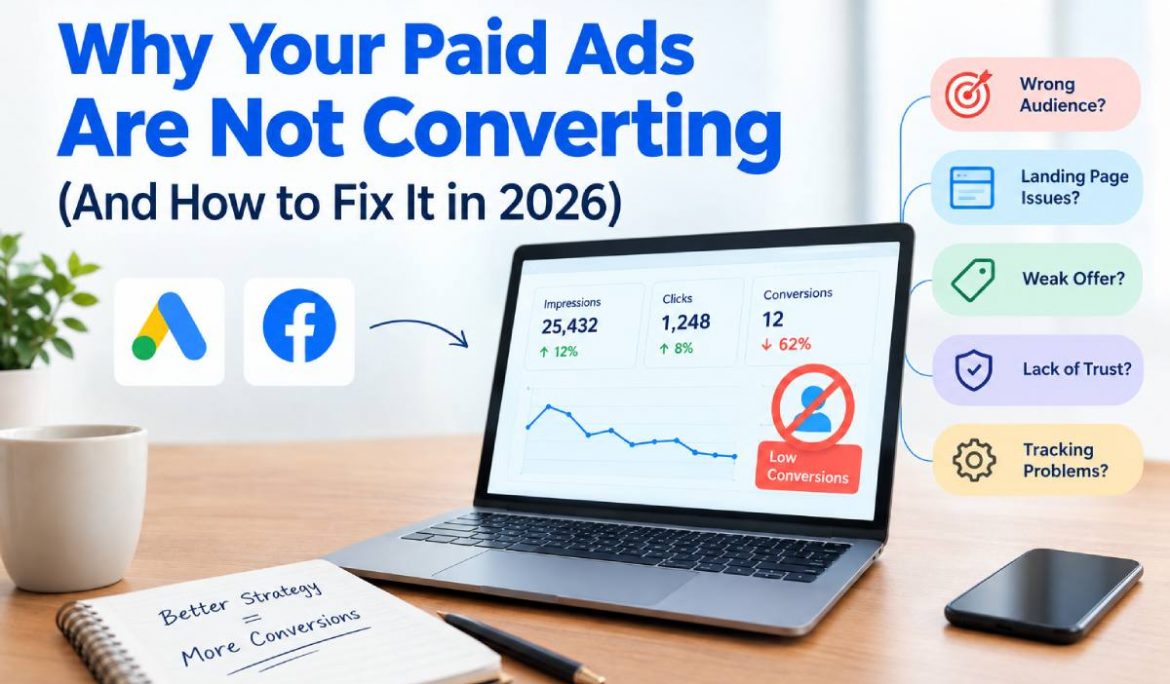
You are getting clicks. The ad is receiving impressions. The campaign is spending money. But the leads, enquiries, purchases, or bookings are not coming in. This is one of the most frustrating situations in paid advertising because the campaign can look healthy at first glance. You might have a reasonable click-through rate, decent traffic and an acceptable cost per click, yet the actual business result remains poor.
If your ads are not converting, the problem is rarely just “the ad.” The breakdown can happen at almost any stage: Targeting → Search/Audience Intent → Ad Message → Click → Landing Page → Offer → Trust → Conversion → Follow-up. A campaign can lose potential customers at any one of these points.
For example, if 1,000 people see your ad, 50 click it, but nobody submits the enquiry form, changing the headline of the advertisement may not solve the problem. The landing page, offer, form, pricing, targeting, or conversion tracking may be responsible.
That is why fixing low conversion ads starts with diagnosis rather than immediately increasing the budget. Google itself describes landing pages as important to generating conversions from Google Ads traffic and provides specific tools for checking landing-page performance and mobile optimisation.
The Short Answer: Why Are Your Ads Not Converting?
Your paid ads may not be converting because:
- You are targeting the wrong audience.
- The traffic has weak buying intent.
- The ad promise does not match the landing page.
- Your offer is not compelling enough.
- The landing page creates friction.
- The page is slow or difficult to use on mobile.
- Your form is too complicated.
- Users do not trust the business yet.
- Your campaign is optimising for the wrong conversion.
- Conversion tracking is broken or incomplete.
- Your budget is spread across too many campaigns.
- Your keywords are too broad.
- Your Facebook/Instagram audience is poorly defined.
- Your Google Ads search terms are irrelevant.
- You are judging performance using clicks instead of business outcomes.
- Leads are being generated, but the sales process is failing afterward.
The important point is that paid advertising is a system. If the system leaks, buying more traffic simply makes the leak more expensive.
First: Understand Where the Conversion Problem Actually Is
Before changing campaigns, identify the stage at which people are dropping out.
Consider this example:
100,000 impressions
↓
2,500 clicks
↓
100 landing-page enquiries
↓
30 qualified leads
↓
8 sales
Now imagine another campaign:
100,000 impressions
↓
2,500 clicks
↓
15 enquiries
↓
5 qualified leads
↓
2 sales
The two campaigns have identical impressions and clicks. But something after the click is dramatically different. That means looking only at impressions, CTR, and CPC would miss the actual problem.
A better diagnostic framework is:
| Stage | Metric | Problem Indication |
| Impression | Reach / impressions | Not enough visibility |
| Impression → Click | CTR | Weak targeting or message |
| Click → Page | Landing-page engagement | Poor page experience |
| Page → Lead | Conversion rate | Offer/page/form problem |
| Lead → Qualified lead | Lead quality | Targeting or intent problem |
| Qualified lead → Sale | Close rate | Sales/follow-up problem |
| Sale → Revenue | ROAS / CAC / profit | Economics problem |
This distinction is critical. An ad campaign can have a conversion problem even when the ads themselves are doing their job.
1. You Are Targeting People Who Were Never Going to Buy
One of the most common reasons ads are not converting is simple: the campaign is attracting the wrong people. However, ads not converting does not always mean the targeting itself is wrong; the problem may appear later in the funnel. Traffic is not the same as demand.
Suppose you sell enterprise cybersecurity software. Someone searching “what is cybersecurity?” is unlikely to have the same commercial intent as someone searching “enterprise cybersecurity software pricing.” Both searches are relevant to cybersecurity. They are not equally valuable to an advertiser. The same principle applies to Facebook and Instagram. An audience may match your demographic profile but have little actual buying intent.
You can have:
- Correct age range
- Correct location
- Correct industry
- Thousands of impressions
- Low CPC
and still generate terrible leads.
How to Fix It
Separate audiences according to intent.
For Google Ads, review:
- Search terms
- Keyword match types
- Location settings
- Negative keywords
- Device performance
- Time-of-day performance
- Geographic performance
- Audience signals
- Search intent
For Meta Ads, examine:
- Audience quality
- Creative-to-audience fit
- Placement performance
- Retargeting segments
- Lookalike/source audience quality
- Engagement quality
- Lead quality
The question should be: “Would this person realistically buy what we sell?” not simply: “Can this person click the advertisement?”
2. Your Keywords Are Too Broad
This is especially common when businesses ask, “Why are my Google Ads not working?” A company may choose keywords that are related to its business but not commercially specific enough. For example, imagine a company selling industrial machinery.
A broad keyword around “machinery” could attract searches for:
- Machinery jobs
- Machinery definitions
- Used machinery
- Machinery repair
- Machinery manufacturers
- Machinery videos
- Machinery suppliers
- Machinery training
- Machinery parts
Some of these searches may have absolutely no purchase intent. The campaign pays for the click anyway.
How to Fix It
Review the actual search terms generating clicks. Do not optimise only from the keyword list. The search-term report tells you what people actually typed before triggering your ads.
From there:
- Add irrelevant queries as negative keywords.
- Separate high-intent terms into dedicated campaigns or ad groups.
- Build ads around the exact problem being searched.
- Send each intent group to an appropriate landing page.
- Reduce exposure to searches with little commercial value.
This can improve lead quality without necessarily increasing the advertising budget.
3. Your Ad and Landing Page Are Saying Different Things
This is one of the most overlooked causes behind low conversion ads and poor conversion rates. Imagine your advertisement says: “Get Industrial RO Plant Price in 24 Hours”. The user clicks.
The landing page says: “Welcome to Our Company”
- There is no pricing information.
- No explanation of the RO plant.
- No clear enquiry option.
- No mention of the 24-hour response.
The user has to figure out what to do next. That creates friction. Google’s own documentation stresses that the landing page should take users to the appropriate part of the website and provides tools for identifying destination and URL problems.
Better Approach
The advertisement should establish the expectation. The landing page should immediately confirm it. Ad: “Commercial Solar Panels for Factories.” Landing page: “Commercial Solar Panels for Factories”
Then explain:
- Capacity options
- Applications
- Benefits
- Installation
- Certifications
- Case evidence
- Pricing/request-a-quote process
- FAQs
- Contact method
The closer the connection between query → ad → landing page → offer, the less cognitive work the visitor has to do.
4. You Are Sending Paid Traffic to the Homepage
Your homepage is not automatically the best landing page. This is one of the most common structural problems in paid campaigns. If someone searches: “B2B SEO services Mumbai,” and your advertisement sends them to a homepage containing 15 different services, the visitor has to find the relevant information themselves.
A dedicated landing page can instead focus on B2B SEO Services with:
- Specific positioning
- Relevant proof
- Service details
- Deliverables
- Industry relevance
- FAQs
- CTA
- Contact form
Google recommends evaluating the actual pages receiving ad traffic and specifically provides landing-page performance information in Google Ads.
When the Homepage Can Work
A homepage can work when:
- The brand itself is the search intent.
- The campaign is broad and brand-led.
- The homepage directly addresses the advertised offer.
- The user needs to explore several products before choosing.
But for high-intent commercial campaigns, a purpose-built landing page is often worth testing.
5. Your Offer Is Weak
Sometimes the advertising is not the problem. The offer is.
Consider these two advertisements:
Ad A
- “Digital Marketing Services”
- Learn more about our services.
Ad B
“Free Google Ads Account Audit.” Find wasted spend, irrelevant search terms, conversion-tracking problems, and landing-page issues. Which one gives a prospect a stronger reason to click? The second one gives the visitor a specific outcome. This does not mean every business needs to offer something for free.
The offer could be:
- Consultation
- Quote
- Product demonstration
- Assessment
- Sample
- Trial
- Pricing
- Technical consultation
- Site inspection
- Strategy session
- Downloadable resource
The key is relevance. The visitor needs to understand why taking the next step is worthwhile.
6. Your Landing Page Does Not Establish Trust
A visitor who does not know your company has a question running through their head: “Why should I trust you?” Your landing page needs to answer that without forcing the visitor to search elsewhere.
Depending on the business, useful trust elements can include:
- Client logos
- Certifications
- Industry experience
- Reviews
- Testimonials
- Case studies
- Product specifications
- Awards
- Memberships
- Project photographs
- Guarantees where legitimately offered
- Clear contact information
- Physical business details where relevant
Do not manufacture proof.
- If you have served 50 companies, say so only if that figure can be substantiated.
- If you have certifications, display the actual certifications.
- If you have case studies, show measurable outcomes where the data is genuine.
Trust is particularly important for high-value B2B products because the visitor may not be prepared to make a purchase after one click.
7. Your Landing Page Is Too Slow
A visitor cannot convert if the page takes too long to become usable. This matters especially on mobile devices. Google’s landing-page documentation specifically recommends monitoring mobile optimisation and notes that improving landing page speed can improve mobile ad performance.
Common causes include:
- Oversized images
- Poorly optimised videos
- Excessive scripts
- Too many third-party tracking tools
- Heavy page builders
- Poor hosting configuration
- Render-blocking resources
- Unnecessary animations
What to Check
Measure:
- Mobile load performance
- Core Web Vitals
- Largest Contentful Paint
- Interaction responsiveness
- Cumulative Layout Shift
- Server response time
- Image sizes
- JavaScript execution
Do not optimise speed simply to improve a score. Optimise it because the person who clicked your advertisement should be able to see the offer and act on it quickly.
8. Your Form Is Asking for Too Much
A paid advertisement creates an expensive introduction. Don’t ruin it with a 14-field enquiry form.
Imagine asking for:
- Name
- Company
- Job title
- Department
- Address
- City
- State
- Country
- Phone
- Website
- Annual turnover
- Number of employees
- Budget
- Requirements
- Comments
before the visitor has even spoken to you. Some businesses genuinely need qualification information. But every additional field introduces another opportunity for abandonment.
Test Shorter Forms
Try:
- Name
- Phone / Email
- Requirement
Then qualify the lead afterward. For high-ticket B2B services, you can test longer forms against shorter ones rather than assuming one approach is universally better.
9. Your Call to Action Is Vague
“Submit” is not an offer. Neither is “Click Here.”
Compare:
- Submit
- with: Request a Project Quote
- or: Book a 20-Minute Consultation
- or: Get Industrial Equipment Pricing
The second group tells the user what happens next. The CTA should match the visitor’s intent and the stage of the buying journey.
10. Your Conversion Tracking Is Wrong
This is one of the most dangerous problems because it can make a successful campaign look unsuccessful-or a poor campaign look successful. When ads are not converting, incorrect tracking can make diagnosis even more difficult.
Suppose a Google Ads account counts:
- Page views
- Button clicks
- Form opens
- Time on page
as conversions.
But the actual business cares about:
- Completed enquiries
- Phone calls
- Qualified leads
- Purchases
The optimisation system may receive the wrong signals. Google provides specific troubleshooting tools for conversion actions and recommends checking whether tags are installed correctly and recording conversions. Google also recommends proper sitewide tagging and conversion configuration to improve measurement accuracy.
Audit These Items
Check:
- Google Ads conversion actions
- Google Tag Manager
- Google Analytics
- Form-submit tracking
- Phone-call tracking
- Thank-you page events
- Cross-domain tracking
- Duplicate tags
- Primary vs secondary conversions
- Enhanced conversions
- CRM attribution
- Offline conversion imports
In 2026, Google’s enhanced-conversions documentation describes using hashed first-party customer information to improve conversion measurement and bidding. If tracking is unreliable, optimisation decisions are being made on unreliable data.
11. You Are Optimising for Cheap Leads Instead of Good Leads
This is a major problem for service businesses.
Suppose Campaign A produces: 100 leads × ₹300 = ₹30,000
Campaign B produces: 20 leads × ₹1,500 = ₹30,000
At first glance, Campaign A looks much better.
But suppose:
- Campaign A: 100 leads → 3 customers
- Campaign B: 20 leads → 8 customers
Campaign B is far more valuable.
This is why businesses should track: Cost per lead → Cost per qualified lead → Cost per customer → Revenue → Profit, not simply cost per conversion. A campaign generating inexpensive but irrelevant leads is not efficient advertising. It is inexpensive waste.
12. You Have a Lead-Quality Problem, Not a Conversion Problem
Sometimes people are submitting forms. The business still says: “Google Ads aren’t working.” But when the leads are examined, the actual problem is lead quality.
For example:
- Students
- Job seekers
- Competitors
- People looking for free information
- People outside the service area
- People looking for products you do not sell
- People with unrealistic budgets
In that situation, increasing the conversion rate is not necessarily the goal. You may actually want fewer conversions. You want more qualified conversions.
13. Why Facebook Ads Fail: The Creative Is Not Doing Enough Work
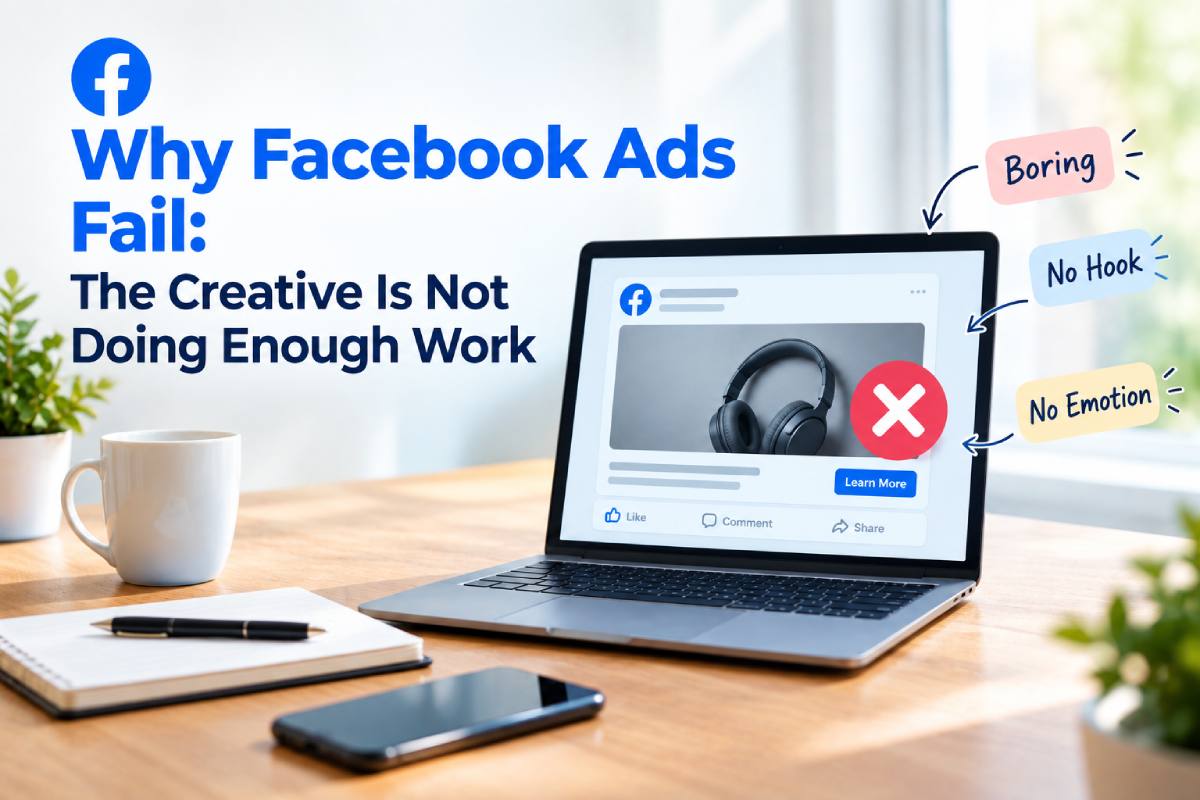
When people ask “why Facebook ads fail,” they often blame targeting first. Creative is frequently the bigger issue. On Meta platforms, people are not necessarily searching for your product at the moment they see the advertisement.
You therefore have less time to establish:
- The problem
- The audience
- The outcome
- The reason to care
- The proof
- The next step
A generic image with: “Best Digital Marketing Services” may not stop anyone. A more specific creative might focus on: “Spending ₹1 lakh/month on Google Ads but receiving poor-quality leads?” That speaks directly to a problem.
Test Different Creative Angles
Instead of producing 10 visually different versions of the same message, test different reasons to respond:
- Problem-led
- Outcome-led
- Comparison-led
- Educational
- Demonstration
- Testimonial
- Case-study
- Objection handling
- Offer-led
- Product-specific
The goal is not simply to make the advertisement prettier. It is to find a message that makes the right person think: “This is exactly my problem.”
14. Your Facebook Audience Is Too Broad-or Too Narrow
Both extremes can create problems. Understanding why Facebook ads fail requires looking at both audience size and audience relevance rather than focusing on one targeting setting.
Too Broad
You may reach people with limited relevance.
Too Narrow
You may restrict delivery and make it difficult for the system to find enough potential customers.
The correct audience depends on:
- Product
- Market size
- Sales cycle
- Geographic coverage
- Customer value
- Existing customer data
- Campaign objective
- Creative strength
Do not copy an audience structure from another business and assume it will work for yours. A B2C ecommerce product and an enterprise industrial solution should not necessarily be advertised in the same way.
15. Your Google Ads Campaign Structure Is Fighting Your Data
If you are wondering why Google Ads not working, campaign structure is another area worth examining before making major changes. Over-segmentation can be just as problematic as poor targeting.
Suppose you create:
- 15 campaigns
- 60 ad groups
- 100 keywords
- 40 locations
- 8 audiences
but the account generates only 30 conversions a month.
You may have spread the data too thin. Automated optimisation needs useful signals. The appropriate structure depends on the account’s budget, conversion volume, product range, and business model. The goal is not to create the most sophisticated-looking account. The goal is to create a structure that allows meaningful decisions.
16. Your Ad Copy Talks About Your Company Instead of the Customer
This happens constantly.
Company-focused copy:
“We are a leading digital marketing company with 15 years of experience.” That may be true. But the customer is asking: “Can you solve my problem?” A stronger structure is: Problem → Solution → Proof → Action
For example: Google Ads Generating Clicks but No Leads? Find wasted spend, irrelevant traffic, and conversion-tracking issues with a campaign audit. Request an Account Review. The company credentials can come afterward.
17. You Are Testing Too Many Variables at Once
If you change:
- Audience
- Budget
- Landing page
- Ad copy
- Creative
- Keywords
- Bidding
- Conversion settings
all at the same time, you may see a performance change without knowing what caused it.
A disciplined testing process asks:
- What are we changing?
- Why are we changing it?
- What metric should improve?
- How long will we evaluate it?
- What result would cause us to keep or reject the change?
Not every test needs to run for exactly the same duration. The amount of data required depends on traffic, conversion volume, and decision impact.
18. Your Budget Is Too Small for the Target You Want
This is uncomfortable, but sometimes the economics simply don’t work. Suppose your average CPC is ₹100. A ₹5,000 monthly budget buys approximately 50 clicks. If the landing-page conversion rate is 4%, that produces roughly 2 conversions/month. You cannot expect statistically useful optimisation from extremely small volumes. The solution is not automatically “spend more.”
First check:
- CPC
- Search volume
- Audience size
- Conversion rate
- Average customer value
- Gross margin
- Close rate
Then calculate what acquisition economics are actually possible.
19. Your Sales Team Is Losing the Leads
This is where paid advertising becomes a business problem rather than a marketing problem. Imagine your campaign generates 50 leads. Only 20 receive a call. Five are contacted after several days. Ten never receive a second follow-up. The business concludes: “The leads are poor.” But the advertising may have done its job.
The complete funnel needs to be measured: Ad → Landing Page → Lead → Contacted → Qualified → Proposal → Won. If your CRM shows that paid leads are frequently contacted late or poorly followed up, improving the advertisement may have limited impact on revenue.
20. You Are Looking at Account-Level Numbers Instead of Finding the Leaks
An account can report:
- CTR: 4.2%
- CPC: ₹38
- Conversions: 42
Those numbers sound useful.
But they don’t answer:
- Which campaign generated qualified leads?
- Which keyword generated sales?
- Which landing page converted?
- Which location produced revenue?
- Which audience produced poor-quality leads?
- Which device generated customers?
- Which ad produced high-value enquiries?
Break the account down.
Analyse performance by:
- Campaign
- Ad group
- Keyword
- Search term
- Location
- Device
- Audience
- Creative
- Landing page
- Time period
- Conversion type
That’s where the actual problem usually becomes visible.
A Practical Diagnostic Framework for Ads Not Converting
Use this sequence before making major campaign changes. This framework helps identify exactly why ads not converting before you make expensive campaign changes.
Step 1: Confirm Tracking
Are conversions being recorded correctly? If not, fix measurement first.
Step 2: Check Traffic Quality
Are people actually looking for what you sell?
Step 3: Check Search Terms or Audience Quality
Are irrelevant users consuming budget?
Step 4: Check Ad Relevance
Does the advertisement clearly address the user’s need?
Step 5: Check Landing Page Match
Does the landing page deliver what the advertisement promised?
Step 6: Check Page Experience
Is the page fast, mobile-friendly, and easy to navigate?
Step 7: Check Offer
Is there a compelling reason to take action?
Step 8: Check Conversion Friction
Is the form, checkout, or enquiry process unnecessarily difficult?
Step 9: Check Lead Quality
Are conversions actually potential customers?
Step 10: Check Sales Follow-Up
Are qualified leads being contacted and progressed?
Only after these questions are answered should you decide whether the campaign needs a major structural change.
How We Would Audit a Low-Converting Paid Campaign
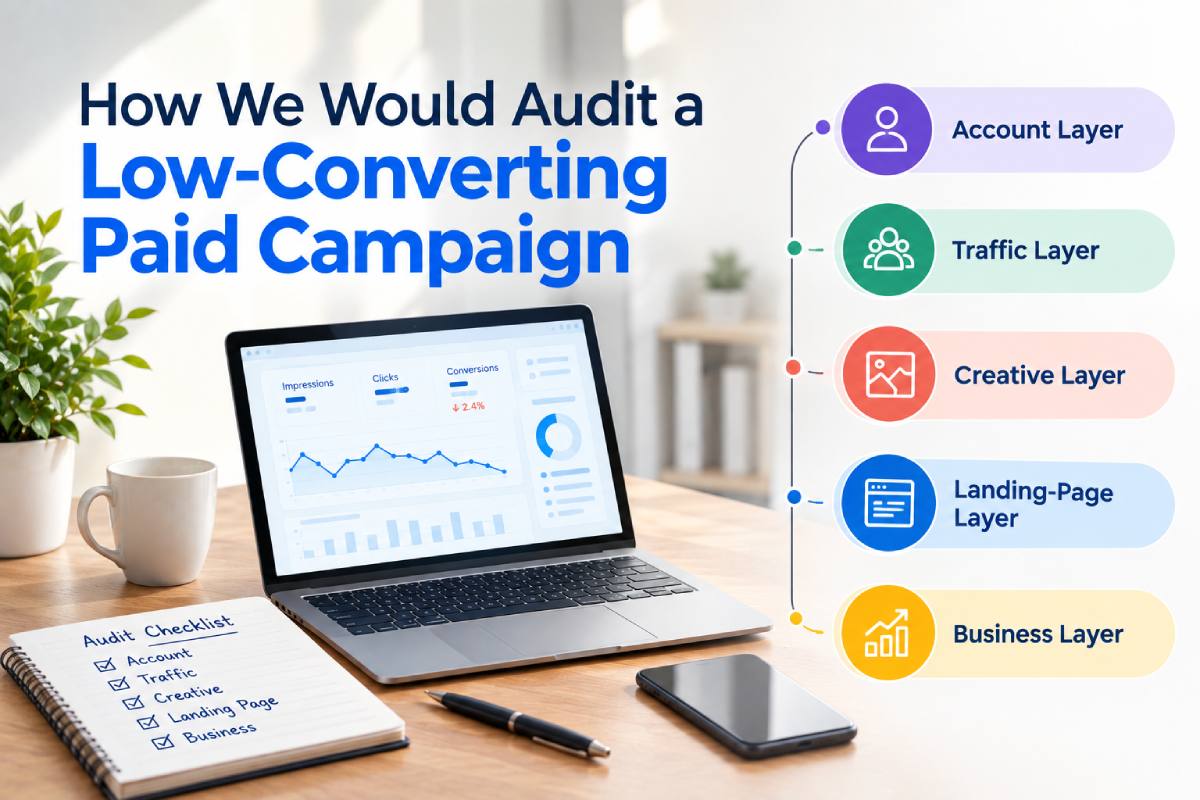
A serious paid advertising review should not start with: “Let’s create new ads.” It should start with: Where is the money being lost? We would typically examine five layers.
Account Layer
- Campaign structure
- Budget allocation
- Bidding
- Conversion settings
- Geographic targeting
- Audience settings
Traffic Layer
- Search terms
- Keywords
- Placements
- Devices
- Locations
- Audience segments
Creative Layer
- Headlines
- Descriptions
- Images
- Videos
- Hooks
- Offers
- CTAs
Landing-Page Layer
- Message match
- Speed
- Mobile experience
- Content
- Trust
- Form
- CTA
- Conversion friction
Business Layer
- Lead quality
- Sales response
- Qualified-lead rate
- Customer acquisition cost
- Revenue
- Profitability
This is much closer to performance marketing than simply “running ads.”
What Our Website Audit Teaches About Paid Traffic
Our SEO audit work also demonstrates an important principle for paid advertising: traffic acquisition and website conversion cannot be treated as separate problems. In the August 2026 audit conducted for San Industries, the website had multiple on-page issues across its 257 pages, including title, description, heading, and H1/H2 optimisation gaps. The audit also found thin content on several product-category pages and inconsistent keyword targeting.
The same audit identified performance concerns associated with large images and slow page loading, along with canonical issues. Most importantly from a conversion perspective, the audit identified limited CTAs on product pages, which reduced opportunities to turn visitors into leads. That lesson applies directly to paid advertising. You can improve targeting and ad creative, but if the destination page does not clearly communicate the offer or give the visitor an easy next step, the campaign can still underperform.
Google Ads vs Facebook Ads: Different Reasons for Low Conversion
| Problem | Google Ads | Facebook / Meta Ads |
| Weak intent | Broad keywords | Weak audience fit |
| Poor message | Ad doesn’t match search | Creative doesn’t stop attention |
| Bad landing page | Major issue | Major issue |
| Tracking | Critical | Critical |
| Creative fatigue | Relevant | Often particularly important |
| Search terms | Major diagnostic | Not applicable in same way |
| Audience quality | Keyword + audience intent | Audience + creative interaction |
| Retargeting | Useful | Useful |
| Offer | Critical | Critical |
| Sales follow-up | Critical | Critical |
The platforms are different, but the underlying business principle remains the same: The right person needs to receive the right message and have a convincing next step.
How to Fix Low Conversion Ads in 2026
Don’t rebuild everything automatically. Use a prioritised approach.
If CTR is Low
Investigate:
- Targeting
- Keyword relevance
- Audience
- Creative
- Offer
- Ad copy
If CTR Is Good but Conversion Rate Is Low
Investigate:
- Landing page
- Message match
- Offer
- Trust
- Form
- Page speed
- CTA
If Conversion Rate Is Good but Lead Quality Is Low
Investigate:
- Targeting
- Search terms
- Negative keywords
- Qualification
- Offer positioning
- Audience exclusions
If Leads Are Good but Sales Are Low
Investigate:
- Sales response time
- Follow-up process
- Qualification
- Pricing
- Sales messaging
- CRM process
If Sales Are Good but Profit Is Low
Investigate:
- CPC
- Customer acquisition cost
- Average order value
- Gross margin
- Budget allocation
- Customer lifetime value
This prevents you from fixing the wrong part of the funnel.
The Most Important Paid Ads Formula
Don’t stop at:
- CTR
- CPC
- Conversion Rate
For a business, the more useful chain is: Ad Spend → Leads → Qualified Leads → Customers → Revenue → Profit
For example: ₹100,000 ad spend
- 100 leads
- 40 qualified leads
- 10 customers
- ₹500,000 revenue
Now you can calculate: Customer Acquisition Cost = ₹10,000; ROAS = 5X. But even ROAS can be misleading if margins are low. A business with ₹500,000 revenue and ₹450,000 gross costs does not necessarily have a healthy acquisition model. That is why the final question should be: “Does this campaign acquire customers profitably?”
What Not to Do When Your Ads Stop Converting
Avoid these common reactions.
Don’t immediately double the budget
More spend on a broken funnel means more expensive failure.
Don’t change every campaign at once
You lose the ability to identify the cause.
Don’t blame the platform immediately
Poor results may come from targeting, creative, landing pages, tracking, or sales.
Don’t optimise only for CTR
People clicking your ads are not necessarily customers.
Don’t celebrate cheap leads without checking quality
₹200 leads that never buy are not better than ₹1,000 leads that generate revenue.
Don’t create endless new ads without analysing existing data
Your existing campaigns often contain clues about what is working.
Don’t ignore the landing page
A strong ad cannot compensate indefinitely for a weak destination.
When Should You Hire a Paid Advertising Agency?
Consider professional Google Ads management or paid advertising support when:
- Your spend is significant enough that mistakes are expensive.
- You cannot identify why conversions are falling.
- Your tracking is unreliable.
- You have multiple campaigns and audiences.
- You need better lead quality rather than simply more leads.
- You need landing-page and conversion optimisation alongside media buying.
- Your internal team does not have enough time for search-term, audience, and creative analysis.
- You need reporting tied to revenue rather than clicks.
A good agency, such as Ideamagix, should be able to explain why performance is poor, not simply provide a new set of advertisements.
A Better Way to Think About Paid Advertising
Paid advertising does not fail because an advertisement gets a few bad clicks. It fails when the economics of the complete acquisition journey do not work.
The strongest campaigns connect:
- Audience
- Intent
- Message
- Offer
- Landing Page
- Tracking
- Sales Follow-Up
When one component is weak, the entire campaign can suffer. So if your Google Ads are not working, don’t immediately assume you need more keywords. If your Facebook ads are failing, don’t automatically assume you need a new audience. If your ads are not converting, find the exact point where potential customers are disappearing. That is where the real optimisation opportunity usually is.
Final Checklist: Are Your Ads Actually Ready to Scale?
Before increasing your paid advertising budget, check:
Targeting
- Are you reaching people who can actually buy?
- Are irrelevant searches excluded?
- Are locations correct?
- Are audiences commercially relevant?
Ad
- Does the message address a specific problem?
- Is the offer clear?
- Does the CTA tell users what happens next?
- Does the creative match the audience?
Landing Page
- Does it match the advertisement?
- Does it load quickly?
- Is it mobile-friendly?
- Is the value proposition obvious?
- Is there enough trust evidence?
- Is the CTA prominent?
- Is the form easy to complete?
Tracking
- Are conversions firing?
- Are primary conversions correctly configured?
- Are duplicate conversions excluded?
- Are calls and forms tracked?
- Can conversions be connected to actual leads?
Business
- Are leads qualified?
- Are sales teams following up?
- Are customers being attributed correctly?
- Is customer acquisition cost sustainable?
- Is advertising producing profitable revenue?
- If several boxes remain unchecked, increasing the budget is probably not the first thing to do.
Frequently Asked Questions
Why are my ads not converting?
Ads may fail to convert because of poor targeting, weak intent, irrelevant traffic, weak offers, poor ad-to-landing-page alignment, slow pages, difficult forms, insufficient trust, incorrect tracking or poor sales follow-up. The correct fix depends on where the conversion funnel is breaking.
Why are my Google Ads not working?
Google Ads may underperform because of irrelevant search terms, broad targeting, weak ad relevance, poor landing pages, incorrect conversion tracking, or unprofitable bidding economics. Start by analysing search terms, conversion tracking, and landing-page performance rather than immediately increasing the budget.
Why do Facebook ads fail?
When businesses ask why Facebook ads fail, the cause can include a poorly matched audience, weak creative, an unclear offer, creative fatigue, or a landing page that fails to convert the traffic generated.
What is a good conversion rate for paid ads?
There is no universal conversion-rate benchmark that applies to every industry. A conversion rate should be evaluated against traffic intent, lead quality, customer value, sales close rate, and acquisition cost. A lower conversion rate can still be commercially successful if the leads are highly valuable.
Should I increase my ad budget if conversions are low?
Usually not immediately. First, determine whether the problem is traffic quality, targeting, creative, landing-page experience, tracking, offer strength, or sales follow-up. Scaling should come after you understand the campaign economics.
How do I know if my ads or landing page are the problem?
If clicks and engagement are reasonable but visitors rarely take the desired action, investigate the landing page, offer, and conversion process. If CTR is already weak, investigate targeting, search intent, creative and ad messaging first.
How can I reduce wasted Google Ads spend?
Start by analysing search terms, adding irrelevant negative keywords, improving keyword-to-ad relevance, tightening location targeting, reviewing device and audience performance, and ensuring that high-intent traffic reaches relevant landing pages.
Should I optimise for leads or sales?
If possible, optimise toward the business outcome that matters rather than treating every form submission as equally valuable. For lead-generation businesses, connecting advertising data with qualified leads and eventual sales gives a much clearer picture of campaign performance.