
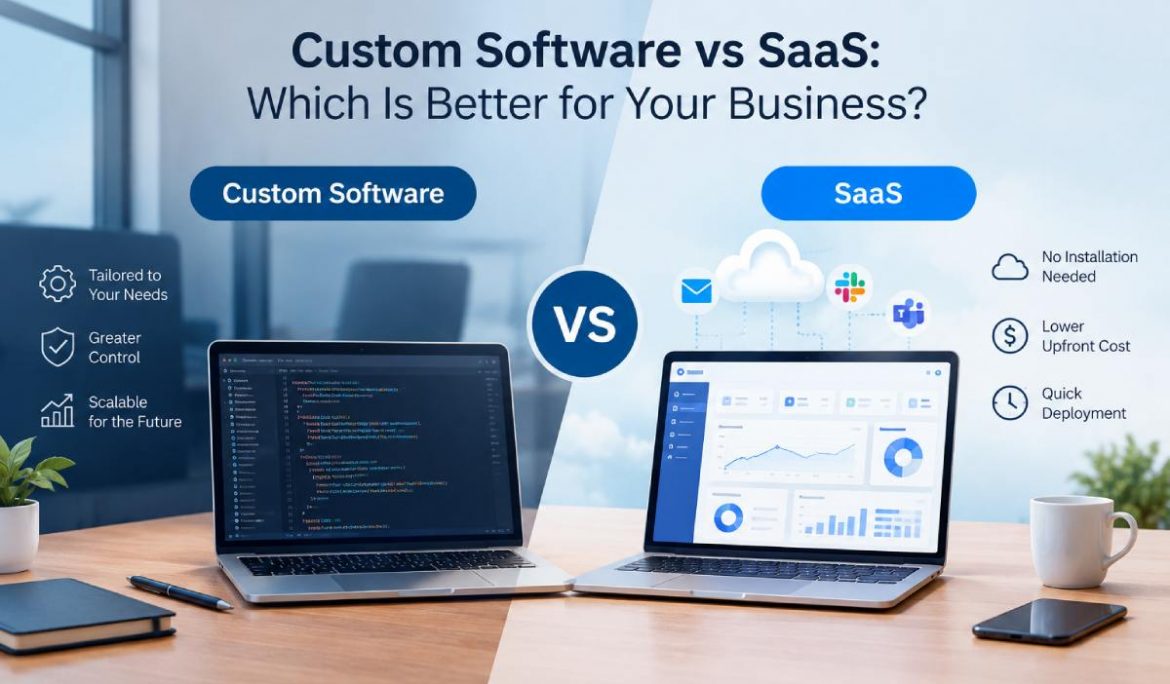
Choosing between custom software vs SaaS is not simply a question of whether your company should “build” or “buy” technology. It is a business decision that affects operating costs, employee productivity, data ownership, integrations, scalability, security, customer experience, and the amount of control your company has over its technology stack.
A SaaS platform can get a business operational in days or weeks without requiring an internal development team. Custom software, on the other hand, can be designed around the company’s exact processes rather than forcing employees to adapt their workflows to someone else’s product.
The difficult part is that neither option is automatically better. Current build-vs-buy software guidance increasingly points toward a third option as well: use SaaS software for standard capabilities and build the parts of the system that are genuinely strategic or differentiated.
This is also an important conclusion from the audit work we have been using to shape this content strategy: decision-stage software content should not simply explain technologies; it should help a business understand what it should choose, why it should choose it, what the financial and operational consequences will be, and when professional development becomes justified.
That is the purpose of this guide. If you are currently comparing build vs buy software, this article gives you a practical framework for deciding between SaaS, custom development, or a hybrid architecture.
The Short Answer: Custom Software vs SaaS
If your business needs a standard capability that is already mature in the market, SaaS is usually the sensible starting point. For example, businesses rarely need to build their own accounting software, email platform, video-conferencing system, or general-purpose CRM unless there is a highly unusual requirement.
Custom software becomes more compelling when the workflow is unique, strategically important, integration-heavy, highly regulated, difficult to support with existing products, or directly connected to competitive advantage.
The most practical answer for many growing and enterprise businesses is actually a custom software vs SaaS solution approach: purchase commodity capabilities and develop a custom layer around the processes that differentiate the business. This avoids rebuilding mature infrastructure while still giving the company control over its important workflows.
Quick decision framework
| Business requirement | Better option |
| Standard business process | SaaS |
| Need to launch quickly | SaaS |
| Small team and limited technical resources | SaaS |
| Unique business workflow | Custom software |
| Complex internal processes | Custom software |
| Deep integrations with internal systems | Custom or hybrid |
| Highly specific compliance requirements | Custom or hybrid |
| Strategic customer-facing product | Custom |
| Commodity functionality + unique workflow | Hybrid |
| Unsure whether customisation is actually required | Start with SaaS evaluation |
The key is not to ask “Which technology is better?” Ask: “Which option gives our business the best combination of capability, cost, control, scalability and long-term flexibility?”
What Is SaaS?
Software as a Service (SaaS) is SaaS software hosted and operated by a provider that customers access over the internet, generally through a browser or application. Instead of purchasing and maintaining the entire software infrastructure, the business subscribes to the service.
The SaaS provider typically manages:
- application hosting
- infrastructure
- software updates
- security controls
- backups
- availability
- maintenance
- product upgrades
The customer generally manages configuration, users, permissions, business processes, and the way the software is used.
Examples of SaaS categories include:
- CRM
- accounting
- HR management
- payroll
- email marketing
- project management
- customer support
- analytics
- collaboration
- communication
The major advantage is that the business doesn’t have to build the underlying product before it can use the capability.
What Is Custom Software?
Custom software development involves creating software specifically for a particular company’s requirements. Instead of adapting the business to an existing product, the software is designed around the company’s workflows, users, data structures, integrations, and business rules.
A custom application could be:
- an internal business management platform
- enterprise portal
- dealer management system
- customer portal
- workflow automation system
- ERP extension
- logistics platform
- booking platform
- marketplace
- B2B ordering system
- custom CRM
- business intelligence platform
- industry-specific application
The important distinction is ownership and control of the solution architecture. The business can decide how the system behaves, what workflows exist, how data moves between systems, and which features are prioritised.
However, that control comes with responsibility. The business must account for development, infrastructure, security, maintenance, testing, upgrades, and future changes.
Custom Software vs SaaS: The Fundamental Difference
The simplest distinction is this: SaaS software gives you an existing product that you configure to your business. Custom software gives you a product designed around your business. This is the fundamental distinction when evaluating SaaS vs custom software.
That sounds straightforward, but the practical difference is much deeper. With SaaS, your workflow operates within the boundaries of the vendor’s architecture. With custom software, the architecture can be designed around your workflow.
That means SaaS generally gives you speed and convenience, while custom development gives you control and flexibility. Neither characteristic is automatically more valuable. The correct choice depends on how strategically important the workflow is.
Custom Software vs SaaS: Detailed Comparison
When evaluating custom software vs SaaS, businesses should compare more than the initial purchase price. The right custom software vs SaaS solution depends on cost, flexibility, integrations, maintenance, security, and long-term business requirements.
| Factor | SaaS | Custom Software |
| Initial cost | Usually lower | Usually higher |
| Deployment | Fast | Longer |
| Customisation | Limited to available capabilities | Designed around requirements |
| Maintenance | Vendor managed | Business/development partner managed |
| Infrastructure | Vendor managed | Must be planned and managed |
| Data control | Subject to provider architecture and terms | Greater architectural control |
| Integrations | APIs/connectors available from vendor | Designed for required integrations |
| Feature roadmap | Vendor controlled | Business controlled |
| Scalability | Depends on provider | Designed around requirements |
| Per-user pricing | Common | Not necessarily applicable |
| Vendor dependency | Higher | Lower, but development dependency remains |
| Security | Vendor’s controls | Your architecture and operational responsibility |
| Time to market | Usually faster | Usually slower |
| Competitive differentiation | Limited | High potential |
| Long-term flexibility | Vendor dependent | Greater control |
| Best use | Standard workflows | Differentiated workflows |
The important point is that custom software is not simply “SaaS without a subscription.” It introduces a different ownership model.
Cost: Is Custom Software More Expensive Than SaaS?
This is one of the most misleading comparisons in the custom software development cost and SaaS debate.
Businesses often compare:
- SaaS monthly subscription
- custom software development cost
and immediately conclude that SaaS is cheaper. That comparison is incomplete. The correct analysis should consider Total Cost of Ownership (TCO) over a relevant period.
For example:
SaaS TCO
Consider:
- subscription
- implementation
- paid add-ons
- additional users
- premium features
- integration development
- data migration
- administration
- training
- vendor price increases
- switching costs
Custom TCO
Consider:
- discovery
- UX/UI design
- development
- testing
- infrastructure
- security
- maintenance
- support
- upgrades
- development resources
- future enhancements
The cheaper option on day one isn’t necessarily cheaper over three or five years.
Current build-vs-buy analysis similarly recommends evaluating TCO, workflow fit, integrations, security, ownership and long-term optionality rather than looking only at the initial purchase price.
Why SaaS Often Wins on Initial Cost
SaaS spreads development and infrastructure costs across many customers. Instead of one company funding the entire product, thousands of customers may contribute through subscriptions. That makes SaaS attractive when your requirements overlap substantially with what the product already provides.
You can start using the software without paying for an entire engineering project. For a startup or smaller organisation, preserving capital and getting operational quickly can be more important than owning the underlying software. This is why buying SaaS software is often the right decision when the workflow is standard.
When SaaS Becomes Expensive
SaaS costs can become less attractive when usage, users and complexity increase.
For example, consider a company that has:
- 500 employees
- multiple departments
- several SaaS platforms
- extensive integrations
- complex permissions
- customised workflows
The subscription bill may no longer represent the entire cost.
There may also be:
- integration work
- middleware
- automation tools
- custom scripts
- data synchronisation
- administrative overhead
- duplicate data
- manual reconciliation
The company may effectively be building a custom ecosystem around SaaS.
At that point, the question becomes: Would owning the core workflow be more efficient than continuously adapting external products to it? This is where a structured build vs buy software assessment can help determine whether continued SaaS usage or custom software development provides better long-term value.
The Hidden Cost of SaaS: Workflow Compromise
One of the biggest costs of SaaS is difficult to put on an invoice: employee time spent working around software limitations.
Suppose your actual process is:
A → B → C → D → E
but the SaaS application supports:
A → B → D → E
Your team may create:
- spreadsheets
- email approvals
- manual exports
- duplicate records
- WhatsApp messages
- custom scripts
- separate databases
The subscription may still look inexpensive. But the organisation is paying for the gap through operational inefficiency. This is one of the most important areas to investigate during a build vs buy software assessment.
When SaaS Is the Better Choice
SaaS is generally preferable when your business needs are common and well served by established products.
Standardised Processes
If your requirement is essentially the same as thousands of other businesses, building from scratch usually provides little strategic advantage.
Examples include:
- basic accounting
- payroll
- standard project management
- conventional CRM
- video meetings
If a mature product handles the requirement reliably, buying can free your development resources for more important work.
Speed Is Critical
If your business needs a solution immediately, SaaS has a major advantage.
A product can potentially be:
Selected → Configured → Integrated → Deployed
within a relatively short implementation cycle.
Custom development requires:
Discovery → Architecture → Design → Development → Testing → Deployment
The exact timeline varies significantly with scope and complexity, but custom software naturally requires more planning before production use.
You Don’t Have a Technical Ownership Model
Custom software needs someone to own it.
That means somebody must be responsible for:
- architecture
- security
- releases
- bug fixes
- infrastructure
- technical documentation
- monitoring
- upgrades
If your organisation cannot support that responsibility internally or through a reliable development partner, SaaS may reduce operational risk.
When Custom Software Is the Better Choice
Custom development becomes increasingly attractive when software is closely connected to how the business operates or competes. In these situations, a custom software development company in Mumbai can provide greater control over workflows, integrations, and business logic than a standard SaaS platform.
Your Workflow Is Unique
If your business process doesn’t fit existing SaaS products without significant compromises, custom development can be justified.
Examples include:
- specialised approval workflows
- proprietary pricing
- complex commission calculations
- industry-specific operational processes
- custom customer journeys
- complex scheduling logic
- unique order management
The question isn’t whether the workflow is unusual for the sake of being unusual. The question is: Does the uniqueness create enough operational or commercial value to justify owning the software?
Your Software Is a Competitive Advantage
This is one of the strongest reasons to build. When comparing SaaS vs custom software, this is one of the clearest situations where custom development can create strategic value.
If the software directly affects:
- customer experience
- pricing
- speed
- operational efficiency
- product differentiation
- margins
- data intelligence
- revenue generation
then outsourcing that capability entirely to a generic SaaS product may constrain the business.
A custom system can become part of the company’s operating advantage. This doesn’t mean every internal application should be custom. It means the closer software is to your competitive advantage, the stronger the argument for owning the underlying capability.
You Need Deep Integrations
Integration requirements can change the build-vs-buy equation considerably.
Imagine a business that needs its application to communicate with:
- ERP
- CRM
- payment gateway
- inventory system
- warehouse management
- accounting platform
- logistics provider
- identity provider
- analytics platform
If the SaaS product offers excellent APIs and integrations, it may still be the right choice. But if critical systems require complex custom synchronisation, the integration layer itself can become a significant software project.
Custom software can be designed with those integrations as part of the architecture instead of treating them as afterthoughts. For businesses with complex integration requirements, custom software development can provide greater control over how systems exchange data and business logic.
You Need Complete Control Over Business Logic
Generic software has generic assumptions. Your business may have rules that are difficult to represent through configuration.
For example: If customer category = enterprise, region = West, product type = B, contract value > X and approval level = Y, then route the transaction through workflow Z.
When business rules become this specific, configuration-heavy SaaS can become difficult to maintain. Custom software allows those rules to become part of the application’s domain logic. That can make the system easier to evolve when the architecture is properly designed.
You Need Greater Control Over Data
Data architecture is another important consideration.
Businesses should assess:
- where data is stored
- how data can be exported
- retention requirements
- backup procedures
- access controls
- audit requirements
- data relationships
- integration access
- disaster recovery
- exit strategy
SaaS doesn’t automatically mean poor data security. Likewise, custom software doesn’t automatically mean better security. The difference is how much control your organisation has over the architecture and operating model.
This distinction should be considered carefully when evaluating a custom software vs SaaS solution, particularly when data ownership, access and integration requirements are strategically important. A custom system gives you more control, but that also means you are responsible for making good architectural and security decisions.
Security: Is SaaS or Custom Software Safer?
There is no universal answer. SaaS providers may have mature security teams, infrastructure, and operational processes that would be expensive for an individual company to reproduce. At the same time, custom software can be designed around specific security requirements that a generic SaaS platform cannot accommodate.
The correct comparison should examine:
- authentication
- authorisation
- encryption
- data isolation
- audit logging
- vulnerability management
- backups
- monitoring
- incident response
- access controls
- compliance requirements
The question should therefore be: Which option allows us to meet our actual security requirements with an acceptable level of operational risk? Not: “Is custom automatically safer?”
Scalability: SaaS vs Custom Software
SaaS providers generally build their platforms to support large numbers of customers. That means infrastructure scaling is largely handled by the vendor.
This is a major advantage for businesses that want predictable growth without managing infrastructure themselves. Custom software, however, gives the development team the opportunity to design scalability around actual business requirements.
That can include:
- horizontal scaling
- caching
- database optimisation
- asynchronous processing
- queues
- microservices where justified
- CDN usage
- load balancing
- cloud infrastructure
- database partitioning
But scalability doesn’t happen simply because software is custom. It has to be deliberately engineered.
Flexibility: Where Custom Software Has the Biggest Advantage
The strongest argument for custom software is usually not price. It is flexibility.
If your business changes:
- workflow
- pricing
- customer model
- approval process
- product structure
- integration requirements
- reporting requirements
- you control the development roadmap.
You don’t have to wait for a SaaS provider to decide whether your requirement is worth building. This is especially valuable for companies where software is closely tied to their operating model.
SaaS Vendor Lock-In: What Businesses Should Evaluate
SaaS creates a form of dependency on the vendor.
Before adopting a critical platform, evaluate:
- data export capabilities
- API availability
- contract terms
- pricing model
- migration options
- user licensing
- backup arrangements
- service availability
- roadmap dependency
- integration dependency
The issue isn’t simply whether vendor lock-in exists. It is: How difficult would it be to leave if we needed to? A strong procurement process should consider the exit path before committing to a platform.
Custom Software Has a Different Kind of Dependency
Custom software reduces dependency on a SaaS vendor but doesn’t eliminate dependency.
Your organisation may depend on:
- developers
- technology partners
- cloud providers
- third-party APIs
- open-source libraries
- infrastructure platforms
This is why architecture and documentation matter. A well-designed system should not become understandable only to the developer who originally built it.
Before commissioning custom software, establish:
- source-code ownership
- repository access
- documentation
- deployment procedures
- architecture documentation
- database documentation
- API documentation
- credentials ownership
- backup ownership
- support arrangements
These are business continuity issues, not merely technical details.
Build vs Buy Software: A Better Decision Framework
Instead of asking one broad question, evaluate the build vs buy software decision across several dimensions.
Workflow Fit
Ask: Does the SaaS platform support the actual process, or does the process need to change to fit the software?
If the business must repeatedly create workarounds, custom development becomes more attractive.
Strategic Importance
Ask: Does this software affect how we compete?
If the application directly affects customer experience, revenue, margin or operational advantage, ownership becomes more valuable.
Time to Market
Ask: How quickly do we need the capability?
If speed is critical and a mature SaaS platform meets requirements, buying may be preferable.
Total Cost of Ownership
Calculate: SaaS TCO = Subscription + Implementation + Integrations + Administration + Switching Cost
versus: Custom TCO = Discovery + Development + Infrastructure + Maintenance + Support + Future Enhancements
The exact components should be tailored to the project.
Integration Complexity
Count not only the number of integrations but their importance.
There is a major difference between:
- CRM → Email
- ERP ↔ Inventory ↔ Orders ↔ Finance ↔ Warehouse ↔ Customer Portal
The second scenario may justify architectural control.
A Practical Build-vs-Buy Scorecard
Score each category from 1 to 5. Use this scorecard as part of your build vs buy software evaluation rather than treating it as a standalone mathematical formula.
| Decision factor | 1 = SaaS-friendly | 5 = Custom-friendly |
| Workflow uniqueness | Standard | Highly specialised |
| Strategic importance | Low | Critical |
| Integration complexity | Simple | Extensive |
| Required customisation | Minimal | Extensive |
| Data control requirements | Standard | High |
| Competitive differentiation | Low | High |
| Regulatory requirements | Standard | Highly specific |
| User scale | Small | Large/complex |
| Vendor lock-in risk | Acceptable | Unacceptable |
| Feature roadmap dependency | Acceptable | Unacceptable |
| Time pressure | Immediate | Flexible |
| Technical ownership | Limited | Available |
The score shouldn’t be treated as an automatic mathematical answer. It is a structured way to expose the assumptions behind the decision.
The Hybrid Approach: Often the Best SaaS vs Custom Solution
The biggest mistake in the custom software vs SaaS debate is assuming that the company must choose one or the other. A hybrid architecture can combine both, making it a practical custom software vs SaaS solution for organisations that need standard capabilities alongside specialised workflows.
For example:
SaaS
→ Accounting
SaaS
→ CRM
SaaS
SaaS
→ Payments
Custom
→ Core business workflow
Custom
→ Customer portal
Custom
→ Proprietary reporting
Integration layer
→ Connects everything
This approach lets the company avoid rebuilding commodity technology while maintaining control over the parts that matter most. Modern build-vs-buy frameworks increasingly treat this “buy and extend” or hybrid model as a major option rather than a compromise.
Example: Manufacturing Company
Imagine a manufacturing company with:
- ERP
- accounting
- inventory
- procurement
- production
- dealer network
- customer portal
The company doesn’t necessarily need to replace its ERP. Instead, it could build a custom dealer and order-management platform that integrates with the ERP.
The result could be:
- ERP = system of record
- Custom application = customer/dealer experience
- SaaS = supporting capabilities
This is often more sensible than either rebuilding the ERP or forcing dealers into an unsuitable SaaS workflow.
Example: B2B Service Company
Suppose a B2B company has a specialised quotation process.
The CRM handles:
- leads
- contacts
- opportunities
- communication
But the actual quotation engine requires:
- proprietary pricing
- multiple approval levels
- product combinations
- regional rules
- margin calculations
The company could keep the CRM while building a custom quotation and approval application. This is a classic example of buying commodity functionality while building differentiated business logic.
Example: Enterprise Customer Portal
A SaaS customer portal may handle basic:
- login
- profile management
- ticketing
- But an enterprise may need:
- contract-specific pricing
- real-time order status
- custom approvals
- dealer hierarchies
- account-specific dashboards
- ERP integration
- document workflows
At that point, a custom portal may provide substantially more control over the customer experience.
Common Mistakes Businesses Make When Choosing
Choosing SaaS Because It Is Cheaper
The subscription price is only one component of TCO. If employees spend hundreds of hours maintaining workarounds, the actual cost can be substantially higher.
Choosing Custom Because It Sounds More Powerful
Custom software isn’t automatically better. If an established SaaS product already solves the problem effectively, building the same functionality may waste capital and engineering resources.
Ignoring Maintenance
Custom software isn’t finished when it launches.
It requires:
- security updates
- bug fixes
- monitoring
- performance improvements
- infrastructure management
- feature changes
Maintenance must be included in the original business case.
Ignoring the Exit Strategy
SaaS users should understand how they will retrieve their data. Custom software users should understand who can maintain and operate the system. Both models require an exit and continuity strategy.
Building Before Validating the Workflow
One of the most expensive mistakes is starting development before understanding the actual process.
Before building, document:
- users
- workflows
- business rules
- exceptions
- integrations
- permissions
- reporting
- acceptance criteria
The goal is not to document everything forever. It is to ensure that development solves a validated business problem.
What About AI-Assisted Software Development in 2026?
AI-assisted development has changed the economics of some software projects, particularly prototyping, internal tools, and certain development tasks.
But faster code generation does not eliminate the need for:
- architecture
- requirements
- security
- testing
- code review
- infrastructure
- monitoring
- data design
- integration planning
- maintenance
Recent 2026 discussions around build-vs-buy similarly distinguish between accelerating development and actually operating production software successfully. This matters because a working prototype isn’t necessarily production-ready software.
The correct question isn’t: “Can AI build this?” It is: “Can we build, secure, integrate, operate, maintain and evolve this system reliably?” That is the more useful business question.
When Should You Move From SaaS to Custom Software?
A business doesn’t necessarily have to make the decision on day one.
A common evolution is:
Stage 1
Use SaaS.
↓
Stage 2
Configure and integrate SaaS.
↓
Stage 3
Identify recurring limitations.
↓
Stage 4
Measure the cost of those limitations.
↓
Stage 5
Build custom components where the business case is strong.
This approach can reduce risk because the company learns its actual requirements before committing to a major custom platform. The important trigger is not simply: “We have used SaaS for three years.” It is: “The cost and strategic impact of the limitations now exceed the cost and risk of owning the solution.”
How to Calculate Whether Custom Development Is Worth It
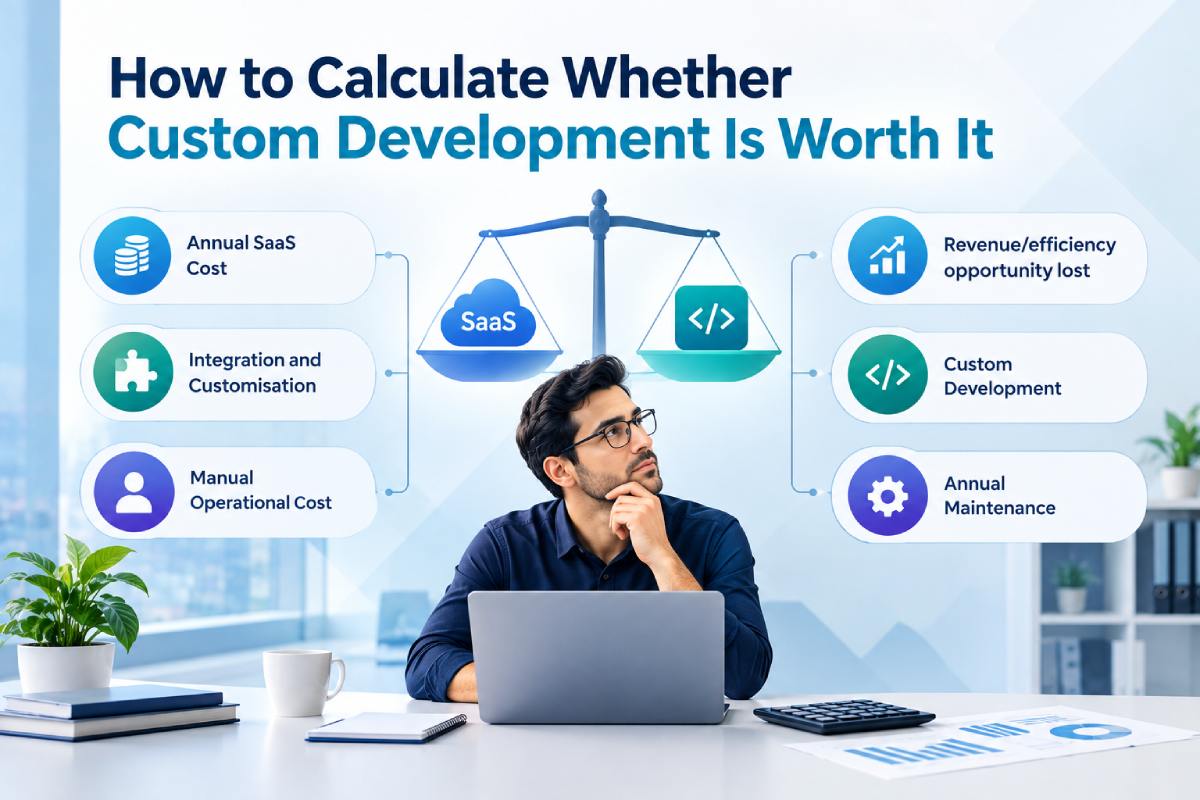
Use a simple business model.
Annual SaaS Cost
₹X per year
Integration and Customisation
₹Y per year
Manual Operational Cost
₹Z per year
Revenue/efficiency opportunity lost
₹A per year
Then estimate:
Custom Development
₹B initial investment
Annual Maintenance
₹C
Now compare the options over a three- to five-year period. Don’t assume that every benefit is financial.
Some benefits may include:
- faster processing
- fewer errors
- improved employee experience
- stronger customer experience
- better data ownership
- improved compliance
- faster product iteration
But where possible, convert these benefits into measurable financial values.
A Simple Decision Rule
You can use this starting rule:
Buy SaaS when:
The process is common + the product fits + speed matters + ownership isn’t strategically important.
Build custom when:
The process is unique + the workflow matters + SaaS creates costly constraints + the business can own the system.
Choose hybrid when:
Commodity functionality exists + the core workflow is differentiated.
This is usually more useful than treating the decision as an ideological choice between “build” and “buy.”
Custom Software vs SaaS: Which Is Better for Startups?
For most early-stage startups, SaaS software is usually the sensible default for non-differentiating functions.
Startups need to conserve:
- capital
- engineering resources
- management attention
There is little strategic value in spending months building software that already exists. However, if the startup’s product is the software, custom development is obviously central to the business.
The distinction is therefore:
- Build your product.
- Buy your infrastructure and commodity business tools where appropriate.
Custom Software vs SaaS: Which Is Better for SMEs?
SMEs should look at the point where SaaS limitations begin creating measurable costs. For SMEs, the SaaS vs custom software decision should be based on workflow fit, operational costs, scalability and the strategic importance of the software.
Questions to ask:
- Are employees maintaining spreadsheets around the SaaS?
- Are users paying for features they don’t need?
- Are critical workflows impossible to automate?
- Are integrations becoming fragile?
- Is data duplicated between systems?
- Is the subscription cost growing rapidly?
- Does the software constrain customer experience?
If the answer is consistently yes, custom or hybrid software may deserve evaluation.
Custom Software vs SaaS: Which Is Better for Enterprises?
Enterprise organisations often have more complex requirements around:
- identity
- access control
- integrations
- governance
- auditability
- data
- workflow
- reporting
- scalability
That doesn’t mean enterprises should build everything.
In fact, enterprise architecture often benefits from clearly separating: commodity capabilities from: differentiated capabilities Use mature products where standardisation provides value. Own the architecture where customisation provides strategic advantage.
Questions to Ask Before Buying SaaS
Before signing a contract, ask:
- Does the software support our critical workflows?
- What requires manual workarounds?
- How does pricing change as users increase?
- What integrations are available?
- Can all required data be exported?
- What happens if we cancel?
- Who owns the data?
- What security controls are provided?
- How frequently does the vendor change pricing?
- What happens if the vendor discontinues a feature?
- Can we customise permissions and workflows?
- What is the migration process if we leave?
These questions are particularly important when the SaaS platform becomes operationally critical.
Questions to Ask Before Building Custom Software
Before approving a custom development project, ask:
- What exact business problem are we solving?
- Why can’t an existing product solve it?
- Which workflows are genuinely unique?
- What is the expected business benefit?
- What is the three- to five-year TCO?
- Who owns the source code?
- Who will maintain it?
- What is the security architecture?
- What integrations are required?
- What is the MVP?
- What happens after launch?
- How will success be measured?
If the answers are unclear, the project may not yet be ready for development.
Custom Software vs SaaS: Final Decision Matrix
| If your situation looks like this | Consider |
| Standard workflow | SaaS |
| Need software immediately | SaaS |
| Limited technical resources | SaaS |
| Low strategic importance | SaaS |
| Unique business process | Custom |
| Software is competitive advantage | Custom |
| Deep internal integrations | Custom/Hybrid |
| Complex customer experience | Custom |
| High SaaS seat costs | Evaluate Custom |
| Heavy SaaS workarounds | Evaluate Custom |
| Commodity + differentiated requirements | Hybrid |
| Unclear requirements | Discovery first |
Frequently Asked Questions
Is custom software better than SaaS?
Not universally. SaaS is usually better for standardised business requirements where speed, convenience and lower initial investment matter. Custom software is generally better when workflows are unique, strategically important or difficult to support through existing platforms.
Is SaaS cheaper than custom software?
SaaS is usually cheaper to start, but that does not automatically make it cheaper over the long term. A proper comparison should include subscriptions, implementation, integrations, user growth, administrative effort, and switching costs alongside custom software development cost, infrastructure, and maintenance costs.
What does build vs buy software mean?
Build vs buy software refers to the decision between developing a software solution internally or through a development partner versus purchasing an existing software product such as SaaS. In 2026, many businesses should also evaluate a third option: buying standard capabilities and using custom software development for components that provide strategic value.
When should a business build custom software?
A business should consider custom software when its workflow is unique, strategically important, integration-heavy, highly specialised, or poorly supported by existing products. The expected business value should justify both development and ongoing ownership costs.
When should a business buy SaaS?
Buy SaaS when an established product already handles the required workflow with minimal compromises, the capability isn’t a competitive differentiator and rapid deployment is important.
Is hybrid software better than choosing SaaS or custom software?
For many organisations, it can be. A hybrid approach allows businesses to use SaaS software for commodity functions while using custom software development for differentiated workflows, customer experiences, or integrations.
Is custom software more secure than SaaS?
Not automatically. SaaS providers may have mature security operations, while custom software provides greater architectural control. Security depends on the actual architecture, implementation, access controls, infrastructure, monitoring, and operational practices.
Does custom software scale better than SaaS?
Either can scale effectively. SaaS providers typically handle infrastructure scaling, while custom software allows the architecture to be designed specifically around the application’s expected workloads. Poorly designed custom software can scale badly, so scalability must be deliberately engineered.
Can AI make custom software cheaper?
AI-assisted development can accelerate some development activities, particularly prototyping and certain coding tasks, but production software still requires requirements engineering, architecture, security, testing, deployment, and ongoing maintenance. Faster coding alone does not eliminate the total cost of software ownership.
Final Verdict: Build, Buy or Combine?
There is no universal winner in the custom software vs SaaS debate.
- If the software solves a common business problem and a mature SaaS product meets your requirements, buy it.
- If the software represents a unique workflow, customer experience, or competitive advantage that existing products cannot support effectively, custom software development may be the stronger option. Build it
- If your organisation needs both standard capabilities and differentiated workflows, combine them.
The most important decision is not the technology itself. It is identifying which parts of your business should be standardised and which parts deserve to be owned. A useful way to think about the decision is: Buy what commodity is. Build what differentiates you. Integrate where the two need to work together.
That approach prevents two expensive mistakes: building software that already exists and forcing strategically important business processes into software that was never designed for them.
Need Help Deciding Between Custom Software and SaaS?
If you are evaluating your options with a custom software development company in Mumbai, start by comparing your business requirements against SaaS, custom, and hybrid approaches before committing to development. If your organisation is currently evaluating a new business application, replacing an existing SaaS platform, or struggling with multiple disconnected systems, the right first step isn’t necessarily development. Start with a build-vs-buy assessment.
The assessment should map:
- Current business workflows
- User roles
- Existing SaaS tools
- Functional gaps
- Integration requirements
- Data architecture
- Security requirements
- Manual workarounds
- Current software costs
- Expected growth
- Custom development requirements
- Three- to five-year TCO
- SaaS, custom and hybrid options
The outcome should be a recommendation based on your actual operating model, not a generic argument for either SaaS or custom software.
Get a Custom Software vs SaaS Assessment
Tell us what you’re trying to build, replace, or integrate. We can help you determine whether SaaS, custom development, or a hybrid solution makes the stronger business case before you commit your budget. Contact Us Now.