
Introduction: Why Choosing the Wrong Software Development Company Can Cost More Than the Project Itself
Businesses today rely on software for almost every critical operation.
Whether it’s:
- customer management
- sales automation
- inventory control
- ecommerce operations
- analytics
- workflow automation
Software has become a competitive advantage rather than just a technology investment. However, many software projects fail, not because the idea is bad, but because the wrong development partner was selected.
Research consistently shows that software projects often exceed budgets, miss deadlines, or fail to deliver expected business outcomes. In many cases, the root cause is not technology itself but poor planning, weak communication, unrealistic expectations, or a lack of technical expertise from the development partner. A software development company is not simply a vendor that writes code. It becomes a strategic partner responsible for translating business goals into scalable technology solutions.
The difference between choosing the right partner and the wrong partner can mean:
Success
- scalable software
- improved efficiency
- competitive advantage
- measurable ROI
Failure
- budget overruns
- security issues
- technical debt
- poor user adoption
This guide explains how businesses can evaluate software development companies effectively and choose a partner capable of delivering long-term value.
Why Choosing the Right Software Development Company in Mumbai Matters?
Many businesses evaluate software vendors based primarily on pricing. While cost is important, it should rarely be the primary decision factor. Software systems often become deeply integrated into daily business operations. Once implemented, changing vendors can be expensive, disruptive, and risky.
Choosing the right development company impacts:
- project success
- scalability
- security
- user adoption
- long-term maintenance costs
A lower-cost vendor may initially appear attractive, but can create high costs later through poor architecture, limited scalability, and technical issues. Understanding how to choose a software company helps businesses reduce risks and build technology that supports sustainable long-term growth. Understanding Different Types of Software Development Companies
Software Development Is a Long-Term Investment
Unlike many marketing initiatives, software often remains operational for years.
A CRM platform developed today may support operations for:
- 5 years
- 10 years
- or longer
The architecture decisions made during development influence:
- future enhancements
- performance
- security
- maintenance requirements
This is why selecting a software partner requires strategic thinking rather than short-term budgeting.
The Hidden Cost of Choosing the Wrong Vendor
Businesses often focus on project costs while ignoring failure costs.
Examples include:
Delayed Launches
Lost revenue opportunities.
Poor User Adoption
Employees refuse to use the system.
Scalability Issues
Performance deteriorates as usage grows.
Security Vulnerabilities
Risk of data breaches.
Technical Debt
Future changes become expensive.
The cheapest proposal can ultimately become the most expensive decision.
Understanding Different Types of Software Development Companies
Before evaluating providers, businesses should understand that software companies are not all the same. Different firms specialize in different project types. Selecting a company without relevant expertise often leads to poor outcomes. Knowing how to choose a software company starts with identifying providers whose expertise aligns with your project’s technical requirements and business objectives.
Product Development Companies
These companies focus on building software products intended for large user bases.
Examples include:
- SaaS platforms
- mobile applications
- subscription software
- digital products
They typically excel at:
- product strategy
- user experience
- scalability
- cloud architecture
Custom Software Development Companies
These firms build software tailored to specific business requirements.
Projects may include:
- CRM systems
- ERP platforms
- workflow automation
- customer portals
- inventory management systems
Their strength lies in understanding unique business processes.
Enterprise Software Development Companies
Enterprise-focused firms specialize in large-scale software environments.
Projects often involve:
- thousands of users
- multiple departments
- advanced integrations
- high-security requirements
These companies usually provide deeper expertise in:
- scalability
- infrastructure
- enterprise architecture
- compliance
Digital Transformation Companies
These organizations focus on helping businesses modernize operations through technology.
Services often include:
- software development
- process automation
- cloud migration
- AI integration
- data analytics
They are often strategic partners rather than purely development vendors.
Step 1: Define Your Software Requirements Before Contacting Vendors
One of the biggest mistakes businesses make is approaching software companies before fully understanding their own requirements.
This often results in:
- inaccurate proposals
- unrealistic budgets
- misaligned expectations
The clearer your requirements, the more accurate vendor evaluations become.
Start With Business Problems
Instead of beginning with features, start with objectives.
Ask:
What problem are we solving?
For example:
Current Problem:
- Manual sales tracking.
- Desired Outcome:
- Automated lead management.
What Business Impact Is Expected?
Examples:
- Reduce operational costs
- Improve customer experience
- Increase sales productivity
- eliminate manual processes
The software should serve business goals rather than technology goals.
Document Core Requirements
Create a requirements list including:
User Types
Who will use the software?
Workflows
How should processes function?
Integrations
What systems must connect?
Security Requirements
What data requires protection?
Reporting Needs
What insights are required?
This preparation significantly improves project success rates.
Step 2: Evaluate Industry Experience
Not all software development experience is equally valuable. A company may have built dozens of projects but still lack expertise relevant to your industry.
Why Industry Knowledge Matters?
Industry-specific experience accelerates development because the vendor already understands common workflows and challenges.
Examples:
Healthcare
- Patient management
- Compliance
- Appointments
Finance
- Security
- Transactions
- Regulatory requirements
Ecommerce
- Payments
- Inventory
- Order processing
Manufacturing
- Supply chains
- Inventory systems
- Production workflows
The learning curve becomes much shorter.
Questions to Ask
- Have you worked in our industry before?
- Can you show similar projects?
- What challenges did you solve?
- What lessons did you learn?
Experienced vendors provide detailed, practical answers rather than generic responses.
Step 3: Assess Technical Expertise
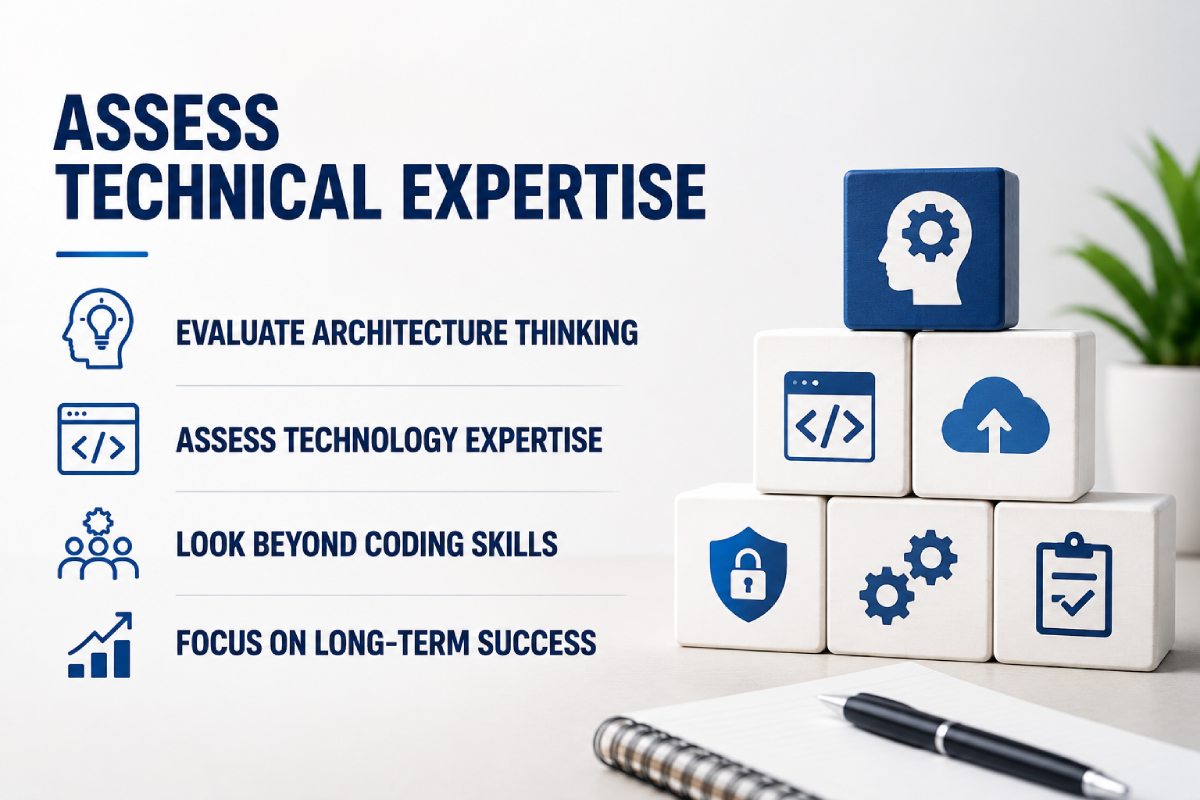
Technical capability is one of the strongest indicators of long-term project success. A vendor’s ability to build software today matters. Their ability to support growth tomorrow matters even more.
Evaluate Architecture Thinking
Strong software companies discuss:
- scalability
- maintainability
- performance
- security
before discussing technology stacks. This demonstrates strategic thinking.
Assess Technology Expertise
Common technologies include:
Frontend
- React
- Angular
- Vue
Backend
- Node.js
- Python
- .NET
- Java
Databases
- PostgreSQL
- MySQL
- MongoDB
Cloud
- AWS
- Azure
- Google Cloud
The specific technology matters less than whether it aligns with project goals.
Look Beyond Coding Skills
Modern software projects require expertise in:
- architecture
- DevOps
- cloud infrastructure
- security
- testing
- UX design
Development is much more than writing code.
Step 4: Understand the Enterprise Software Development Process
One of the biggest mistakes businesses make is evaluating software companies solely based on technical skills without understanding their development process. Even highly skilled developers can struggle to deliver successful projects if the process itself is weak.
A structured software development process reduces risk, improves communication, and increases the likelihood of delivering software that meets business objectives. The best software development company in Mumbai follows a systematic framework rather than jumping directly into coding.
Why Process Matters More Than Coding?
Many clients assume software development begins with coding. In reality, coding often represents only 30–40% of the project.
The remaining effort involves:
- discovery
- planning
- architecture
- testing
- deployment
- optimization
Without these stages, projects frequently encounter:
- scope creep
- budget overruns
- delays
- poor user adoption
A mature development process minimizes these risks.
Enterprise Software Development Framework
Stage 1: Discovery & Requirement Analysis
This phase focuses on understanding:
- business goals
- user needs
- workflows
- challenges
The development team should ask:
- What business problem are we solving?
- What measurable outcomes are expected?
- Who will use the system?
- How will success be measured?
This phase forms the foundation for every future decision.
Stage 2: Architecture Planning
Before writing code, the software architecture must be designed.
This includes:
- technology selection
- database design
- infrastructure planning
- integration strategy
- scalability planning
Poor architecture decisions create long-term technical debt that becomes expensive to fix later.
Strong software companies invest heavily in architecture planning because it influences:
- performance
- scalability
- maintenance costs
- future flexibility
Stage 3: UI/UX Design
Many software projects fail because users dislike the experience. A strong software company prioritizes user experience before development begins.
This stage includes:
- wireframes
- user journeys
- interface design
- usability validation
The objective is ensuring users can complete tasks efficiently.
Stage 4: Development
Only after planning and design are completed should development begin.
This phase includes:
- frontend development
- backend development
- API development
- integrations
- database implementation
The best companies develop in stages and gather feedback continuously.
Stage 5: Testing & Quality Assurance
Testing is one of the most overlooked aspects of software development.
A mature testing process includes:
- functional testing
- performance testing
- security testing
- integration testing
- user acceptance testing
The goal is preventing issues from reaching production environments.
Stage 6: Deployment & Monitoring
Launching software is not the end of the project.
The software must be monitored continuously to ensure:
- stability
- performance
- security
- reliability
Leading software companies implement monitoring systems from day one.
Step 5: Evaluate Security & Scalability Capabilities
Many businesses only evaluate features.
Enterprise buyers evaluate:
- security
- scalability
- reliability
because these factors determine long-term success.
Why Security Should Be a Priority?
A security breach can create:
- financial losses
- reputational damage
- legal consequences
- operational disruptions
The larger the business, the greater the impact.
Security Questions to Ask
Data Protection
How is sensitive information stored?
Encryption
Is data encrypted in transit and at rest?
Authentication
How is user access managed?
Compliance
Do you support industry compliance requirements?
Backup Systems
What disaster recovery procedures exist?
Strong software companies answer these questions confidently and specifically.
Example
A CRM containing customer information requires:
- secure authentication
- encrypted databases
- role-based access controls
- audit trails
Without these controls, risk increases significantly.
Why Scalability Matters?
Many software systems perform well initially but struggle as usage increases. Scalability determines whether software can grow alongside the business.
Common Scalability Challenges
Increased Users
More users create greater load.
Larger Databases
Performance can decline as data grows.
New Features
Architecture must support expansion.
Geographic Growth
Systems may need global access.
A scalable system anticipates future growth rather than reacting to it.
Questions to Ask About Scalability
- How many users can the system support?
- How does the architecture scale?
- What happens if usage doubles?
- What cloud infrastructure is used?
- How are performance bottlenecks identified?
The quality of these answers often reveals the maturity of the software company.
Step 6: Understand Development Methodologies
Software development methodologies influence:
- communication
- timelines
- flexibility
- project outcomes
Businesses should understand how a vendor approaches project execution.
Agile Development
Agile is currently the most widely used methodology. Rather than delivering everything at the end, development occurs in short cycles called sprints. Each sprint produces working functionality.
Advantages of Agile
Faster Feedback
Clients see progress regularly.
Greater Flexibility
Changes can be incorporated throughout the project.
Lower Risk
Problems are identified earlier.
Improved Collaboration
Business stakeholders remain involved.
Example
Instead of waiting six months for delivery:
- Month 1 → User Management
- Month 2 → Reporting
- Month 3 → Integrations
This creates visibility and reduces uncertainty.
Waterfall Development
Waterfall follows a sequential process. Requirements are finalized before development begins. Changes become difficult later.
Advantages of Waterfall
Predictability
Clear timelines and scope.
Documentation
Extensive planning.
Suitable for Fixed Requirements
Works well when requirements rarely change.
Limitations
Modern software projects often evolve during development. This makes Waterfall less flexible than Agile.
Which Is Better? For most software projects in 2026:
Agile is generally preferred because business requirements frequently change. However, certain enterprise or compliance-driven projects may still benefit from Waterfall methodologies. The key is selecting a company that understands when each approach is appropriate.
Step 7: Evaluate Team Structure
A strong software project requires more than developers.
Businesses often assume:
More developers = Better outcomes.
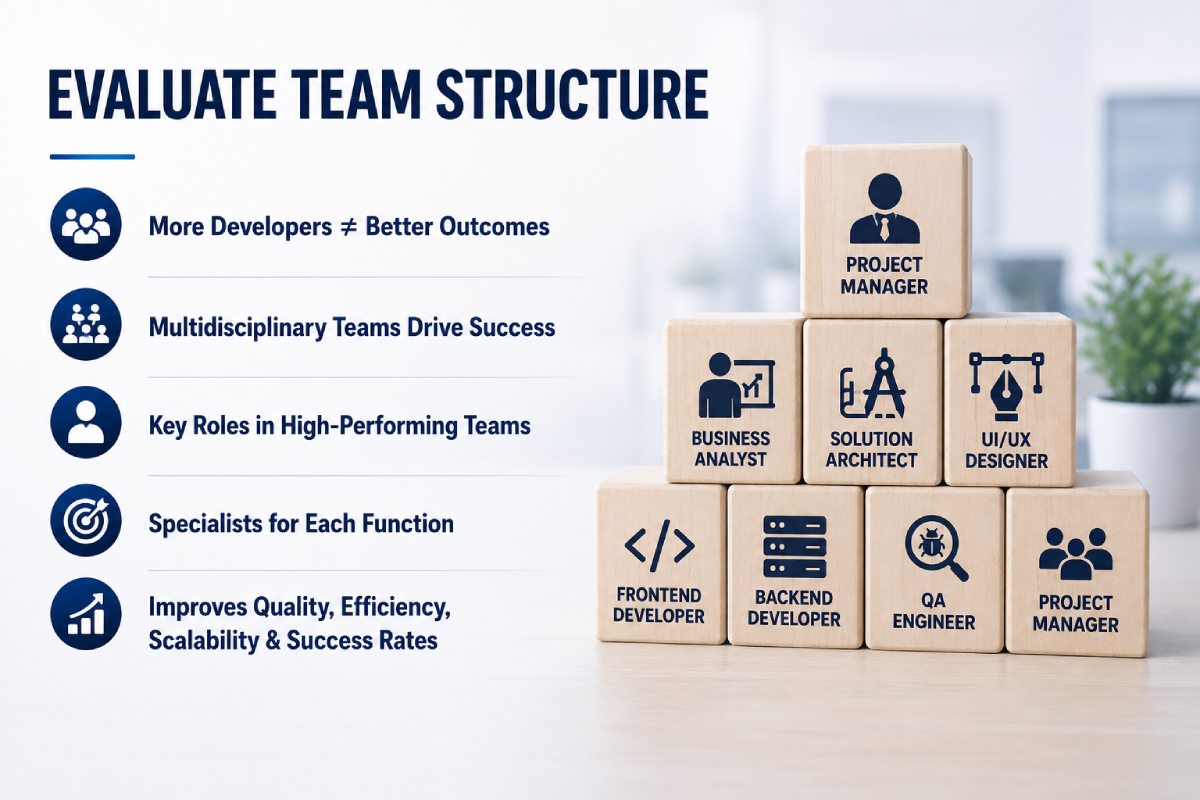
This is rarely true. Successful projects depend on multidisciplinary teams.
Key Roles in High-Performing Teams
Business Analyst
Translates business requirements into technical requirements.
Solution Architect
Designs the overall system architecture.
UI/UX Designer
Creates user-friendly experiences.
Frontend Developers
Build user interfaces.
Backend Developers
Develop application logic.
QA Engineers
Ensure quality and reliability.
Project Managers
Coordinate communication and timelines.
Why Team Structure Matters?
A freelancer may handle several roles simultaneously. An experienced software development company provides specialists for each function.
This improves:
- quality
- efficiency
- scalability
- project success rates
Step 8: Questions to Ask Before Hiring a Software Development Company
Before signing a contract, businesses should conduct thorough due diligence.
Technical Questions
- What architecture do you recommend?
- Why is this technology stack suitable?
- How will scalability be handled?
- How will security be managed?
Project Management Questions
- How frequently will progress be reported?
- Who will be our point of contact?
- How are changes managed?
- How do you handle delays?
Support Questions
- What happens after launch?
- Do you provide maintenance?
- How are bugs handled?
- What support SLAs are available?
Business Questions
- Have you solved similar problems before?
- Can you show relevant case studies?
- What measurable outcomes have clients achieved?
- The quality of responses often reveals more than the answers themselves.
Step 9: Red Flags to Avoid When Hiring a Software Development Company
Choosing the wrong software development company can result in budget overruns, delayed launches, security vulnerabilities, and software that fails to deliver business value. Many warning signs appear early in the evaluation process if you know what to look for. Businesses should pay as much attention to red flags as they do to strengths.
Red Flag #1: Immediate Pricing Without Understanding Requirements
A reputable software company rarely provides an accurate quote within minutes of an initial conversation.
Enterprise software projects involve:
- business workflows
- integrations
- scalability requirements
- user roles
- reporting needs
If a vendor provides pricing without asking detailed questions, it often indicates a template-based approach rather than a strategic development process.
What Good Companies Do?
They spend time understanding:
- business objectives
- workflows
- technical requirements
- expected outcomes
- before estimating cost.
Red Flag #2: Overpromising Timelines
Many vendors win projects by promising unrealistic delivery schedules.
Examples:
- “Enterprise CRM in 4 weeks”
- “Complete ERP in 30 days”
- “Marketplace platform in 6 weeks”
Complex software requires:
- planning
- architecture
- design
- development
- testing
Rushing these stages typically creates technical debt and quality issues.
Key Insight
A realistic timeline often reflects greater professionalism than an aggressive timeline.
Red Flag #3: No Discussion About Scalability
Many software companies focus only on current requirements.
Strong vendors discuss:
- future growth
- scaling challenges
- infrastructure planning
- performance optimization
before development begins. If scalability is never mentioned, future expansion may become expensive and difficult.
Red Flag #4: No Security Framework
Security should never be an afterthought.
A professional software company should be able to explain:
- authentication methods
- authorization models
- encryption practices
- backup procedures
- disaster recovery planning
- without hesitation.
If security discussions are vague, risk increases significantly.
Red Flag #5: Lack of Technical Transparency
Businesses should understand:
- architecture decisions
- technology choices
- development methodology
- deployment strategy
Some vendors intentionally keep clients dependent on them by limiting transparency. Strong partners educate clients rather than creating dependency.
Red Flag #6: No QA or Testing Process
Software inevitably contains bugs.The difference between strong and weak vendors is their testing discipline.
Ask about:
- automated testing
- performance testing
- user acceptance testing
- security testing
A company without a structured QA process introduces unnecessary risk.
Software Development Pricing Models Explained
Many businesses compare vendors without understanding how pricing models work. The same project may be quoted differently depending on the engagement structure. Choosing the right pricing model can significantly impact cost, flexibility, and project outcomes. Comparing software development services in mumbai helps businesses select pricing models that balance flexibility, scalability, and long-term value.How to Choose the Best Software Development Company in Mumbai
Fixed Cost Model
What Is Fixed Cost Development?
A fixed-cost project has:
- defined scope
- predefined deliverables
- agreed budget
- agreed timeline
The project cost remains relatively stable as long as requirements remain unchanged.
Best For
- small projects
- clearly defined requirements
- limited scope
- short timelines
Advantages
Budget Predictability
Costs are known upfront.
Easier Procurement
Approval processes become simpler.
Defined Expectations
Deliverables are documented clearly.
Limitations
Reduced Flexibility
Changes may require additional budgets.
Scope Constraints
Innovation can become restricted.
Time & Material Model
What Is Time & Material Pricing?
Under this model, clients pay for actual work performed.
Charges typically depend on:
- hours worked
- team members involved
- project duration
Best For
- evolving projects
- startups
- innovation initiatives
- custom software
Advantages
- Greater Flexibility
- Requirements can evolve.
- Faster Iteration
- Changes are easier to implement.
- Better Product Development
- Allows continuous improvement.
Challenges
- Variable Cost
- Budget forecasting becomes more complex.
- Strong Management Required
- Project oversight becomes important.
Dedicated Development Team Model
What Is a Dedicated Team?
Instead of purchasing a project, businesses effectively hire a development team.
The team may include:
- developers
- architects
- designers
- QA engineers
- project managers
working exclusively on the client’s initiatives.
Best For
- enterprise organizations
- long-term projects
- product development
- digital transformation initiatives
Advantages
Maximum Flexibility
Teams adapt continuously.
Faster Scaling
Resources can expand as needed.
Deep Product Knowledge
Teams become highly familiar with business requirements.
Challenges
Higher Investment
Requires larger budgets.
Long-Term Commitment
Best suited for ongoing initiatives.
Cost vs Value: The Framework Most Businesses Ignore
One of the biggest software purchasing mistakes is focusing entirely on project cost. The more important metric is value.
Example
Vendor A
Project Cost: ₹10 Lakhs
Outcome:
- unstable software
- scalability issues
- frequent maintenance
Vendor B
Project Cost: ₹18 Lakhs
Outcome:
- scalable architecture
- secure infrastructure
- lower maintenance costs
- higher user adoption
Over five years, Vendor B may actually cost less while generating significantly greater business value.
Evaluate Total Cost of Ownership (TCO)
Software cost extends beyond development.
Businesses should evaluate:
Initial Development
Project cost.
Maintenance
Ongoing updates and support.
Infrastructure
Cloud hosting and monitoring.
Enhancements
Future feature development.
Downtime Costs
Operational impact of failures.
The cheapest proposal rarely represents the lowest total cost.
Vendor Comparison Scorecard
Businesses evaluating multiple vendors should use a structured scoring system.
Suggested Evaluation Framework
| Criteria | Weight |
| Technical Expertise | 20% |
| Industry Experience | 15% |
| Scalability Knowledge | 15% |
| Security Capability | 15% |
| Project Management | 10% |
| Communication | 10% |
| Portfolio Quality | 10% |
| Pricing Structure | 5% |
Why Scorecards Work?
Without a framework, decisions become subjective.
Businesses often select vendors based on:
- presentation quality
- personal rapport
- pricing
A scorecard creates objective evaluation criteria.
How to Choose the Best Software Development Company in Mumbai?
After evaluating multiple vendors, businesses should narrow decisions using a strategic framework. Businesses learning how to choose a software company should compare technical expertise, communication, and proven results while evaluating software development services in Mumbai that align with long-term operational and growth objectives.
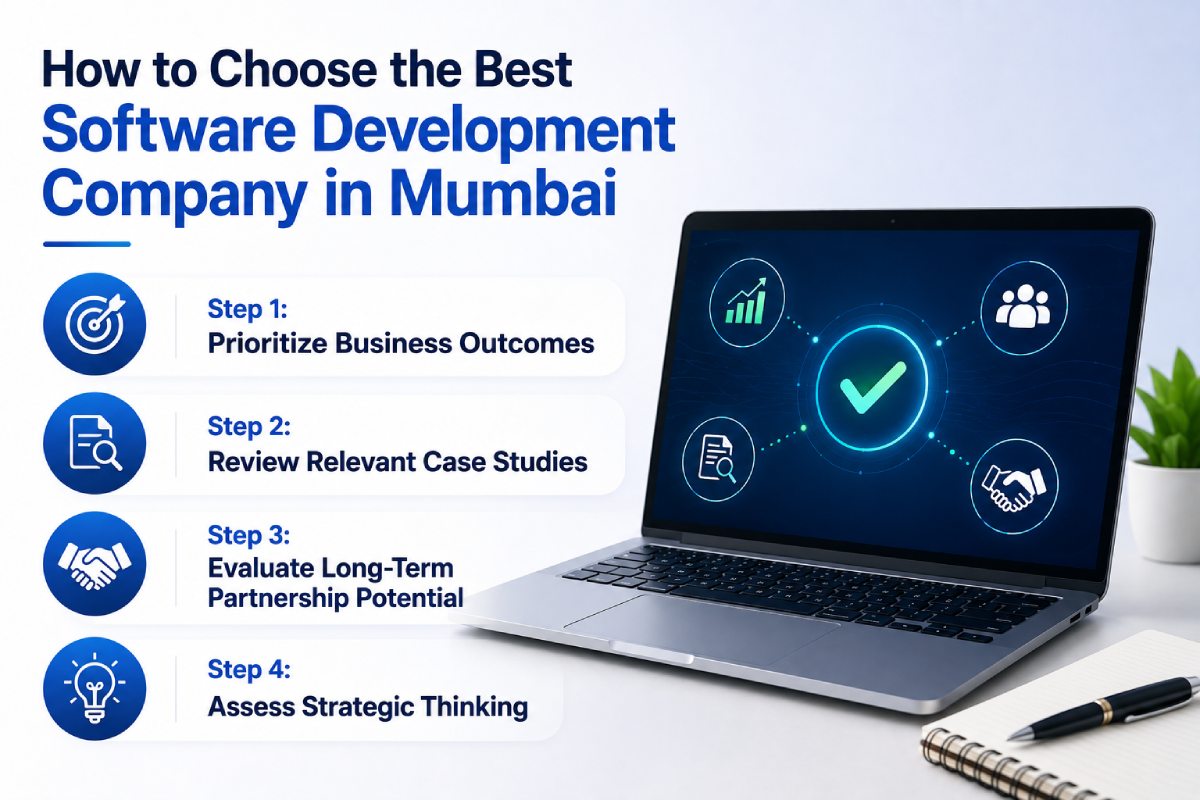
Step 1: Prioritize Business Outcomes
Focus on:
- efficiency improvements
- revenue generation
- operational scalability
- rather than features alone.
Step 2: Review Relevant Case Studies
Look for examples demonstrating:
- similar business challenges
- measurable outcomes
- technical complexity
Strong case studies often reveal more than sales presentations.
Step 3: Evaluate Long-Term Partnership Potential
Software is rarely a one-time project.
Ask:
- Can this company support us for 3–5 years?
- Do they understand our industry?
- Can they scale alongside our business?
Step 4: Assess Strategic Thinking
The best software companies challenge assumptions.
They ask:
- Why is this feature needed?
- What business outcome does it support?
- Is there a better approach?
Strategic thinking often separates exceptional vendors from average ones.
How Ideamagix Delivers Software Development Solutions
At Ideamagix, software development begins with business objectives rather than technology choices. We focus on building systems that improve operational efficiency, support growth, and generate measurable business value.
Our Development Framework
Discovery
↓
Business Analysis
↓
Architecture Planning
↓
UI/UX Design
↓
Development
↓
Testing & QA
↓
Deployment
↓
Continuous Optimization
What We Focus On?
Business-Centric Development
Technology aligned with business goals.
Scalable Architecture
Systems built for future growth.
Security-First Development
Security integrated from the beginning.
Performance Optimization
Reliable and efficient software.
AI Integration
Future-ready solutions leveraging automation and intelligence.
Our Goal
Software
↓
Efficiency
↓
Automation
↓
Growth
↓
Revenue
Because software should be more than code, it should be a competitive advantage. Our software development services in Mumbai focus on scalable, reliable, business-driven software solutions.
Conclusion
The best software development company is not necessarily the largest, the cheapest, or the most well-known.
It is the company that:
- understands your business
- designs scalable solutions
- prioritizes security
- communicates effectively
- supports long-term growth
Selecting the right software development partner can transform operations, improve customer experiences, and create sustainable competitive advantages. The decision should be based on value, expertise, and partnership potential, not simply project cost.
FAQs
1. How do I choose the best software development company in Mumbai?
The best software development company should demonstrate technical expertise, industry experience, strong communication practices, and a structured development process. Businesses should evaluate case studies, architecture capabilities, security practices, and scalability knowledge before making a decision. It is also important to assess how the company approaches problem-solving rather than focusing solely on coding skills. The strongest partners align technology decisions with business objectives and long-term growth plans.
2. How much does custom software development cost in Mumbai?
Custom software development costs vary significantly depending on complexity, integrations, scalability requirements, and team size. Small business applications may start from ₹3–10 lakhs, while enterprise systems can range from ₹25 lakhs to several crores. Factors such as cloud infrastructure, security requirements, AI capabilities, and ongoing support also influence pricing. Businesses should evaluate ROI and long-term value rather than comparing vendors solely on upfront cost.
3. What is the typical timeline for enterprise software development?
Enterprise software projects generally take between 3 and 12 months, depending on complexity and scope. Discovery, architecture planning, UI/UX design, development, testing, and deployment all contribute to timelines. Large-scale systems with multiple integrations often require phased implementations. Companies that rush development frequently encounter higher costs and technical debt later.
4. What development methodology is best: Agile or Waterfall?
For most modern software projects, Agile is preferred because it allows continuous feedback, iterative development, and flexibility. Waterfall can still be effective for projects with fixed requirements and strict compliance needs. The best development companies understand when each methodology is appropriate rather than applying one approach universally.
5. Why is scalability important in software development?
Scalability ensures software can handle growth without performance degradation. As users, transactions, and data volumes increase, poorly designed systems often become unstable. Scalable architecture allows businesses to expand without rebuilding core systems. It also reduces future infrastructure and development costs.
6. What security features should enterprise software include?
Enterprise software should include encryption, role-based access control, multi-factor authentication, audit logs, secure APIs, backup systems, and disaster recovery planning. Security must be built into architecture and development processes rather than added after launch. Strong security frameworks protect businesses from operational, legal, and reputational risks.
7. Should I hire a freelancer or a software development company?
Freelancers can be suitable for small projects with limited requirements. However, complex systems typically require multidisciplinary teams including architects, developers, QA engineers, designers, and project managers. Software development companies provide broader expertise and stronger scalability support.
8. What questions should I ask before hiring a software company?
Ask about architecture recommendations, technology choices, scalability planning, security measures, project management processes, support structures, and similar projects completed. Detailed and confident answers often indicate a mature and experienced development team.
9. Can AI be integrated into custom software applications?
Yes. Modern software solutions increasingly incorporate AI features such as chatbots, recommendation engines, workflow automation, predictive analytics, and intelligent reporting. AI integration can improve efficiency, reduce manual work, and create competitive advantages.
10. What makes a software development project successful?
Successful projects typically share several characteristics: clear requirements, strong stakeholder involvement, scalable architecture, rigorous testing, effective communication, and continuous optimization. The development partner’s ability to align technology with business outcomes is often the strongest predictor of success.