
Enterprise software development is fundamentally different from traditional application development. It is not just about building software; it is about designing high-performance, scalable, secure systems that can support complex business operations at scale.
In 2026, enterprise businesses are investing heavily in custom software to:
- automate operations
- improve efficiency
- scale globally
- gain a competitive advantage
However, building enterprise-grade software requires a deep understanding of:
- architecture design
- scalability planning
- security frameworks
- system integration
- long-term maintainability
This guide breaks down everything you need to know to build robust, future-ready enterprise software systems.
What Is Enterprise Software Development?
Enterprise software development is the process of designing, building, and maintaining large-scale digital systems that support core business operations across departments, geographies, and user groups. Unlike standard applications, enterprise systems are deeply embedded into the organization’s workflow, often becoming the backbone of decision-making, automation, and revenue generation.
At an enterprise level, software is not just a tool; it is an operational infrastructure layer that integrates people, processes, and data. These systems must be capable of handling unpredictable demand, evolving business requirements, and continuous scaling without compromising performance or security.
What makes enterprise software fundamentally different is the level of complexity and risk involved. A failure in a small application may cause inconvenience, but a failure in enterprise software can disrupt entire business operations, impact revenue, and damage customer trust.
Enterprise Software Must Handle:
- Thousands to millions of concurrent users
- requiring real-time processing
- ensuring consistent performance under load
- High volumes of structured and unstructured data
- transactional data
- user-generated content
- analytics pipelines
- Multiple system integrations
- CRMs, ERPs, payment systems
- third-party APIs
- internal tools
- Complex business logic
- workflows
- automation rules
- decision engines
Strategic Insight:
Enterprise software is not built for “use”; it is built for scale, resilience, and continuous evolution.
Key Characteristics of Enterprise Software
Enterprise applications are engineered with a fundamentally different mindset compared to traditional applications. Every decision, from architecture to UI, is influenced by scalability, security, and long-term maintainability.
Core Characteristics (Explained in Depth)
1. High Scalability
Enterprise systems must support rapid growth without requiring a complete rebuild. This means:
- handling traffic spikes (e.g., sales events)
- scaling across regions
- supporting growing datasets
A system that cannot scale becomes a bottleneck to business growth.
2. Strong Security Protocols
Security is not an add-on; it is embedded into every layer of enterprise software.
- data encryption (at rest and in transit)
- access control systems
- compliance with global standards
Enterprise systems often deal with sensitive data, making them prime targets for attacks.
3. Modular Architecture
Instead of building one large system, enterprise applications are divided into smaller modules.
- independent components
- easier updates and maintenance
- faster feature deployment
This modular approach ensures that changes in one part of the system do not break the entire application.
4. Multi-User Support
Enterprise software must support:
- multiple roles (admin, manager, user)
- concurrent usage
- access control across teams
This requires sophisticated session management and permission systems.
5. Integration with Multiple Systems
Enterprise ecosystems are interconnected.
- CRM + ERP + marketing tools
- payment systems + analytics platforms
- third-party integrations
The software must act as a central hub that connects all business systems seamlessly.
Real-World Example: Enterprise CRM System
An enterprise CRM is far more complex than a basic customer database.
It:
- manages customer interactions across sales, marketing, and support
- integrates with email systems, ad platforms, and analytics tools
- tracks customer journeys across multiple touchpoints
- supports thousands of users across departments
What This Enables:
- unified customer view
- better decision-making
- improved customer experience
- higher conversion rates
Key Insight:
Enterprise software is not built for isolated functionality; it is designed to deliver performance, scalability, and reliability at an organizational scale.
Enterprise Software Architecture: The Foundation of Scalability
Architecture is the single most important decision in enterprise application development. It defines how the system behaves under load, how easily it can scale, and how expensive it becomes to maintain over time.
A poorly designed architecture often leads to:
- performance bottlenecks under traffic spikes
- system failures during peak usage
- increasing technical debt
- rising maintenance costs
On the other hand, a well-designed architecture enables:
- seamless scalability
- faster feature releases
- lower long-term costs
- higher system reliability
Strategic Insight:
Architecture decisions made in the early stages can determine the success or failure of the system for years.
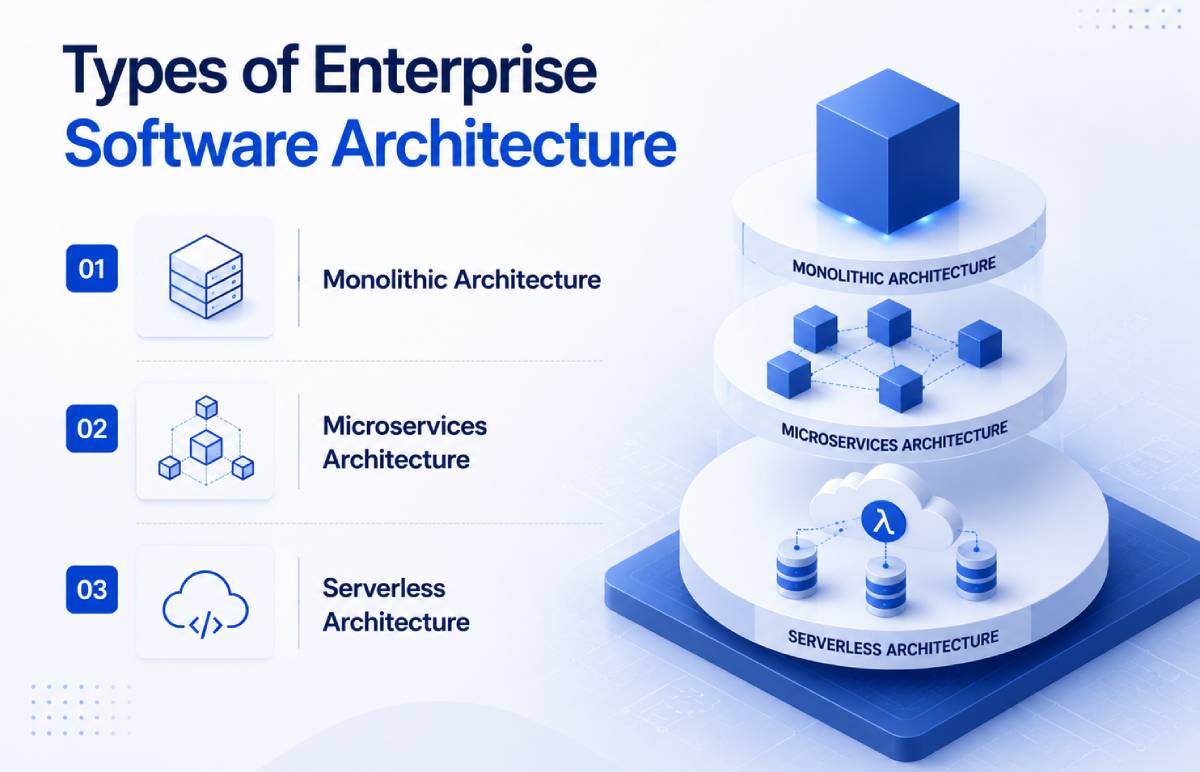
Types of Enterprise Software Architecture
1. Monolithic Architecture
A monolithic architecture is built as a single unified system, where all components are tightly coupled and operate as one unit.
How It Works:
- frontend + backend + database are interconnected
- Any change affects the entire system
- deployed as one application
Advantages:
- simpler initial development
- easier debugging (in early stages)
- faster to launch MVP
Limitations:
- difficult to scale specific components
- slow development cycles as the system grows
- high risk of system-wide failures
Reality Check:
Monolithic architecture works for small systems but becomes a major bottleneck at scale.
2. Microservices Architecture
Microservices architecture breaks the system into independent, loosely coupled services, each responsible for a specific function.
How It Works:
- Each service runs independently
- services communicate via APIs
- Teams can work on different services simultaneously
Advantages:
- highly scalable (scale only what is needed)
- faster deployment cycles
- easier maintenance
- fault isolation (one failure doesn’t crash the entire system)
Challenges:
- increased complexity in management
- requires strong DevOps practices
- Higher initial setup cost
Example:
- An e-commerce platform:
- product service
- payment service
- user service
Each operates independently and scales based on demand.
Best Practice:
Microservices are the preferred architecture for enterprise systems due to flexibility and scalability.
3. Serverless Architecture
Serverless architecture allows developers to build applications without managing servers.
How It Works:
- The cloud provider handles the infrastructure
- Functions run on demand
- Billing is based on usage
Advantages:
- automatic scaling
- cost efficiency
- Reduced infrastructure management
Limitations:
- limited customization
- dependency on the cloud provider
- potential latency issues
Use Case:
Best for:
- event-driven applications
- lightweight services
- startups experimenting with scale
Key Insight:
Modern enterprise systems often use a hybrid approach combining microservices + serverless for maximum efficiency.
Scalable Software Architecture: How to Build Systems That Grow
scalable software architecture ensures that your software can handle increasing demand without performance degradation. In enterprise environments, traffic is unpredictable, and systems must be prepared to handle both steady growth and sudden spikes.
Critical Reality:
Most systems fail not because of poor features, but because they cannot scale under real-world demand.
Types of Scalability
Vertical Scaling (Scaling Up)
This involves increasing the capacity of a single server.
- more CPU
- more RAM
- better hardware
Benefits:
- simple implementation
- no major architecture changes
Limitations:
- hardware limits
- expensive
- single point of failure
Horizontal Scaling (Scaling Out)
This involves adding multiple servers to distribute the load.
Benefits:
- virtually unlimited scalability
- better fault tolerance
- improved performance
Challenges:
- Requires a distributed system design
complex architecture
Enterprise Standard:
Most enterprise systems rely on horizontal scaling for long-term growth.
Key Components of Scalable Systems
1. Load Balancing
Load balancers distribute incoming traffic across multiple servers.
Why It Matters:
- prevents server overload
- improves response time
- ensures high availability
Caching Mechanisms
Caching stores frequently accessed data to reduce processing time.
Types of Caching:
- browser caching
- server caching
- database caching
Impact:
- faster load times
- reduced server load
- improved user experience
Database Optimization
Databases are often the biggest bottleneck in scaling.
Optimization Techniques:
- indexing
- query optimization
- database sharding
- distributed databases
Example:
Without optimization:
- slow queries
- system lag
- With optimization:
- faster data retrieval
- better performance
4. API Management
APIs enable communication between services.
Why It Matters:
- ensures smooth integration
- supports microservices architecture
- improves scalability
Best Practices:
- rate limiting
- version control
- monitoring
Real-World Example: Scalable E-commerce Platform
An enterprise e-commerce platform:
- handles 10,000 users daily
- scales to 1,00,000+ users during peak sales
- uses load balancing + caching + microservices
Result:
- zero downtime during peak traffic
- consistent performance
- Higher revenue generation
Key Insight:
Scalability is not something you “add later.”
It must be architected into the system from day one.
Security in Enterprise Software Development
Security in enterprise software is not just a technical requirement; it is a business-critical function that directly impacts trust, compliance, and long-term sustainability. In enterprise environments, systems often process highly sensitive data such as financial records, customer information, intellectual property, and operational workflows. A single vulnerability can expose the entire organization to serious risks.
The cost of a security breach goes far beyond immediate financial loss. It can lead to regulatory penalties, legal action, customer churn, and irreversible brand damage. This is why modern enterprise software adopts a “security-first” approach, where protection mechanisms are embedded at every stage of the development lifecycle.
Risks of Poor Security
- Financial Loss
fraud, data theft, operational downtime
- Legal Consequences
non-compliance penalties (GDPR, data laws)
- Reputational Damage
loss of customer trust and market credibility
Strategic Insight:
Security is not a feature; it is an architecture-level decision that must be built into the system from day one.
Key Security Layers
Enterprise-grade security is implemented through multiple layers, each designed to protect specific aspects of the system.
1. Data Encryption
Data encryption ensures that sensitive information remains protected even if unauthorized access occurs.
Types of Encryption:
- Data at Rest
- protects stored data in databases
- Data in Transit
secures communication between systems (SSL/TLS)
Why It Matters:
- prevents data leaks
- ensures secure transactions
- protects user privacy
Without encryption, even a minor breach can expose critical business data.
2. Authentication & Authorization
Authentication verifies who the user is, while authorization determines what they are allowed to do.
Key Components:
- Role-Based Access Control (RBAC)
- different access levels (admin, manager, user)
- Multi-Factor Authentication (MFA)
- adds an extra layer of protection
- Single Sign-On (SSO)
- Improves user experience with centralized login
Impact:
- prevents unauthorized access
- reduces insider threats
- enhances user security
In enterprise systems, access control must be granular and dynamic.
3. Secure APIs
APIs are the backbone of modern enterprise systems, but they are also a major security vulnerability if not properly managed.
API Security Measures:
- authentication tokens (OAuth, JWT)
- rate limiting
- input validation
- encryption of API communication
Why It Matters:
- prevents data exposure
- secures system integrations
- protects against malicious attacks
Poor API security can expose entire systems to external threats.
4. Compliance Standards
Enterprise software must adhere to global and industry-specific compliance regulations.
Common Standards:
- GDPR (data protection in the EU)
- ISO Certifications (security standards)
- Industry Regulations
- fintech → PCI-DSS
- healthcare → HIPAA
Benefits:
- legal protection
- increased trust
- global scalability
Real-World Example: Fintech Application
A fintech platform must:
- encrypt financial transactions
- Implement strict authentication systems
- comply with regulatory frameworks
- ensure zero data leakage
Result:
- secure financial operations
- user trust
- regulatory approval
Key Insight:
Security should be proactively engineered, not reactively implemented.
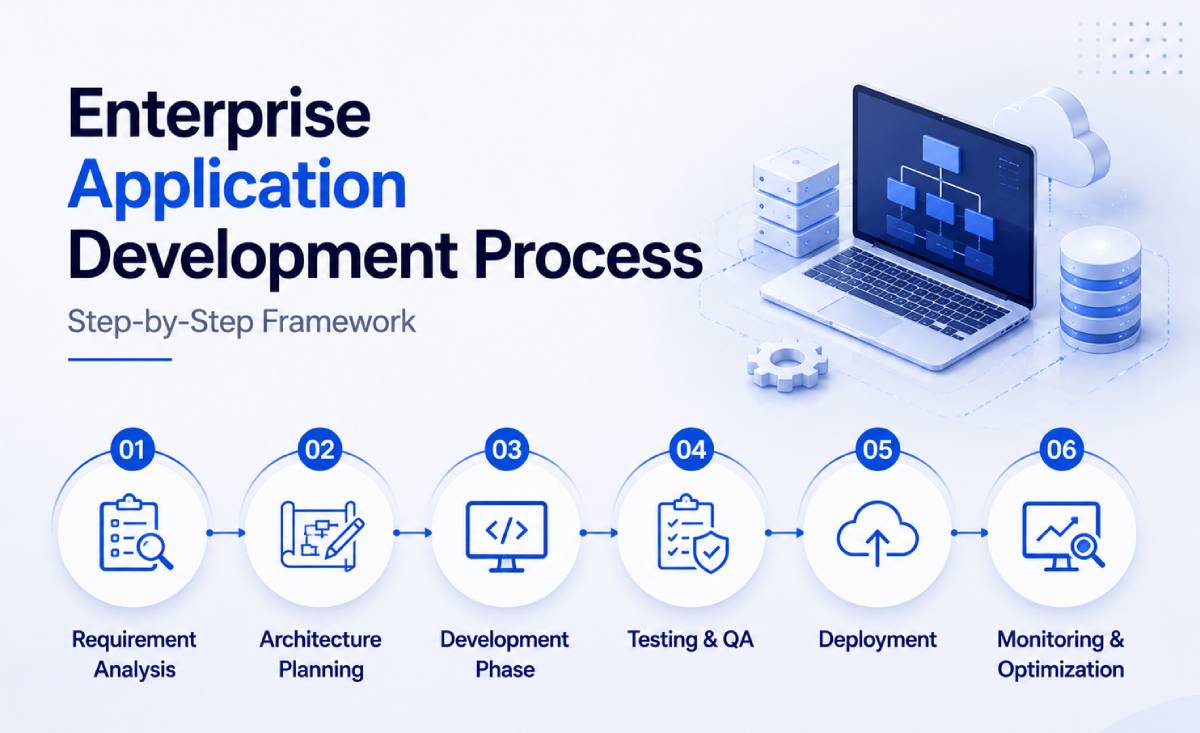
Enterprise Application Development Process
Enterprise application development requires a structured, multi-phase approach that balances technical execution with business alignment. Unlike small projects, enterprise systems evolve continuously and require careful planning at every stage.
Reality Check:
Skipping structured processes leads to:
- scope creep
- delays
- poor system performance
Step-by-Step Framework
1. Requirement Analysis
This is the foundation of the entire project. The goal is to align the software with business objectives and operational needs.
Key Activities:
- stakeholder interviews
- workflow mapping
- defining KPIs and success metrics
Outcome:
- clear project scope
- reduced ambiguity
- aligned expectations
Poor requirement analysis leads to expensive rework later.
2. Architecture Planning
This phase defines how the system will be structured and how components will interact.
Key Decisions:
- architecture type (microservices, monolith)
- database structure
- scalability strategy
Outcome:
- scalable system design
- reduced future bottlenecks
Architecture decisions determine long-term success.
3. Development Phase
This is where the actual software is built, but execution must follow structured workflows.
Includes:
- frontend development (UI/UX)
- backend development (logic, database)
- API development and integrations
Best Practices:
- modular coding
- version control
- agile development cycles
4. Testing & QA
Testing ensures the system performs reliably under different conditions.
Types of Testing:
- functional testing
- performance testing
- security testing
- usability testing
Outcome:
- bug-free system
- optimized performance
- improved reliability
5. Deployment
Deployment involves launching the system in a live environment.
Includes:
- cloud setup
- server configuration
- CI/CD pipelines
Outcome:
- smooth go-live
- minimal downtime
6. Monitoring & Optimization
Enterprise software requires continuous monitoring and improvement.
Key Areas:
- performance tracking
- error monitoring
- user behavior analysis
Outcome:
- continuous improvement
- higher efficiency
- better user experience
Key Insight:
Enterprise development is not a one-time project; it is a continuous evolution cycle.
Cloud & Infrastructure in Enterprise Development
Cloud computing has become the backbone of modern enterprise software, enabling businesses to scale rapidly without heavy infrastructure investments.
Popular Cloud Platforms
- AWS (Amazon Web Services)
- highly scalable
- wide service ecosystem
- Microsoft Azure
- strong enterprise integrations
- ideal for Microsoft-based systems
- Google Cloud
- strong in data analytics and AI
Benefits of Cloud Infrastructure
Scalability
- scale resources up/down instantly
- handle traffic spikes seamlessly
Cost Efficiency
- pay-as-you-go model
- reduces capital expenditure
Global Access
- deploy across multiple regions
- serve global users efficiently
Reliability
- high uptime guarantees
- disaster recovery systems
Key Insight:
Cloud infrastructure transforms software from static systems into dynamic, scalable ecosystems.
Integration & API Ecosystem
Enterprise systems do not operate in isolation; they are part of a larger ecosystem of tools and platforms. Integration is essential for seamless operations and data flow.
Common Integrations
CRM Systems
- manage customer data
- track interactions
- improve sales efficiency
ERP Platforms
- manage operations
- streamline workflows
- integrate departments
Payment Gateways
- enable transactions
- ensure secure payments
Marketing Tools
- automation platforms
- analytics tools
- campaign management systems
Why APIs Matter
APIs enable:
- seamless communication between systems
- real-time data synchronization
- scalable integrations
Key Insight:
APIs are the connective tissue of enterprise systems, enabling flexibility and scalability.
Enterprise Software Cost Breakdown
Enterprise software costs vary significantly depending on the scale and complexity of the system. Unlike standard applications, enterprise software is a long-term investment that delivers ongoing value.
Cost Range Overview
| Type | Cost |
| Basic Enterprise App | ₹5L – ₹15L |
| Mid-Level Platform | ₹15L – ₹50L |
| Advanced Enterprise System | ₹50L – ₹5Cr+ |
What Drives Cost?
1. Complexity
- business logic
- workflows
- system interactions
2. Features
- dashboards
- automation
- AI integrations
3. Integrations
- third-party tools
- APIs
- legacy systems
4. Scalability Requirements
- user volume
- data load
- global operations
Strategic Cost Insight
A ₹50L enterprise system may seem expensive, but if it:
- reduces operational cost by 20%
- increases efficiency
- improves revenue
It delivers exponential ROI.
Key Insight:
Enterprise software cost should be evaluated based on business impact, not development expense.
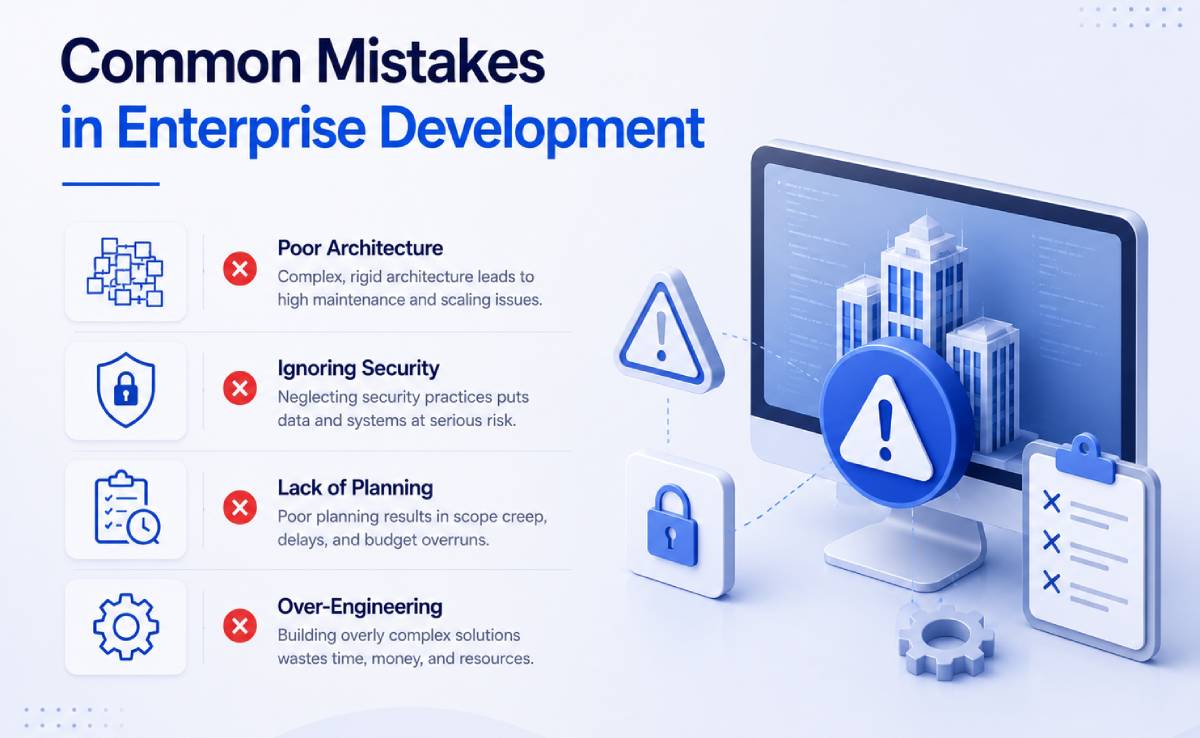
Common Mistakes in Enterprise Development
Enterprise software projects often fail not because of poor intent, but due to strategic and architectural missteps made early in the process. These mistakes compound over time, leading to rising costs, performance issues, and systems that cannot scale with the business.
Understanding these pitfalls is critical because enterprise systems are long-term investments; fixing mistakes later is exponentially more expensive than preventing them early.
Poor Architecture
A weak or short-sighted architecture is one of the most damaging mistakes in enterprise development. Many businesses prioritize speed over structure, leading to systems that work initially but fail under growth.
What Goes Wrong:
- tightly coupled systems that are hard to modify
- lack of scalability planning
- inefficient data handling
Long-Term Impact:
- performance bottlenecks under load
- frequent system failures
- expensive re-engineering
Example:
A platform built without scalability planning struggles when traffic grows from 10,000 to 1,00,000 users, requiring a costly rebuild.
Insight:
Architecture decisions should always consider future growth, not just current requirements.
Ignoring Security
Security is often treated as a secondary concern, especially during early development stages. This creates vulnerabilities that can be exploited later, leading to serious consequences.
Common Oversights:
- weak authentication systems
- lack of encryption
- insecure APIs
Consequences:
- data breaches
- compliance violations
- loss of customer trust
Example:
A system without proper API security exposes sensitive data through unauthorized access.
Insight:
Security must be integrated into every layer of development, not added after deployment.
Lack of Planning
Enterprise projects without proper planning often suffer from scope creep, unclear requirements, and misaligned expectations between stakeholders and development teams.
What Happens:
- unclear project scope
- constant requirement changes
- delays in delivery
Impact:
- increased development cost
- missed deadlines
- poor system quality
Example:
A project without defined workflows ends up requiring multiple revisions, doubling development time.
Insight:
Detailed planning ensures clarity, efficiency, and predictable outcomes.
Over-Engineering
While under-engineering causes performance issues, over-engineering creates unnecessary complexity. Many teams add features, tools, or systems that are not required at the current stage.
Common Issues:
- building for hypothetical future needs
- Adding unnecessary microservices
- complex systems for simple problems
Impact:
- Higher development cost
- slower execution
- difficult maintenance
Example:
A startup using an enterprise-level microservices architecture for a simple MVP increases cost without real benefit.
Insight:
Build for current needs with scalable flexibility, not for unrealistic future scenarios.
Final Takeaway for This Section
Avoiding these mistakes ensures:
- scalable architecture
- secure systems
- efficient development
- long-term cost savings
Strategic Insight:
Successful enterprise development is not about building more; it is about building right from the beginning.
How to Choose the Right Enterprise Software Development Company
Selecting the right development partner is one of the most critical decisions for any enterprise project. The wrong choice can lead to delays, cost overruns, and underperforming systems, while the right partner can accelerate growth and create long-term competitive advantage.
A true enterprise software company does more than write code; it acts as a strategic partner that aligns technology with business outcomes.
Key Factors to Evaluate
1. Experience in Enterprise Systems
Enterprise software requires specialized expertise that goes beyond standard development.
What to Look For:
- experience with large-scale applications
- industry-specific case studies
- ability to handle complex workflows
Why It Matters:
Experienced teams can:
- anticipate challenges
- design scalable systems
- avoid costly mistakes
2. Technical Expertise
The company must have deep knowledge across multiple technologies and frameworks.
Core Capabilities:
- backend and frontend development
- cloud infrastructure
- database architecture
- API integrations
Why It Matters:
Strong technical expertise ensures:
- efficient system performance
- scalability readiness
- reduced technical debt
3. Scalability Capabilities
Not all systems are designed to scale. The company must demonstrate its ability to build systems that grow with your business.
What to Evaluate:
- architecture approach (microservices, cloud-native)
- scalability case studies
- infrastructure planning
Why It Matters:
Scalable systems prevent:
- performance failures
- expensive rebuilds
- growth limitations
4. Security Practices
Security should be a core competency, not an afterthought.
What to Check:
- data protection methods
- compliance knowledge
- secure coding practices
Why It Matters:
Strong security ensures:
- data protection
- regulatory compliance
- business continuity
5. Process & Communication
Enterprise development requires structured workflows and clear communication.
Evaluate:
- project management approach
- reporting frequency
- collaboration tools
Why It Matters:
Clear communication leads to:
- faster execution
- fewer misunderstandings
- better alignment
Explore enterprise software development services to understand how structured systems are built.
Key Insight:
The best development company is not the cheapest; it is the one that delivers scalable, secure, and ROI-driven systems.
How Ideamagix Delivers Enterprise Software Solutions
At Ideamagix, enterprise software development is approached as a business transformation strategy, not just a technical project. The focus is on building systems that not only function efficiently but also drive measurable business growth.
Every project is aligned with one core objective:
Turn technology into a revenue-generating asset
Our Approach
Research → Architecture → Development → Optimization → Scaling
This structured approach ensures that every stage of development contributes to long-term performance and scalability.
1. Research Phase
- understand business goals
- analyze workflows
- Identify growth opportunities
2. Architecture Design
- design scalable systems
- Choose the right tech stack
- define system structure
3. Development Execution
- build modular systems
- integrate APIs and tools
- ensure performance optimization
4. Optimization
- improve speed and performance
- enhance user experience
- refine workflows
5. Scaling
- handle increased traffic
- expand features
- support business growth
What We Focus On
1. Scalable Architecture
- microservices-based systems
- cloud-native development
- future-ready infrastructure
2. Secure Systems
- data encryption
- secure APIs
- compliance-ready frameworks
3. Performance Optimization
- fast loading speed
- efficient data processing
- optimized user experience
4. AI Integration
- automation systems
- intelligent workflows
- predictive analytics
These capabilities ensure that the system is not just functional but high-performing and growth-driven.
Growth Framework
Systems → Efficiency → Growth → Revenue
What This Means:
- systems streamline operations
- Efficiency reduces cost
- Growth increases scalability
- revenue drives business success
Key Insight:
Enterprise software should not just support business; it should accelerate it.
Conclusion
Enterprise software development is a strategic investment that enables businesses to scale efficiently and compete globally.
Key Takeaways
- Architecture defines scalability
- Security is critical
- cloud enables growth
- ROI is long-term
Businesses that invest in enterprise software gain a significant competitive advantage.
FAQs
1. What is enterprise software development?
Enterprise software development involves designing and building large-scale, mission-critical applications that support core business operations such as CRM systems, ERP platforms, and custom internal tools. Unlike standard applications, enterprise systems are built to handle high user volumes, complex workflows, and multiple integrations across departments. These solutions are typically customised to match specific business requirements rather than using off-the-shelf software. They also require advanced architecture, strong security, and scalability planning to ensure long-term performance. In most cases, enterprise software becomes the backbone of an organisation’s digital ecosystem, driving efficiency and decision-making.
Key Insight: Enterprise software is not just a tool; it is a strategic business infrastructure.
2. Why is scalability important in enterprise software?
Scalability ensures that your software can handle increasing users, data, and transactions without performance degradation or system failures. As businesses grow, their software must support higher traffic, more integrations, and expanding datasets. Without proper scalability, systems may crash during peak usage, leading to revenue loss and poor user experience. Enterprise applications are typically designed with horizontal scaling, load balancing, and distributed systems to handle growth efficiently. Scalability also reduces the need for costly system rebuilds in the future.
Key Insight: A scalable system allows your business to grow without technical limitations.
3. How much does enterprise software cost?
The cost of enterprise software development can range from ₹5 lakh to ₹5 crore or more, depending on the complexity, features, integrations, and scalability requirements. Basic enterprise tools with limited functionality fall on the lower end, while advanced systems with AI, automation, and global infrastructure require significantly higher investment. Factors such as custom development, third-party integrations, cloud infrastructure, and security requirements heavily influence pricing. It’s important to evaluate cost not just as an expense but as an investment with long-term ROI. Businesses should also consider ongoing costs like maintenance, upgrades, and scaling.
Key Insight: The real value lies in the business impact and efficiency gains, not just the upfront cost.
4. What architecture is best for enterprise software?
Microservices architecture is widely preferred for enterprise software because it allows systems to be broken into independent, scalable services that can be developed, deployed, and maintained separately. This approach improves flexibility, fault isolation, and scalability compared to traditional monolithic systems. However, the “best” architecture depends on business requirements, team expertise, and system complexity. Some organizations also use hybrid approaches combining microservices with serverless components for efficiency. Choosing the right architecture is critical because it directly impacts performance, scalability, and long-term maintenance costs.
Key Insight: The best architecture is one that aligns with your business scale and future growth plans.
5. How long does enterprise software development take?
Enterprise software development timelines typically range from 3 to 12 months, depending on the scope, complexity, and number of features involved. Smaller systems or MVPs can be developed faster, while large-scale platforms with integrations, automation, and advanced features require longer timelines. The development process includes multiple stages such as planning, architecture design, development, testing, and deployment. Delays often occur when requirements are unclear or when changes are introduced mid-project. Using agile methodologies can help deliver incremental results faster while maintaining flexibility.
Key Insight: Timelines depend more on clarity and planning than just development speed.
6. What industries benefit most from enterprise software development?
Enterprise software is highly beneficial across industries that require complex operations, large-scale data management, and multi-system integration. Key sectors include finance, healthcare, e-commerce, logistics, manufacturing, and SaaS businesses. For example, banks use enterprise systems for transaction processing, while e-commerce platforms rely on them for inventory, payments, and customer management. These industries benefit from improved efficiency, automation, and better decision-making through centralized systems. As digital transformation accelerates, more industries are adopting enterprise software to remain competitive.
Key Insight: Any business operating at scale can benefit from custom enterprise solutions.
7. What is the difference between enterprise software and SaaS solutions?
Enterprise software is typically custom-built for a specific organization, tailored to its workflows, processes, and integration needs. In contrast, SaaS (Software as a Service) solutions are pre-built platforms offered to multiple users on a subscription basis. While SaaS is faster to implement and cost-effective initially, it often lacks deep customization and scalability for complex enterprise needs. Enterprise software provides greater control, flexibility, and long-term value, especially for large organizations. Many businesses use a hybrid approach, combining SaaS tools with custom enterprise systems for optimal efficiency.