
Introduction: Why Enterprise Web Development Is Entering a New Phase
Enterprise websites are no longer simple marketing platforms. For large organizations, the website now serves as a central digital hub that connects marketing, customer experience, sales, analytics, automation, and internal business systems. This shift has significantly changed the expectations placed on enterprise web development. Performance, scalability, integration, and intelligent automation have become core priorities rather than optional enhancements.
A few years ago, many enterprise websites were designed primarily for information delivery. Today, however, enterprises expect their digital platforms to function as business engines capable of handling large volumes of traffic, processing customer data in real time, and delivering personalized experiences across devices and markets. This transformation has driven a new generation of enterprise web development trends focused on performance, AI-driven insights, security, and advanced architecture.
Organizations operating at enterprise scale face unique technical challenges that smaller businesses rarely encounter. Their websites must support:
- millions of page views
- global audiences
- multilingual content
- integrations with enterprise systems such as CRMs and ERPs
- large databases and content ecosystems
- strict security and compliance requirements
Because of this complexity, modern enterprise website development strategies emphasize performance-first architecture combined with intelligent automation. Businesses that adopt these innovations gain significant advantages in customer experience, operational efficiency, and long-term scalability.
In this article, we explore seven of the most influential enterprise web development trends shaping the next generation of enterprise platforms. These trends focus on speed, scalability, and AI-powered capabilities, enabling organizations to build digital systems that support long-term growth.
Trend 1: Performance-First Architecture as the Foundation of Enterprise Platforms
The first major shift in enterprise website development is the transition toward performance-first architecture. Enterprises have realized that website speed and system efficiency directly affect customer engagement, conversion rates, and search visibility. Slow websites not only frustrate users but also reduce SEO performance and limit the scalability of digital campaigns.
Performance-first architecture prioritizes speed and efficiency at every stage of development. Instead of optimizing performance after the site is built, developers now design systems that inherently support high performance from the start.
Key strategies used in this approach include:
- Headless architecture separating front-end and back-end systems
- Content delivery networks (CDNs) for faster global access
- Server-side rendering (SSR) for improved load time and SEO
- Edge computing to reduce server latency
- Efficient database structures for faster data retrieval
This approach also emphasizes front-end optimization. Even visually rich enterprise platforms must maintain fast load times across devices. Developers therefore use:
- optimized image delivery
- minimal JavaScript execution
- progressive loading techniques
- mobile-first design structures
For enterprises, performance-first design delivers several benefits:
- Improved user experience for high traffic volumes
- Higher search engine rankings due to faster load times
- Better conversion rates across landing pages and applications
- Lower infrastructure costs through optimized resource usage
As a result, performance-first architecture has become one of the most important trends in enterprise web development, influencing both technical strategy and user experience design.
Trend 2: AI-Powered Personalization for Enterprise Customer Experiences
Artificial intelligence is rapidly transforming how enterprises deliver digital experiences. Instead of showing the same content to every visitor, modern enterprise platforms now use AI to tailor experiences based on user behavior, demographics, and interaction history.
AI-driven personalization has become a key component of modern web development strategies, as enterprises operate across multiple customer segments and geographic regions. AI enables organizations to tailor content and recommendations to each user dynamically.
Examples of AI-powered features in enterprise websites include:
- Personalized product recommendations
- Dynamic content based on user behavior
- AI-driven search functionality
- Predictive lead scoring for marketing teams
- Intelligent chatbots for customer support
For instance, when a user visits an enterprise ecommerce site, AI systems analyze past interactions to display relevant products or offers. Similarly, enterprise SaaS platforms use AI to recommend features or onboarding resources based on the user’s activity.
These capabilities rely on advanced data processing systems integrated directly into the website architecture. Developers, therefore, design platforms capable of collecting, processing, and analyzing user data in real time.
AI integration provides several strategic advantages:
- improved customer engagement
- higher conversion rates
- better customer retention
- more accurate marketing insights
Because AI enables enterprises to deliver more relevant digital experiences, it has quickly become a defining trend in web development, shaping the next generation of enterprise platforms.
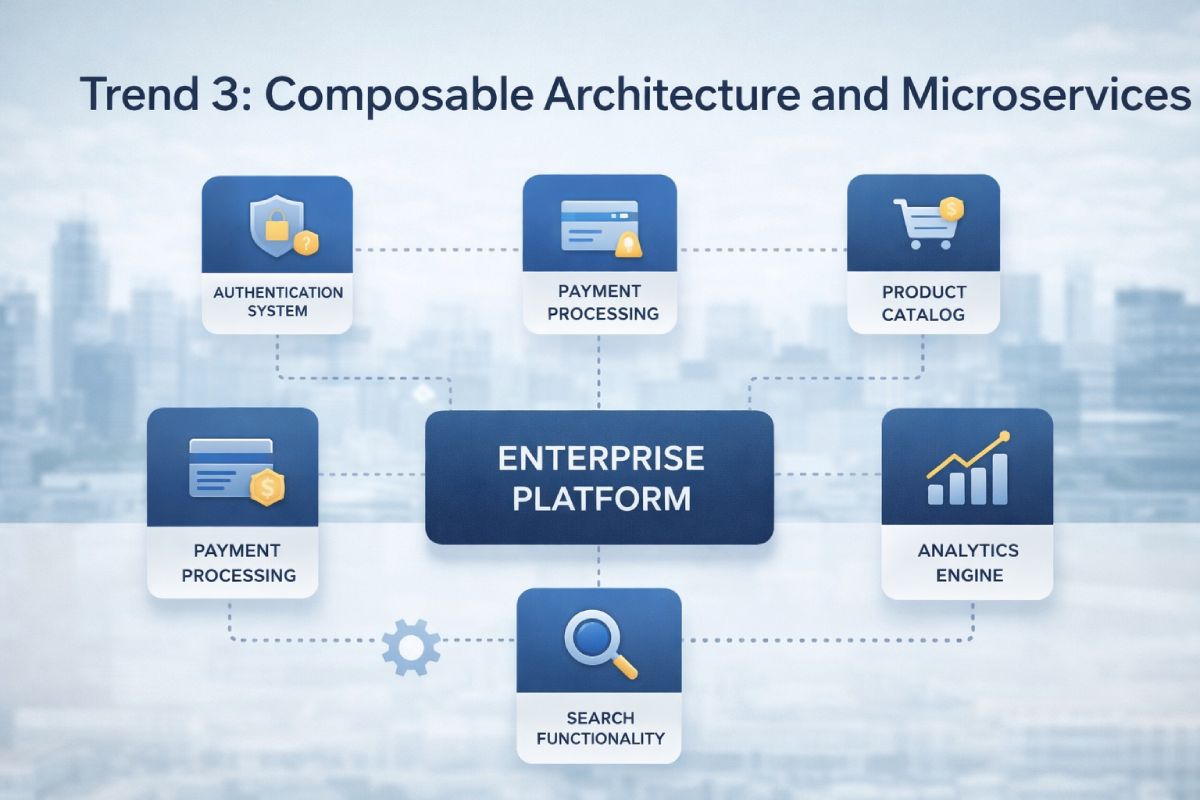
Trend 3: Composable Architecture and Microservices
Another major evolution in enterprise web development is the adoption of composable architecture. Traditional enterprise systems were often built as large monolithic platforms. While these systems could handle significant workloads, they were difficult to modify or scale as business needs evolved.
Composable architecture addresses this challenge by dividing applications into smaller independent services known as microservices. Each service performs a specific function and communicates with other services through APIs.
Examples of microservices in enterprise platforms include:
- authentication systems
- payment processing
- product catalog services
- search functionality
- analytics engines
Because each component operates independently, enterprises gain greater flexibility in system development and maintenance.
Benefits of composable enterprise architecture include:
- Faster development cycles
- Easier integration with third-party tools
- Improved scalability during high traffic events
- Reduced risk when deploying updates
This modular approach allows enterprises to innovate more quickly without disrupting the entire system. As digital ecosystems become increasingly complex, composable architecture is emerging as one of the most influential trends in enterprise web development.
Trend 4: Advanced Security and Compliance Infrastructure
Security has always been important in enterprise technology, but modern digital ecosystems have introduced new challenges. Enterprise websites handle sensitive data, including customer information, financial transactions, and proprietary business intelligence. As a result, security infrastructure has become a core component of web development strategies.
Modern enterprise platforms integrate multiple layers of security, including:
- end-to-end encryption
- secure authentication protocols
- automated vulnerability monitoring
- real-time threat detection
- compliance frameworks such as GDPR and SOC2
Developers now build security directly into the architecture rather than adding it as a secondary feature. This approach is often referred to as security-first development, and it aligns closely with performance-first strategies.
Security architecture also includes:
- identity management systems
- access control frameworks
- secure API communication
- encrypted data storage
For global enterprises operating in regulated industries, compliance is equally important. Websites must comply with strict legal standards for data protection and privacy. This makes security and compliance one of the most critical enterprise web development trends for organizations operating at scale.
Trend 5: Progressive Web Applications (PWAs) for Enterprise Platforms
Progressive Web Applications are becoming increasingly popular in enterprise website development because they combine the functionality of mobile apps with the accessibility of websites. PWAs allow users to interact with web platforms in ways that previously required native mobile applications.
Key capabilities of PWAs include:
- offline access to content
- push notifications
- fast loading speeds
- app-like user experiences
- home screen installation
For enterprises, this approach reduces the need to maintain multiple mobile applications across different platforms. Instead, a single web-based application can deliver a consistent experience across devices.
Advantages of PWAs for enterprise platforms include:
- lower development and maintenance costs
- improved user engagement
- faster deployment cycles
- better performance on mobile networks
As mobile usage continues to grow globally, PWAs are among the most impactful trends shaping enterprise digital infrastructure.
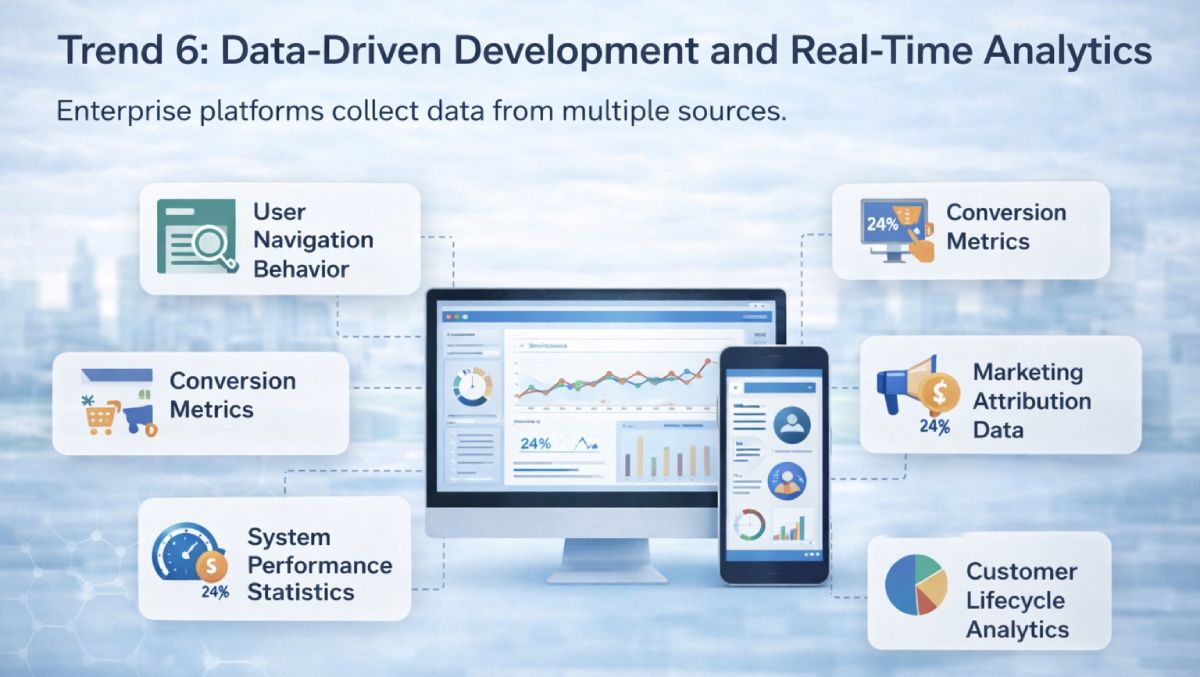
Trend 6: Data-Driven Development and Real-Time Analytics
Modern enterprise websites are deeply integrated with analytics systems that provide continuous insight into user behavior. Data-driven development has become a central strategy in web development, allowing organizations to make informed decisions about user experience, marketing campaigns, and product design.
Enterprise platforms collect data from multiple sources, including:
- user navigation behavior
- conversion metrics
- marketing attribution data
- system performance statistics
- customer lifecycle analytics
These insights help development teams continuously refine digital platforms. Instead of relying on assumptions, enterprises can use real data to identify usability issues, optimize conversion funnels, and improve product features.
Real-time analytics also support operational monitoring. Developers can detect performance issues or traffic spikes instantly, enabling quick responses to potential system disruptions.
As enterprises increasingly rely on data to guide strategic decisions, analytics integration has become one of the most essential trends in enterprise web development.
Trend 7: AI-Assisted Development and Automation
The final major trend shaping modern enterprise website development is the integration of AI-assisted development tools. These tools help developers automate repetitive tasks, identify code vulnerabilities, and accelerate system design.
Examples of AI-assisted development include:
- automated code generation
- intelligent debugging systems
- predictive system monitoring
- AI-based UX optimization tools
These technologies reduce development time while improving code quality. Developers can focus on strategic system design rather than repetitive manual tasks.
Automation also plays a role in deployment pipelines. Continuous integration and continuous deployment (CI/CD) systems automate testing, deployment, and performance monitoring across large enterprise environments.
Benefits of AI-assisted development include:
- faster product releases
- improved system stability
- reduced operational risk
- greater development efficiency
As AI capabilities continue to evolve, automation will become an even more influential component of future enterprise web development trends.
Conclusion: Building the Next Generation of Enterprise Digital Platforms
The evolution of enterprise reflects the growing importance of digital infrastructure in modern business. Enterprise websites are no longer static platforms; they are dynamic systems that support customer engagement, operational efficiency, and global growth.
The enterprise web development trends discussed in this article highlight a clear shift toward performance-first design, intelligent automation, modular architecture, and data-driven decision making. Organizations that adopt these innovations can build digital platforms that support complex business operations while delivering exceptional user experiences.
As technology continues to advance, enterprises must remain adaptable. By embracing performance optimization, AI integration, and scalable architecture, companies can ensure their digital platforms remain competitive in an increasingly technology-driven marketplace.
FAQs
What is enterprise web development?
Web development involves building large-scale websites and digital platforms for organizations that require high performance, scalability, advanced integrations, and robust security. These platforms often integrate with enterprise systems, including CRM, ERP, analytics tools, and marketing automation platforms, to support complex business operations.
Why is performance-first architecture important in enterprise web development?
Performance-first architecture ensures that enterprise websites load quickly, handle high traffic volumes, and deliver a smooth user experience across devices. Fast websites improve SEO rankings, increase user engagement, and reduce bounce rates, which directly impacts business growth and customer acquisition.
How is artificial intelligence used in enterprise web development?
AI is used in enterprise web platforms to personalize user experiences, automate customer support through chatbots, analyze user behavior, and provide intelligent recommendations. AI-powered systems can also help businesses optimize content, improve marketing targeting, and enhance decision-making using real-time data insights.
What are the benefits of microservices architecture for enterprise websites?
Microservices architecture allows enterprise platforms to be built as independent components that communicate through APIs. This structure makes systems more scalable, easier to update, and more flexible when integrating new technologies or third-party tools.
Key advantages include:
- faster development cycles
- easier scalability
- Reduced system downtime during updates
- Better integration with enterprise software
What role do Progressive Web Apps play in enterprise web development?
Progressive Web Apps (PWAs) allow enterprise websites to deliver mobile app-like experiences directly through the browser. PWAs deliver fast load times, offline access, push notifications, and improved engagement, while reducing the need for separate native mobile applications.
How do analytics and data-driven development improve enterprise websites?
Enterprise websites rely heavily on real-time analytics to understand user behavior, identify performance issues, and improve conversion rates. Data-driven development enables organizations to make continuous improvements based on measurable insights rather than assumptions.
How are AI development tools transforming enterprise web development?
AI development tools assist developers by automating coding tasks, identifying potential bugs, enhancing security testing, and accelerating deployment. These tools increase productivity while helping teams maintain high-quality and scalable enterprise applications.