
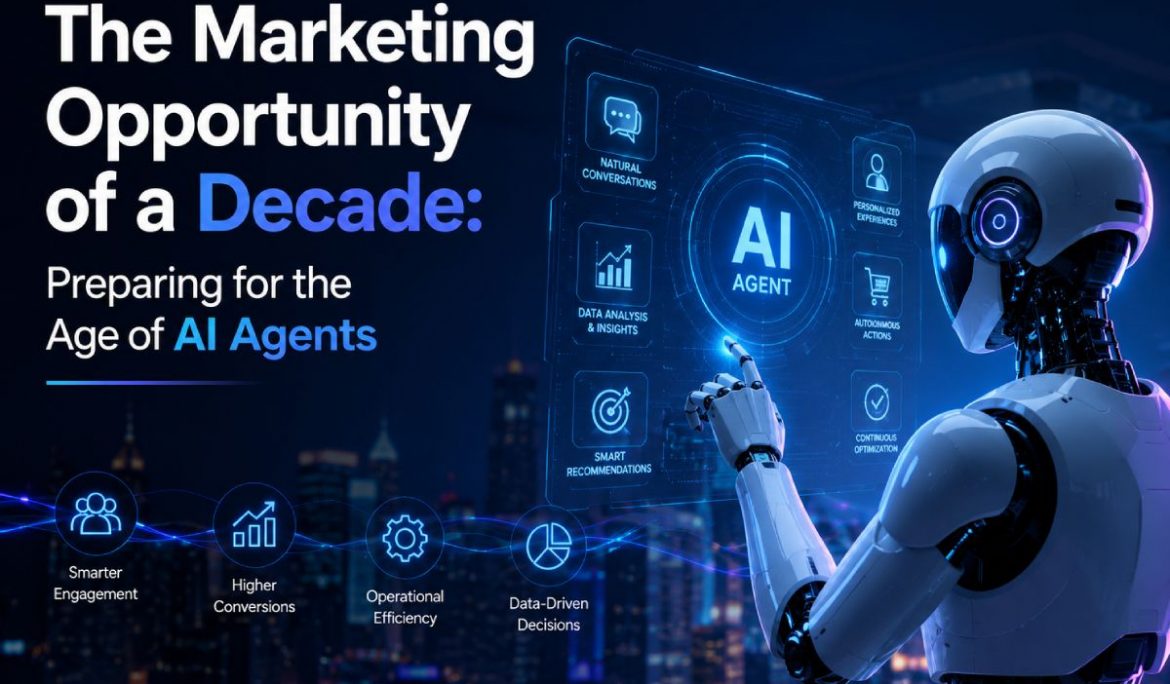
The way customers discover and choose businesses is undergoing one of the most profound transformations in the history of the internet.
For the last two decades, search engines like Google have been the gateway to information, products, and services. Businesses competed for visibility through SEO, ads, and content. Users searched, clicked, compared, and decided.
That model is now being disrupted. This disruption is driven by AI agents in marketing, making ai search optimization and AI SEO Agents critical for businesses aiming to stay visible and competitive.
In the next 12 to 24 months, millions of users will stop searching manually and instead rely on AI agents to do it for them. Businesses investing in ai agents for seo 2026 strategies will be better positioned to earn AI recommendations as these agents evaluate, compare, and, in many cases, complete transactions on behalf of users.
This is not an incremental change. It is a fundamental shift in how demand is created and captured. Businesses that adapt early will see exponential growth. Those who don’t may even realize they are being excluded from consideration.
The Third Major Internet Shift
To understand the magnitude of this change, it helps to look at the previous shifts that reshaped digital marketing.
Shift 1: The Desktop Internet (Search Era)
When Google became the dominant gateway to information, businesses that mastered SEO gained a massive advantage.
Those who ranked on page one captured:
- the majority of clicks
- consistent inbound traffic
- long-term brand visibility
Companies that invested early in SEO built authority that compounded for years.
Shift 2: The Mobile Internet
The rise of smartphones changed how users interacted with the internet.
Businesses that adapted quickly by:
- building responsive websites
- optimizing page speed
- creating mobile-first experiences
captured a dominant share of mobile traffic. Those who delayed struggled to recover.
Shift 3: The AI Agent Era (Happening Now)
We are now entering the third shift, but this one is fundamentally different. Previous shifts changed how people searched. This shift changes who is doing the searching, making AI SEO Agents and AI-ready websites increasingly important for future visibility.
Instead of humans browsing websites, AI agents will:
- search across multiple sources
- Extract relevant information
- compare options
- present recommendations
This means your website is no longer competing for human attention alone; it is competing to be selected by machines, highlighting the growing importance of ai agents for seo 2026. This shift marks the rise of agentic SEO as a new standard.
The New AI driven Customer Journey
For more than two decades, the way customers discovered and evaluated businesses followed a predictable, step-by-step journey. Whether someone was searching for a product, a service provider, or a solution to a problem, the process was manual and time-consuming. This marks the evolution toward a fully AI driven customer journey.
The Traditional Customer Journey
Search → Click → Browse → Compare → Decide
At every stage, the user had to invest effort.
They searched on Google, clicked through multiple websites, browsed pages, compared options, read reviews, and gradually narrowed down their choices before making a decision. This process often took hours, or even days, depending on the complexity of the purchase.
For businesses, this created multiple opportunities to influence the user:
- ranking higher in search results
- designing visually appealing websites
- crafting persuasive messaging
- optimizing conversion funnels
However, this entire model was built around one assumption:
Humans were doing the searching and decision-making.
The Shift: From Human Search to AI Decision-Making
That assumption is now changing. Instead of navigating the internet themselves, users are beginning to rely on AI systems, making ai search optimization increasingly important for businesses. This is not just about convenience; it’s about efficiency.
Users no longer want to:
- Open 10 browser tabs
- Compare multiple websites
- and manually evaluate options
They want answers. And AI agents are becoming the fastest way to get them. This transformation makes AI search optimization, future of SEO 2026 readiness, and website optimization for AI agents essential for staying competitive in evolving digital ecosystems.
The AI-Driven Funnel
User Query → AI Agent Analysis → Recommendation → Decision
In this new model, the entire journey is compressed into a single interaction.
Instead of searching, a user might simply say:
“Find me the best digital marketing agency under ₹1 lakh per month.”
From that one query, the AI agent takes over.
What Happens Behind the Scenes
Within seconds, the AI agent performs tasks that would normally take a human hours:
- scans dozens (or even hundreds) of websites
- extracts pricing, services, and key offerings
- analyzes reviews and brand reputation
- compares multiple providers across parameters
- filters results based on user constraints (budget, location, specialization)
- returns a shortlist of recommendations
All of this happens without the user visiting a single website directly.
Why This Changes Everything
This shift fundamentally changes how businesses compete for visibility.
In the traditional model, your goal was to:
- attract clicks
- keep users engaged
- guide them toward conversion
In the AI-driven model, your goal is different:
You need to be selected before the user even sees you, making AI search optimization a key competitive advantage.
This means your website is no longer just a marketing asset; it becomes a data source that AI systems evaluate and interpret.
What This Means for Businesses
The implications are significant.
If your website:
- hides important information
- lacks structure
- It is difficult for machines to interpret
You risk being completely excluded from recommendations.
And the most dangerous part?
You won’t even know you were considered and rejected.
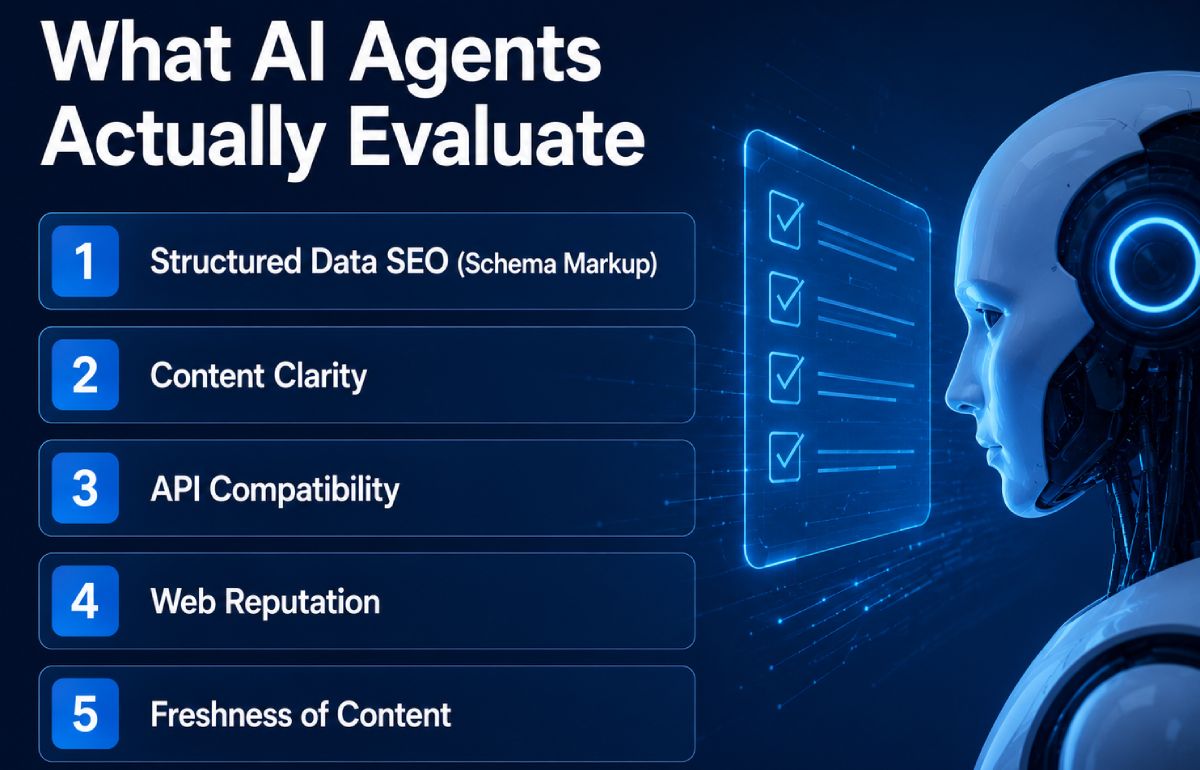
What AI Agents Actually Evaluate
AI agents do not behave like human users.
- They don’t scroll through your homepage.
- They don’t admire your design.
- They don’t get influenced by branding elements like colors, fonts, or animations.
Instead, they process your website the way a machine does, by analyzing structured signals, clarity of information, and external validation.
1. Structured Data SEO (Schema Markup)
Structured data SEO is one of the most critical signals for AI agents because it provides a clear, machine-readable understanding of your business.
Schema markup acts as a translation layer between your website and AI systems. It explicitly tells them:
- What your business offers
- How your services are categorized
- What your pricing looks like
- What do customers think about you
Without structured data SEO AI has to “guess” what your content means. And when it guesses, it often skips.
Why Schema Matters More Than Ever
In an AI-driven ecosystem, clarity beats creativity, which is why the best ai seo agents 2026 prioritize structured and machine-readable content.
A page that clearly defines:
- service name
- pricing range
- customer ratings
will outperform a beautifully written page that lacks structure.
Example Insight:
Two websites offer the same service.
- Website A uses schema with clear pricing and reviews
- Website B describes everything in long paragraphs
The AI agent will prioritize Website A because it can extract data faster and more reliably.
2. Content Clarity
Content clarity is becoming one of the most important ranking factors in the age of AI.
In the past, brands focused on storytelling, tone, and creative messaging. While these still matter for human users, AI agents prioritize clarity, structure, and precision.
Common Mistakes Businesses Make
Many websites:
- bury pricing deep within content
- Use vague or generic descriptions
- fail to clearly explain their services
This makes it difficult for AI systems to understand what the business actually offers.
What AI-Friendly Content Looks Like
AI-friendly content:
- answers key questions directly
- uses simple and structured language
- clearly defines services, pricing, and processes
Key Principle:
If an AI agent cannot quickly answer:
- What do you offer?
- Who is it for?
- How much does it cost?
You will not be recommended.
3. API Compatibility
AI agents are not just reading content; they are increasingly interacting with systems. Businesses that provide machine-accessible data gain a major advantage. This evolution highlights the growing importance of API driven SEO strategies.
What This Includes
- real-time pricing APIs
- booking or scheduling integrations
- inventory or availability feeds
Why This Matters
If an AI agent can:
- Check availability instantly
- confirm pricing accuracy
- initiate bookings
It is far more likely to recommend your business.
Strategic Insight:
The future of SEO is not just about content; it’s about connectivity.
4. Web Reputation
AI agents do not trust your website alone.
They validate your credibility by cross-referencing:
- online reviews
- third-party platforms
- brand mentions
- industry authority
What This Means
Even if your website is perfectly optimized, weak external signals can hurt your chances of being recommended.
AI systems prioritize businesses that:
- are talked about
- are reviewed positively
- are referenced across the web
Reality Check:
If your brand has little to no digital footprint, AI agents will struggle to trust it.
5. Freshness of Content
In a rapidly changing digital environment, outdated information is a major red flag.
AI agents prioritize content that is:
- recently updated
- accurate and relevant
- aligned with current data
Why Freshness Matters
If your website shows:
- outdated pricing
- old case studies
- stale content
It signals unreliability.
Best Practices
- Update key pages regularly
- include “last updated” timestamps
- refresh content based on industry changes
Key Insight:
AI agents reward businesses that demonstrate consistency and relevance over time.
The 6-Step Playbook for Agent-Ready Websites
Most businesses are still optimizing for traditional SEO. Very few businesses and even fewer ai search optimization marketing agencies 2026 are preparing for AI-driven discovery. This creates a rare early-mover advantage.
Step 1: Implement Structured Data Everywhere
Schema markup for AI is the foundation of AI visibility.
It should be applied across:
- service pages
- product listings
- FAQs
- reviews
This ensures that Schema markup for AI systems can instantly understand your offerings without ambiguity.
Step 2: Rewrite Content for Clarity
Every page should function like a clear answer sheet.
It should explicitly communicate:
- What you offer
- Who is it designed for
- How it works
- What it costs
Avoid unnecessary storytelling where clarity is required.
Step 3: Enable Machine Access (APIs & Data Feeds)
Make your website accessible not just to users, but to machines.
Provide structured access to:
- pricing data
- availability
- booking systems
This makes your business easier to evaluate and recommend. This is where machine-readable content SEO becomes essential for visibility.
Step 4: Build a Strong Digital Reputation
Invest in:
- customer reviews
- backlinks
- brand mentions
These signals act as trust indicators for AI systems. This directly impacts AI buying behavior and the future of digital marketing.
Step 5: Keep Content Fresh
Consistency is key. Regular updates show that your business is active, reliable, and relevant.
Step 6: Train AI on Your Category
Create content that defines your expertise:
- comparison pages
- category-specific guides
- in-depth industry content
This helps AI understand:
- What you do
- where you fit
- Why you matter
Final Insight
We are moving from:
👉 SEO (Search Engine Optimization)
to
👉 AEO (Agent Engine Optimization)
The businesses that succeed will not just be the ones that rank.
They will be the ones that are:
- understood
- trusted
- selected
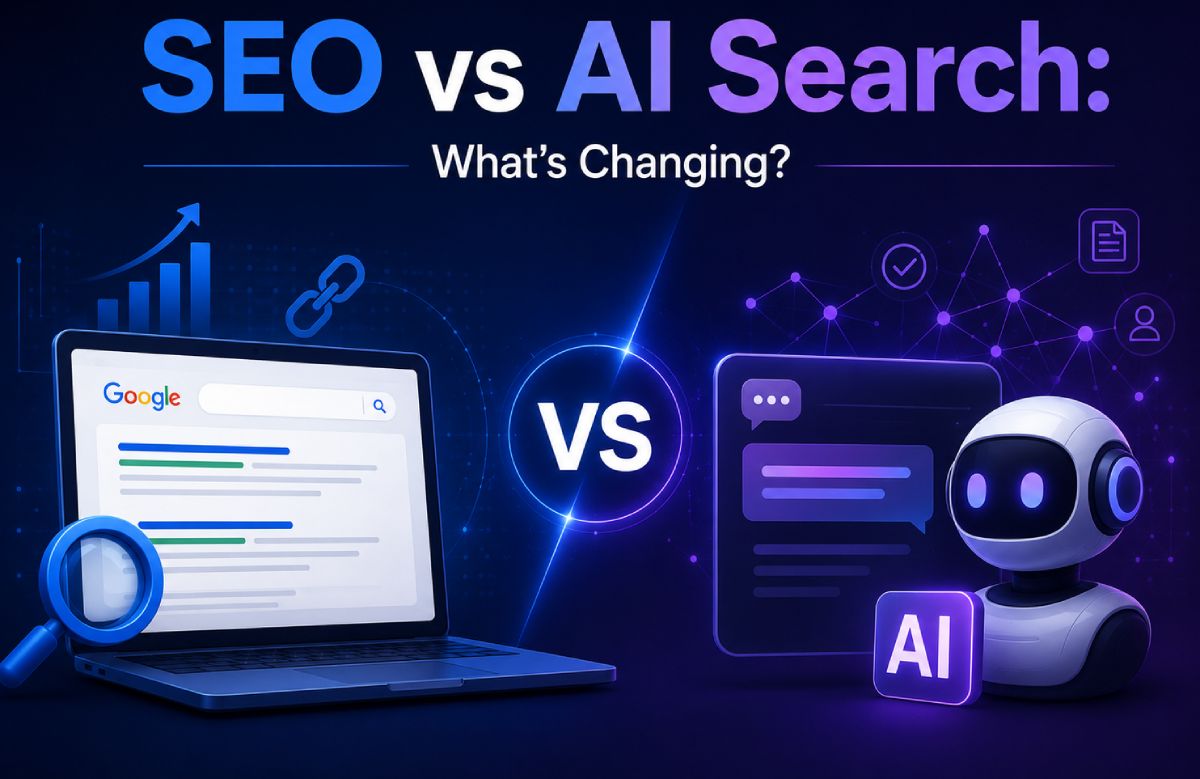
SEO vs AI Search: What’s Changing?
SEO is not disappearing, but it is evolving into something far more sophisticated than keyword rankings and backlinks. For years, search engine optimization was about improving visibility in Google’s results and capturing clicks from users actively searching. That model still exists, but it is now being layered with AI-driven systems that interpret, filter, and recommend results instead of simply displaying them.
The shift is subtle but powerful. Instead of users browsing multiple websites, AI agents are increasingly acting as intermediaries that decide which businesses are worth considering. This means your website is no longer competing only for rankings; it is competing for selection by intelligent systems. This clearly defines the new landscape of SEO vs AI search dynamics.
Traditional SEO Focus
Traditional SEO was built around optimizing websites to perform well within search engine algorithms. The emphasis was on visibility, getting your page to rank higher than competitors for specific keywords.
Core focus areas included:
- identifying high-volume keywords
- building backlinks to improve authority
- optimizing pages to rank on page one
While this approach still drives traffic, it is heavily dependent on users clicking through search results and manually evaluating options. The effectiveness of traditional SEO decreases when users rely less on browsing and more on AI-driven recommendations.
AI SEO Focus
AI-driven search introduces a completely different layer of optimization, making ai search optimization marketing agencies 2026 increasingly valuable for businesses adapting to AI-powered discovery.
Key focus areas now include:
- Structured data → making your content machine-readable
- Semantic clarity → ensuring your content answers specific user intent
- Authority signals → building trust across multiple platforms
- Machine readability → enabling AI systems to extract and process data efficiently
This shift prioritizes clarity and structure over creativity alone. A well-structured page with clear data can outperform a highly designed page that lacks machine-readable signals. This is shaping the future of SEO 2026, where AI SEO strategy and semantic SEO for AI define visibility.
New Reality:
Ranking #1 on Google is no longer enough in the era of ai agents for seo 2026. If your website is not structured, clear, and trusted, AI agents may skip it entirely.
The Business Impact: Winners vs Invisible Brands
The transition to AI-driven discovery is not just a technical evolution it has direct business consequences. As AI agents begin to filter and recommend options, visibility becomes selective rather than open.
This creates a clear divide between businesses that adapt and those that do not.
Winners: Businesses That Adapt Early
Businesses that align with AI-driven systems gain a significant advantage because they become part of the recommendation layer. Instead of competing for attention, they are pre-selected for consideration.
These businesses typically:
- get recommended consistently by AI systems
- attract high-intent users ready to convert
- reduce reliance on paid advertising
- build authority faster through increased exposure
Because AI agents filter out low-quality or unclear options, the traffic that reaches these businesses is often more qualified and conversion-ready.
Invisible Brands: Businesses That Don’t Adapt
Businesses that continue to rely solely on traditional SEO risk becoming invisible in AI-driven environments. Even if they maintain rankings, they may not appear in AI-generated recommendations.
Common challenges they face:
- Reduced visibility despite existing rankings
- missed high-intent opportunities
- declining traffic over time
- Inability to compete with structured, AI-optimized competitors
Critical Insight:
The biggest risk is not losing rankings. It is not being considered at all in the decision-making process.
The Early Mover Advantage
Every major shift in digital marketing has rewarded businesses that adapted early. Whether it was SEO in the early 2000s or mobile optimization in the 2010s, early adopters captured a disproportionate share of the market. The same pattern is repeating with AI, but at a much faster pace.
Why This Shift Is Faster
Unlike previous technological shifts, AI adoption is accelerating due to multiple reinforcing factors. The infrastructure already exists, and user behavior is changing rapidly.
Key drivers include:
- widespread adoption of AI tools across platforms
- rapid improvements in AI capabilities
- increased trust in AI-assisted decisions
- seamless integration of AI into everyday workflows
This combination creates a faster adoption curve compared to previous digital transitions.
Timeline Reality
Historically, shifts like mobile optimization took several years to reach mass adoption. Businesses had time to adapt gradually.
With AI, the timeline is compressed:
What took 5 years before may now happen in 12–18 months. This leaves very little room for delayed action. Businesses that wait for “proof” may find themselves too late to compete effectively.
The Compounding Effect
Early adoption does not just provide a temporary advantage; it creates a long-term growth loop.
AI Recommendations → Traffic → Authority → More Recommendations
Here’s how it works:
- AI systems recommend your business
- You receive more traffic and engagement
- Your authority and trust signals improve
- AI systems become more confident in recommending to you
This cycle continues, strengthening your position over time.
Key Insight:
Early movers benefit from a compounding advantage, while late adopters struggle to catch up.
How Ideamagix Helps Businesses Become AI-Ready
This forward-looking approach reflects how the best ai seo agents 2026 help businesses build long-term AI visibility. This involves building systems that align with how both search engines and AI agents evaluate websites. Instead of isolated optimizations, the approach is structured and holistic.
Our Approach
Ideamagix follows a step-by-step framework that ensures scalability and long-term performance:
Technical SEO
- Structured Data
- Content Clarity
- Authority Building
- AI Optimization
Each stage plays a critical role in making your website both human-friendly and machine-readable.
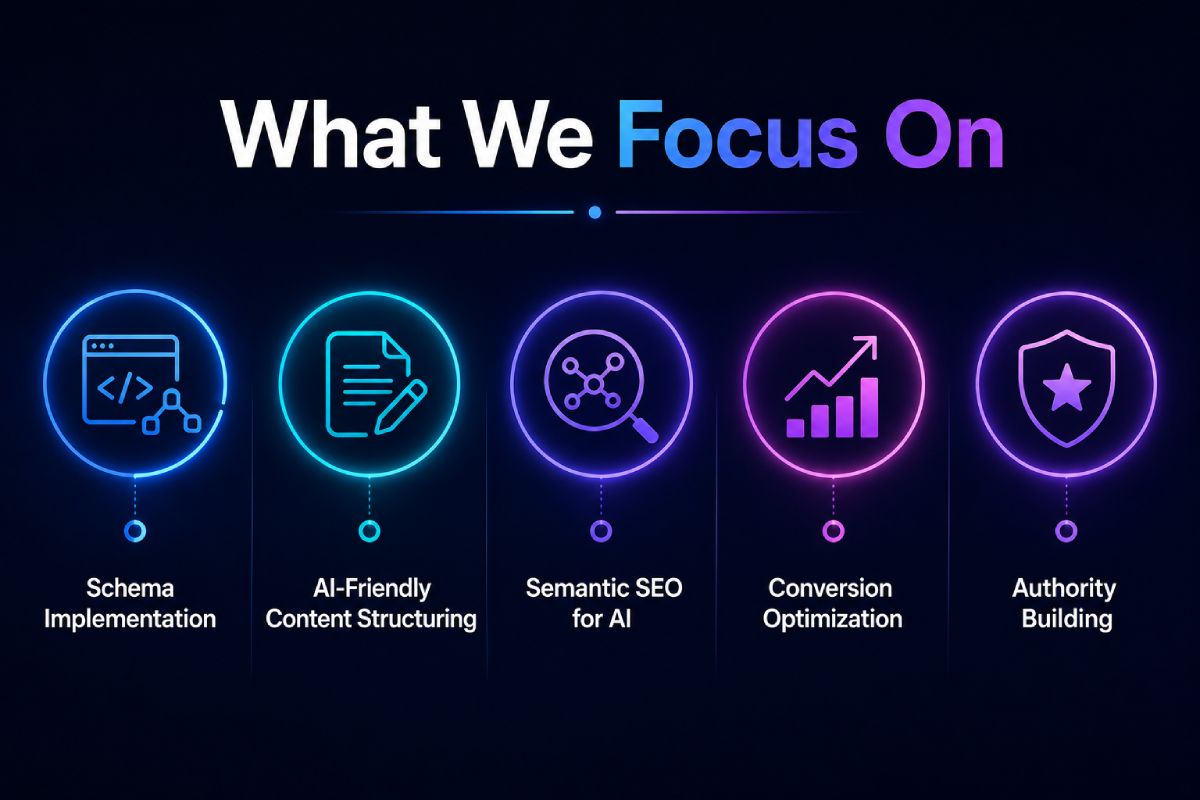
What We Focus On
Schema Implementation
Structured data is implemented across key pages to ensure AI systems can accurately interpret your offerings, pricing, and services.
AI-Friendly Content Structuring
Content is rewritten to prioritize clarity and intent, making it easier for both users and AI agents to extract meaningful information.
Semantic SEO for AI
Instead of focusing only on keywords, Ideamagix builds content around topics and intent, aligning with how AI systems understand relationships between concepts.
Conversion Optimization
Traffic alone does not drive growth. Conversion-focused strategies ensure that increased visibility translates into leads and revenue.
Authority Building
Strong authority signals are developed through:
- backlinks from trusted sources
- brand mentions across platforms
- positive reviews and reputation
Result-Oriented Goal
The ultimate objective is not just visibility, but measurable business growth:
👉 Traffic → AI Visibility → Leads → Revenue
Businesses looking to stay ahead of this shift can partner with Ideamagix to build a future-ready SEO and AI visibility strategy.
Conclusion: The Future Belongs to AI-Ready Businesses
The shift toward AI-driven discovery is already underway, and its impact will only grow stronger over time. Businesses that recognize this change early have a unique opportunity to position themselves ahead of competitors.
Visibility is no longer just about ranking; it is about being understood, trusted, and selected by AI systems.
What This Means Moving Forward
Businesses that adapt early will:
- dominate AI-driven visibility
- capture high-intent demand
- build long-term authority and trust
- reduce dependence on paid acquisition
On the other hand, businesses that delay may find themselves gradually losing relevance in a system where AI controls discovery.
Final Insight:
The future of marketing is not about being seen everywhere. It is about being chosen at the moment of decision. The opportunity is massive, but the window to act is limited.
FAQs
What are AI agents in marketing?
AI agents are intelligent systems that search, analyze, and recommend products or services on behalf of users.
Will SEO become obsolete?
No, SEO is evolving into AI-focused optimization.
How do AI agents choose businesses?
They evaluate structured data, content clarity, reputation, and freshness.
How can I prepare my website?
Focus on schema markup, content clarity, and technical SEO.
Is this shift already happening?
Yes, adoption is growing rapidly and is expected to accelerate.