
Introduction
Social media marketing has evolved from simply publishing posts several times a week into a much broader customer acquisition and brand-building function. For businesses in Mumbai, social platforms can support multiple stages of the customer journey from discovering a brand and evaluating its credibility to generating enquiries, remarketing to interested prospects, and converting existing audiences into customers.
However, the term social media marketing services can mean very different things from one agency to another. One provider may only create graphics and publish posts, while another may handle strategy, content production, paid advertising, community management, influencer campaigns, analytics, lead generation, and conversion optimization. This difference is important because businesses comparing agencies may assume that two proposals offer the same service when their scopes are actually completely different.
Professional social media management services in Mumbai should therefore be evaluated based on what the agency is responsible for, which platforms are included, how content is developed, how campaigns are optimized, and how results are measured. The objective should not be to maximize the number of posts published each month. It should be to create a social media system that supports measurable business objectives.
For a B2B company, that may mean building authority on LinkedIn and generating qualified enquiries. For an ecommerce company, the focus may be product discovery, retargeting, catalog campaigns, and purchases. For a local business, social media may support awareness, enquiries, appointments, reviews, and repeat customers. The correct strategy therefore depends on the business model, audience, sales cycle, and commercial goals.
This guide breaks down what you should expect from professional social media agency services, including Instagram Marketing, Facebook Ads, LinkedIn Marketing, Content Creation, Influencer Marketing, strategy, execution, reporting, and expected results. Social media marketing services Mumbai can help businesses build a consistent and measurable social presence.
What Do Social Media Marketing Services Mumbai Actually Include?
Professional social media engagement usually consists of several interconnected activities rather than one isolated service. Strategy determines what should be communicated, content production turns that strategy into creative assets, publishing distributes those assets, paid campaigns expand reach, and analytics determines what should be improved.
The strongest social media marketing company in Mumbai will connect these activities rather than treating them as separate deliverables. For example, a high-performing Instagram Reel can provide creative insights for a paid campaign, while audience engagement can reveal questions that should become future content. Similarly, LinkedIn engagement data can help identify which business problems resonate most strongly with B2B decision-makers.
A comprehensive engagement may include:
- Social media strategy
- Platform research
- Audience research
- Competitor analysis
- Content calendars
- Copywriting
- Graphic design
- Reels and video content
- Community management
- Instagram marketing
- Facebook advertising
- LinkedIn marketing
- Remarketing
- Influencer campaigns
- Lead generation
- Analytics
- Monthly reporting
- Conversion optimization
The exact combination should depend on the business rather than following a fixed package for every client. Choosing social media marketing services Mumbai with a clearly defined scope can help businesses align content, paid campaigns, audience engagement, and measurable growth objectives.
Strategy Comes Before Content
One of the most common weaknesses in social media marketing is starting with content production before defining the commercial objective. Publishing attractive graphics without understanding the target audience, buying journey, competitive environment, or business goals can create activity without meaningful results.
A professional strategy should first determine who the business needs to reach, what those people care about, which platforms they use, and what action the company wants them to take. The content and advertising strategy should then be built around those answers.
For example, a B2B software company may need content that establishes technical credibility, demonstrates use cases, answers objections, and generates demo requests. A fashion brand may require visually compelling product content, creator collaborations, promotional campaigns, and retargeting. Treating both businesses with the same posting strategy would waste the strengths of each platform.
What a Social Media Strategy Should Define
A detailed strategy should establish:
Business Objectives
Examples include:
- brand awareness
- lead generation
- ecommerce sales
- website traffic
- app downloads
- event registrations
- customer retention
Target Audience
Define:
- demographics
- location
- interests
- professional roles
- buying behaviour
- pain points
- purchase intent
Platform Strategy
Determine whether the business should prioritize:
- YouTube
- X
- other relevant platforms
Content Strategy
Define the balance between:
- educational content
- promotional content
- authority content
- product content
- customer stories
- testimonials
- entertainment
- industry insights
Conversion Strategy
Every platform should have a clear path toward the desired action.
That could be:
Social Content → Website → Landing Page → Enquiry
or: Ad → Product Page → Checkout → Purchase
or: LinkedIn Content → Profile/Website → Consultation → Sales Call
This is what separates strategic social media marketing in Mumbai from simply maintaining social profiles.
Instagram Marketing
Instagram is particularly valuable for businesses where visual communication, brand identity, products, people, or customer experiences influence purchasing decisions. However, effective Instagram marketing is much more than uploading images to a company profile. Modern Instagram strategies typically combine Reels, Stories, carousels, static posts, community engagement, creator collaborations, paid advertising, and conversion-focused campaigns.
Instagram Marketing Strategy
The first step is determining what role Instagram should play in the overall customer journey. For some businesses, Instagram is primarily an awareness channel. For others, it can directly generate enquiries, product sales, appointments, or website traffic.
A strategy may include:
- audience research
- competitor analysis
- content pillars
- visual identity
- Reel strategy
- Story strategy
- promotional campaigns
- creator collaborations
- paid amplification
The content should reflect the audience’s interests rather than simply describing the company’s services.
Instagram Content Execution
Execution may include:
- static posts
- carousel posts
- Reels
- Stories
- product demonstrations
- behind-the-scenes content
- customer testimonials
- educational videos
- founder-led content
- FAQs
The format should match the message. For example, a complex educational topic may work better as a carousel, while a product demonstration may be more effective as a short-form video.
Instagram Paid Advertising
Organic content and paid advertising should work together.
Successful Instagram advertising can target users based on:
- interests
- behaviours
- demographics
- engagement
- website activity
- customer lists
- previous interactions
Retargeting can reconnect with users who have already interacted with your brand but haven’t yet converted.
Expected Instagram Results
Results should not be measured only by follower growth.
Depending on the campaign objective, relevant KPIs include:
- reach
- engagement rate
- video views
- profile visits
- website traffic
- enquiries
- leads
- purchases
- cost per acquisition
A business with 10,000 highly relevant followers can generate more revenue than one with 100,000 unrelated followers.
Key Insight: Instagram success should be measured by the quality of audience engagement and its contribution to business objectives, not follower count alone.
Facebook Ads
Facebook remains an important advertising platform because of its extensive audience data, targeting capabilities, retargeting options, and integration with Meta’s broader advertising ecosystem. For businesses, Facebook advertising can support awareness, lead generation, ecommerce sales, remarketing, and customer retention. Its value depends heavily on campaign structure, audience quality, creative testing, conversion tracking, and landing-page experience.
Facebook Ads Strategy
A professional strategy starts by defining the conversion objective.
Campaign objectives may include:
- lead generation
- website conversions
- ecommerce purchases
- traffic
- awareness
- remarketing
The audience strategy should then be built around the buying journey.
Audience Segmentation
Campaigns can differentiate between:
Cold Audiences
People who have not interacted with your brand.
Warm Audiences
People who have:
- visited your website
- watched videos
- interacted with social content
- engaged with advertisements
Existing Customers
People who have previously purchased or submitted enquiries. Each audience requires different messaging. A cold audience may need education and trust-building, while a warm audience may respond better to a case study, offer, product demonstration, or consultation CTA.
Facebook Ad Creative
Creative testing is a major component of campaign performance.
Test:
- headlines
- images
- videos
- Reels
- offers
- CTAs
- testimonials
- problem-focused messaging
Instead of assuming which creative will perform best, campaigns should generate data through controlled testing.
Expected Facebook Advertising Results
Depending on the business model, KPIs can include:
- Cost Per Lead
- Cost Per Purchase
- Conversion Rate
- Return on Ad Spend
- Revenue
- Qualified Leads
- Customer Acquisition Cost
High engagement doesn’t necessarily mean high commercial performance. A successful campaign is one that moves the right audience toward a valuable business action.
LinkedIn Marketing
LinkedIn is particularly important for B2B businesses because professional identity, industry expertise, company information, and decision-maker relationships are central to the platform.
For B2B companies, LinkedIn can support:
- brand authority
- thought leadership
- lead generation
- recruitment
- partnerships
- enterprise sales
- account-based marketing
However, simply reposting company announcements rarely creates meaningful B2B demand.
LinkedIn Marketing Strategy
A strong LinkedIn strategy should identify:
- target industries
- decision-makers
- job functions
- seniority levels
- company sizes
- geographic markets
Content should then address the problems those audiences face. For example, instead of publishing: “We offer software development services.”
A stronger B2B content strategy might discuss:
- software architecture decisions
- development costs
- common implementation mistakes
- technology selection
- enterprise security
- digital transformation challenges
This demonstrates expertise before the sales conversation begins.
LinkedIn Content
Effective B2B LinkedIn content can include:
- industry insights
- founder perspectives
- case studies
- client outcomes
- educational posts
- research
- expert opinions
- business frameworks
- project stories
Employee and founder profiles can also play an important role because people often engage more strongly with expert perspectives than generic corporate messaging.
LinkedIn Lead Generation
Paid LinkedIn campaigns can target audiences based on professional characteristics such as:
- job title
- company
- industry
- seniority
- company size
- skills
This makes LinkedIn particularly useful for businesses selling high-value B2B products or services. However, targeting precision alone doesn’t guarantee results. The offer, creative, landing page, follow-up process, and sales qualification system must work together.
Expected LinkedIn Results
Depending on the objective, businesses can measure:
- qualified reach
- engagement
- website visits
- content interactions
- demo requests
- lead quality
- sales opportunities
- pipeline contribution
For B2B businesses, the number of leads isn’t always the most important metric. Qualified pipeline generated can be a much more meaningful measurement.
Content Creation
Content is the foundation connecting organic social media and paid campaigns. However, professional content creation involves much more than designing a fixed number of graphics every month. Content needs to be based on audience research, business positioning, platform behaviour, and the buyer journey.
A strong content operation can include:
- content strategy
- topic research
- copywriting
- graphic design
- video production
- Reels
- carousels
- Stories
- founder content
- case studies
- customer testimonials
Content Pillars
A business should generally have several recurring content pillars.
For example:
Educational
Teach the audience something useful.
Authority
Demonstrate expertise.
Product/Service
Explain what the business offers.
Proof
Show results, testimonials, reviews, and case studies.
Brand
Communicate culture, people, values, and positioning.
Conversion
Give users a reason to enquire, purchase, book, or contact. This prevents social profiles from becoming repetitive promotional feeds.
Content Creation Process
A professional workflow typically follows:
Research → Strategy → Content Calendar → Copy → Design/Production → Review → Publishing → Performance Analysis → Optimization
This feedback loop is important. If educational videos consistently outperform static promotional graphics, the strategy should adapt accordingly. Social media should become a learning system, not simply a publishing schedule.
Influencer Marketing
Influencer marketing can be powerful when the creator’s audience closely matches the business’s target market. However, follower count alone is a poor method for selecting influencers. A creator with 50,000 highly relevant followers may be more valuable to a business than one with 500,000 general followers.
Influencer Selection Strategy
Evaluate:
- audience demographics
- audience location
- engagement quality
- content relevance
- brand fit
- previous collaborations
- audience authenticity
- conversion potential
For local businesses, Mumbai-specific creators may provide stronger relevance than national influencers with a broader audience.
Influencer Campaign Execution
A campaign can include:
- product reviews
- demonstrations
- tutorials
- testimonials
- event coverage
- creator-generated content
- sponsored Reels
- Stories
- affiliate campaigns
The campaign should define the desired action before creators are selected.
Possible objectives include:
- awareness
- website traffic
- enquiries
- app installs
- purchases
- content generation
Expected Influencer Marketing Results
Measure campaigns using:
- reach
- engagement
- video views
- website visits
- enquiries
- coupon usage
- tracked purchases
- cost per acquisition
For mature campaigns, use unique links, discount codes, landing pages, or other attribution methods to understand commercial impact.
Key Insight: Influencer marketing works best when creator selection is based on audience relevance and business objectives rather than follower numbers alone.
Strategy → Execution → Expected Results
A useful way to evaluate social media agency services is to examine the complete chain from strategy to measurable outcome.
| Area | Strategy | Execution | Expected Business Outcome |
| Visual discovery & engagement | Reels, Stories, carousels, ads | Awareness, engagement, enquiries | |
| Facebook Ads | Audience & conversion targeting | Paid campaigns, retargeting | Leads, purchases |
| B2B authority & decision-maker targeting | Thought leadership, ads | Qualified leads, pipeline | |
| Content | Audience & buyer journey | Design, video, copy | Engagement, trust |
| Influencer | Audience relevance | Creator campaigns | Reach, awareness, conversions |
The key point is that no single activity should be evaluated in isolation. Content creates attention. Paid advertising expands reach. Remarketing brings interested users back. Landing pages convert traffic. Analytics identifies what’s working. Together, these activities create a measurable marketing funnel.

What Are Social Media Management Services in Mumbai?
Social media management services in Mumbai involve the ongoing planning, creation, publishing, monitoring, optimization, and analysis of a company’s social media presence.
A professional management service should connect daily social activity to broader marketing and business objectives. This means the agency should know why a particular post is being published, which audience it is intended for, what action users should take, and how its performance will be evaluated.
Management may cover:
- Content calendar planning
- Post creation
- Copywriting
- Graphic design
- Reels and video
- Publishing
- Community management
- Comment monitoring
- Message management
- Paid advertising
- Competitor monitoring
- Analytics
- Monthly reporting
- Strategy refinement
The scope should be clearly defined before the engagement begins because “management” can mean very different things between agencies. Choosing the right social media management services Mumbai helps maintain consistency across platforms.
Community Management
Social media is not simply a broadcasting channel. Customers expect businesses to respond to questions, comments, complaints, feedback, and direct messages. Community management is the process of monitoring these interactions and ensuring that relevant conversations receive timely responses. For a business, this can directly influence customer perception because prospective customers often observe how a company responds publicly before deciding whether to engage.
What Community Management Includes
Depending on the engagement, an agency may manage:
- Comments
- Instagram DMs
- Facebook messages
- LinkedIn interactions
- Mentions
- Reviews
- Frequently asked questions
- Customer complaints
The agency should also establish escalation rules for situations requiring involvement from the client’s internal team. For example, a general product question may be answered by the social media team, while a pricing dispute or technical complaint may need to be escalated to sales or customer support.
Why Community Management Matters
Active community management helps businesses:
- build trust
- improve customer relationships
- identify recurring questions
- discover customer objections
- protect brand reputation
- identify sales opportunities
It also provides valuable information for the content strategy. If customers repeatedly ask the same question in comments or messages, that question can become a future Reel, carousel, FAQ, or blog article.
Key Insight: Community management isn’t simply replying to comments. It creates a feedback loop between customers, content strategy, sales, and brand reputation.
Social Media Advertising
Organic social media can build awareness and engagement, but paid advertising allows businesses to deliberately reach specific audiences and scale successful content. A professional social media advertising strategy should be built around measurable objectives rather than simply “boosting posts.”
Campaign objectives may include:
- lead generation
- website conversions
- ecommerce purchases
- remarketing
- app installs
- event registrations
- awareness
Paid Social Campaign Structure
A structured campaign may include:
Cold Audience
↓
Awareness / Education
↓
Engaged Audience
↓
Remarketing
↓
Conversion Campaign
↓
Lead / Purchase
This structure allows businesses to communicate differently with people depending on how familiar they are with the brand. Someone discovering your business for the first time may need educational content, while someone who visited your pricing page yesterday may be ready for a consultation offer.
Remarketing
Remarketing is particularly important because many users don’t convert during their first interaction with a business.
A potential customer may:
- visit the website
- view a product
- watch a video
- read a service page
- engage with an Instagram profile
and then leave without taking action. Remarketing allows the business to reconnect with those users.
Remarketing Audiences
Depending on the platform and setup, audiences can include people who:
- visited the website
- viewed specific pages
- watched videos
- interacted with social content
- submitted partial forms
- added products to carts
- previously purchased
Different audiences should receive different messaging. A previous customer should not necessarily receive the same advertisement as someone who has never heard of the brand.
Social Media Analytics & Reporting
One of the most important differences between professional social media agency services and basic social media management is the quality of reporting. A monthly report shouldn’t simply say: “20 posts published.”
It should explain:
- what happened
- why it happened
- what performed well
- what underperformed
- what the audience responded to
- what should change next month
Organic Social Media Metrics
Depending on the platform, track:
- Reach
- Impressions
- Engagement
- Engagement rate
- Video views
- Watch time
- Profile visits
- Follower growth
- Website clicks
- Saves
- Shares
However, these metrics should be interpreted in context. A post with fewer likes but many saves and website visits may have significantly more commercial value than a highly entertaining post with thousands of likes but no business impact.
Paid Social Media Metrics
Paid campaigns should additionally track:
- CPM
- CPC
- CTR
- Cost Per Lead
- Cost Per Purchase
- Conversion Rate
- ROAS
- Customer Acquisition Cost
For lead-generation campaigns, lead quality should also be tracked. Generating 500 low-quality enquiries is not necessarily better than generating 50 qualified leads.
Competitor Analysis
Social media strategies should not be created in isolation. A professional social media marketing company in Mumbai should regularly analyze competitors to understand how the market communicates with customers.
Competitor research can reveal:
- content themes
- posting formats
- offers
- audience engagement
- creative styles
- advertising messages
- influencer collaborations
- customer complaints
- positioning gaps
The objective isn’t to copy competitors. It is to identify opportunities for differentiation.
What to Look for in Competitor Content
Ask:
- What topics receive the most engagement?
- Which formats perform consistently?
- What questions do customers ask?
- What offers are competitors promoting?
- Which customer pain points are they addressing?
- Where are competitors weak?
For example, if competitors focus heavily on promotional content but rarely publish educational material, a business can potentially differentiate itself through expert-led content. Reliable social media management services mumbai can simplify content planning, publishing, and monitoring.
Social Media Strategy by Business Type
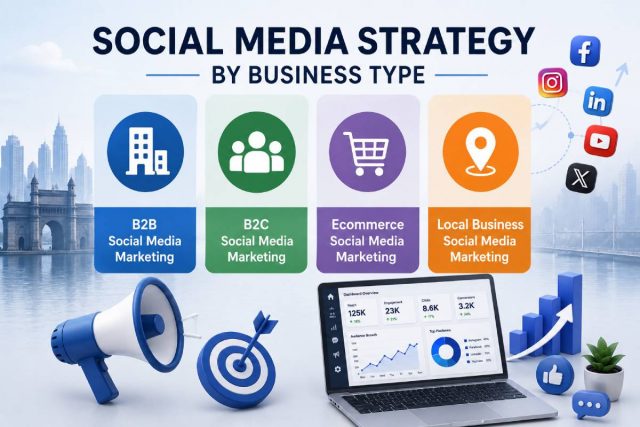
There is no universal social media strategy that works for every business.
The right platform mix and content strategy depend on the business model, audience, buying cycle, and average customer value.
B2B Social Media Marketing
B2B companies typically require a longer customer journey. A potential customer may interact with a company several times before becoming a sales opportunity.
For B2B, platforms such as LinkedIn can support:
- thought leadership
- executive visibility
- industry education
- lead generation
- account-based marketing
- employer branding
Content should focus on business problems rather than constant promotion.
Examples include:
- industry trends
- implementation guides
- case studies
- cost comparisons
- expert opinions
- technical insights
- customer results
The objective is to make the company recognizable and credible before the buyer enters a sales conversation.
B2C Social Media Marketing
B2C businesses often have shorter buying journeys and can leverage visual and emotional content more aggressively.
Depending on the product, strategies may focus on:
- YouTube
- influencer marketing
- product demonstrations
- promotions
- customer-generated content
Creative testing becomes particularly important because consumers respond differently to different visual styles, offers, and messages.
Ecommerce Social Media Marketing
For ecommerce businesses, social media can support the entire customer journey.
A typical funnel might be:
Product Discovery
↓
Content Engagement
↓
Product Page
↓
Remarketing
↓
Purchase
↓
Repeat Purchase
Social campaigns can promote:
- new products
- best sellers
- offers
- bundles
- customer reviews
- demonstrations
Performance should ultimately be evaluated against revenue and profitability rather than engagement alone.
Local Business Social Media Marketing
Mumbai businesses serving specific geographic areas can use social media to build strong local awareness.
Potential strategies include:
- location-specific content
- customer testimonials
- local creator collaborations
- events
- offers
- educational content
- behind-the-scenes content
The strategy should connect social discovery with measurable actions such as:
- calls
- WhatsApp enquiries
- bookings
- store visits
- website enquiries
For local businesses, audience relevance is often more valuable than maximum reach.
Organic vs Paid Social Media Marketing
Businesses frequently ask whether they should invest in organic social media or paid advertising. The strongest strategy is often to use both.
| Organic Social | Paid Social |
| Builds long-term brand presence | Provides immediate distribution |
| Develops community | Scales reach |
| Builds authority | Supports lead generation |
| Relatively slower growth | Faster audience acquisition |
| Content-led | Campaign-led |
| Builds trust | Drives measurable actions |
Organic content creates a foundation. Paid advertising accelerates distribution. Together, they create a stronger social media ecosystem. Effective social media marketing services Mumbai can help businesses improve reach, engagement, and conversions.
How Organic and Paid Social Work Together
Suppose a company publishes a Reel explaining a common customer problem. The Reel performs significantly better than the average post.
Instead of treating that performance as an isolated result, the business can:
- Analyze why the Reel performed well.
- Create related content.
- Turn the concept into an advertisement.
- Target relevant audiences.
- Retarget people who watched the video.
- Send high-intent users to a conversion-focused landing page.
This creates a continuous learning cycle.
Organic Content → Data → Paid Campaign → Conversion → New Insights → Better Content
This is significantly more effective than running organic and paid marketing as completely separate activities.
How Long Does Social Media Marketing Take to Produce Results?
There is no universal timeframe because results depend on:
- industry
- audience size
- competition
- platform
- creative quality
- budget
- offer
- website conversion rate
- sales process
However, businesses should distinguish between early indicators and commercial outcomes.
First 30 Days: Foundation & Learning
The initial period is often focused on:
- audience research
- content testing
- creative testing
- campaign setup
- baseline measurement
Early data helps identify which audiences, topics, formats, and messages deserve greater investment.
30–90 Days: Optimization
Once sufficient data is available, the strategy can become more precise.
Teams can identify:
- best-performing content
- strongest audiences
- effective creative formats
- conversion opportunities
- inefficient campaigns
Budgets can then be redistributed toward higher-performing areas.
90+ Days: Scaling
With a mature data set, businesses can begin scaling proven campaigns and content formats.
This may involve:
- expanding audiences
- increasing budgets
- launching new creative
- introducing remarketing
- testing new platforms
- influencer campaigns
Long-term social media success comes from continuously improving the system rather than expecting one viral post to transform the business.
How to Measure Social Media Marketing ROI
ROI is one of the most important topics when evaluating social media marketing in Mumbai. Businesses shouldn’t evaluate an agency solely on followers, likes, or reach. The right KPI depends on the commercial objective.
For Brand Awareness
Measure:
- qualified reach
- impressions
- video views
- brand searches
- audience growth
For Lead Generation
Measure:
- leads
- qualified leads
- Cost Per Lead
- Cost Per Qualified Lead
- conversion rate
- sales opportunities
For Ecommerce
Measure:
- purchases
- revenue
- ROAS
- Customer Acquisition Cost
- average order value
- repeat purchases
For B2B
Measure:
- qualified enquiries
- meetings
- sales opportunities
- pipeline value
- customer acquisition cost
- revenue generated
The most important principle is simple: Social media metrics should ultimately connect to business metrics.
Common Social Media Marketing Mistakes Businesses Make
Even businesses investing significant amounts in social media can underperform when their strategy is poorly structured.
Posting Without a Strategy
Publishing content simply to maintain activity creates inconsistent messaging and weak audience positioning. Every content piece should have a purpose.
Focusing on Followers Instead of Customers
Follower growth can be useful, but it doesn’t automatically produce revenue. A smaller, relevant audience can be significantly more valuable.
Using the Same Content Everywhere
Instagram, Facebook, and LinkedIn have different audience behaviours and content formats. Republishing identical content everywhere often produces weak engagement. Content should be adapted to each platform.
Over-Promotional Content
If every post says:
“Buy Now.”
“Contact Us.”
“Get Our Services.”
the audience quickly loses interest.
A strong content mix balances:
Education + Authority + Engagement + Proof + Promotion
Ignoring Comments and Messages
Social media is designed for interaction. Slow or inconsistent responses can damage customer trust and result in missed sales opportunities.
No Conversion Tracking
Without tracking, businesses cannot determine which campaigns generate actual business results.
Tracking should connect social platforms with:
- website analytics
- forms
- CRM
- ecommerce systems
What Should You Look for in a Social Media Marketing Company in Mumbai?
When comparing providers, don’t evaluate agencies only by the number of posts they promise. Instead, examine the complete system they provide.
A strong agency should demonstrate capability across:
- strategy
- content
- design
- video
- paid advertising
- community management
- analytics
- conversion optimization
Ask how the agency defines success and what happens when campaigns don’t perform as expected.
Questions to Ask an Agency
Before signing an agreement, ask:
- Which platforms do you recommend for our business and why?
- How will you research our target audience?
- What content strategy will you use?
- Who creates the content?
- Are Reels and videos included?
- Is paid advertising included?
- How will you measure lead quality?
- How frequently will campaigns be optimized?
- What reporting will we receive?
- How do you calculate social media ROI?
- Do you manage comments and messages?
- Do you provide influencer marketing?
- How do you handle negative comments?
- Can you integrate campaigns with our CRM?
- How will social media support our overall SEO and digital marketing strategy?
The answers reveal whether you’re hiring a content publisher or a strategic marketing partner.
Social Media Marketing Services: What a Complete Engagement Can Look Like
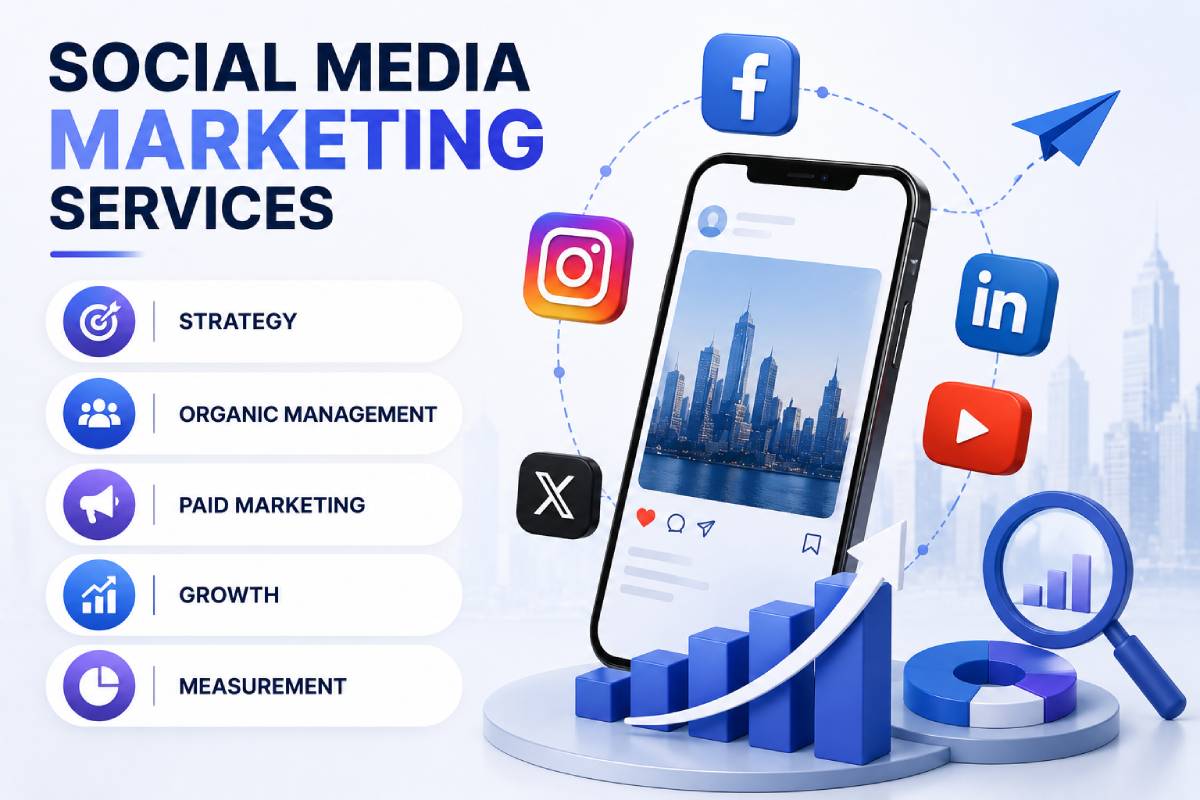
A comprehensive engagement can be organized into several layers.
Strategy
- Business objectives
- Audience research
- Competitor research
- Platform selection
- Content pillars
- Funnel strategy
Organic Management
- Content calendar
- Copywriting
- Design
- Reels
- Stories
- Publishing
- Community management
Paid Marketing
- Campaign setup
- Audience targeting
- Creative testing
- Retargeting
- Budget optimization
- Conversion tracking
Growth
- Influencer campaigns
- Lead generation
- Landing pages
- Conversion optimization
- Audience expansion
Measurement
- Analytics
- Monthly reports
- Campaign analysis
- ROI measurement
- Strategy refinement
This gives businesses a much clearer understanding of what they are actually paying for when purchasing professional social media agency services.
The Complete Social Media Marketing Cycle
A mature social media program should follow a continuous cycle:
Research
↓
Strategy
↓
Content Creation
↓
Publishing
↓
Paid Distribution
↓
Community Engagement
↓
Data Collection
↓
Performance Analysis
↓
Optimization
↓
Scaling
↓
New Strategy
This cycle should repeat every month. The strategy shouldn’t remain static because customer behaviour, competitors, platforms, creative trends, and business priorities continuously change.
Social Media Marketing Pricing in Mumbai
The cost of social media marketing services in Mumbai depends on the scope of work rather than simply the number of posts published each month.
Factors that influence pricing include:
- Number of platforms
- Content volume
- Graphic design requirements
- Video and Reel production
- Paid advertising management
- Advertising budget
- Community management
- Influencer campaigns
- Strategy and research
- Photography or videography
- Reporting requirements
- Landing-page requirements
- Lead-generation objectives
A business requiring three static posts every week has very different requirements from an ecommerce company requiring daily Reels, product creatives, Meta Ads, remarketing, influencer campaigns, and conversion tracking.
Typical Social Media Marketing Packages in Mumbai
The following ranges can be used as a planning benchmark rather than a fixed market price.
| Service Level | Approx. Monthly Agency Fee | Suitable For |
| Basic Social Media Management | ₹15,000–₹30,000 | Small businesses building a consistent presence |
| Growth Social Media Management | ₹30,000–₹60,000 | Growing brands requiring strategy + content |
| Performance Social Media Marketing | ₹60,000–₹1.5 Lakhs+ | Lead generation and ecommerce businesses |
| Integrated Social Media + Paid Ads | ₹75,000–₹2 Lakhs+ | Businesses focused on measurable acquisition |
| Enterprise Social Media | ₹2 Lakhs+ | Multi-location or large organizations |
Advertising spend is generally separate from the agency management fee. The final investment should be determined after understanding the business objectives, audience, platforms, creative requirements, and expected acquisition targets.
What Should a Social Media Marketing Package Include?
A good package should clearly define deliverables rather than simply stating “social media management.” At minimum, a strategic engagement should explain what is included across five areas:
Strategy
- Audience research
- Competitor analysis
- Platform strategy
- Content pillars
- Campaign planning
Content
- Content calendar
- Copywriting
- Graphic design
- Carousels
- Reels
- Stories
Management
- Publishing
- Community management
- Comment monitoring
- Message management
Advertising
- Campaign setup
- Audience targeting
- Creative testing
- Retargeting
- Budget optimization
Measurement
- Analytics
- Monthly reporting
- Performance analysis
- Recommendations
- Strategy refinement
This makes it much easier to compare different social media agency services objectively.
Basic Social Media Management Package
A basic package is generally appropriate for businesses that need to establish or maintain a professional presence but don’t yet require aggressive lead generation.
The focus is usually on:
- content planning
- static graphics
- basic captions
- scheduled publishing
- profile management
- basic reporting
This can work well for:
- local businesses
- professional services
- small startups
- early-stage brands
However, businesses shouldn’t expect a basic publishing package to produce the same results as a comprehensive performance marketing engagement.
Growth Social Media Package
A growth-oriented package adds greater strategic depth.
It may include:
- audience research
- competitor analysis
- content strategy
- Reels
- carousels
- Stories
- community management
- monthly campaign planning
- performance reporting
This model is appropriate for businesses that want to build authority while gradually increasing engagement and inbound enquiries. The key difference is that content is created based on measurable audience insights rather than simply filling a monthly calendar.
Performance Social Media Package
Performance-focused social media management is designed around measurable acquisition.
It typically combines:
- organic content
- paid advertising
- audience segmentation
- retargeting
- conversion tracking
- landing pages
- creative testing
- lead optimization
- campaign reporting
The primary KPIs may include:
- qualified leads
- Cost Per Lead
- Cost Per Acquisition
- conversion rate
- revenue
- ROAS
This approach is particularly relevant to ecommerce, education, healthcare, real estate, SaaS, professional services, and other businesses where customer acquisition can be tracked.
Should Advertising Spend Be Included in the Agency Fee?
Usually, the advertising budget and agency management fee should be treated separately.
For example:
Agency Management Fee: ₹50,000/month
Meta Advertising Budget: ₹1,50,000/month
This separation makes financial reporting clearer because the client can distinguish between:
- The cost of managing and optimizing campaigns.
- The actual amount paid to the advertising platform.
It also makes it easier to scale advertising independently when campaign performance improves.
Influencer Marketing Pricing
Influencer campaigns can vary dramatically in cost.
Pricing depends on:
- creator size
- niche
- audience location
- engagement
- content format
- number of deliverables
- exclusivity
- usage rights
- campaign duration
A micro-influencer may charge significantly less than a celebrity creator, but the smaller creator may provide a more relevant audience and stronger engagement. For this reason, influencer selection should be based on audience relevance and commercial objectives, not follower count alone.
How to Compare Social Media Marketing Companies in Mumbai
When evaluating a social media marketing company in Mumbai, create a comparison framework instead of choosing the lowest quotation.
| Evaluation Area | What to Check |
| Strategy | Is there a documented strategy? |
| Audience Research | Does the agency research customers? |
| Content | Who creates the content? |
| Video | Are Reels/videos included? |
| Platforms | Which platforms are managed? |
| Paid Ads | Is advertising management included? |
| Community | Are comments and DMs managed? |
| Analytics | What metrics are reported? |
| Conversion Tracking | Are leads and sales tracked? |
| Optimization | How often is strategy changed? |
| Influencers | Is creator management available? |
| Reporting | Are insights included or just numbers? |
| Support | Who handles communication? |
A higher-priced agency can actually be more cost-effective if its strategy generates significantly better commercial outcomes. Effective social media management services Mumbai should include regular performance tracking and optimization.
What Results Should You Expect From Social Media Marketing?
There is no universal number of followers, leads, or sales that an agency can legitimately guarantee because results depend on numerous variables outside the agency’s control.
These include:
- market demand
- competition
- offer
- pricing
- audience
- creative quality
- advertising budget
- website conversion rate
- sales follow-up
- product-market fit
Instead of expecting a guaranteed number of leads, establish performance benchmarks and improvement targets.
Early-Stage Results
During the initial phase, the objective may be to establish:
- audience understanding
- baseline engagement
- creative benchmarks
- platform performance
- initial conversion data
The agency should use this information to identify what deserves additional investment.
Growth-Stage Results
Once enough data has accumulated, the strategy should increasingly focus on:
- stronger engagement
- qualified traffic
- lower acquisition costs
- higher conversion rates
- better-performing creative
- audience expansion
Mature Campaign Results
A mature social media program should have enough data to identify:
- highest-value audiences
- strongest content themes
- most efficient campaigns
- best-performing platforms
- profitable acquisition channels
At this stage, the objective becomes scaling what works without allowing acquisition costs to increase disproportionately.
What a Good Monthly Social Media Report Should Tell You
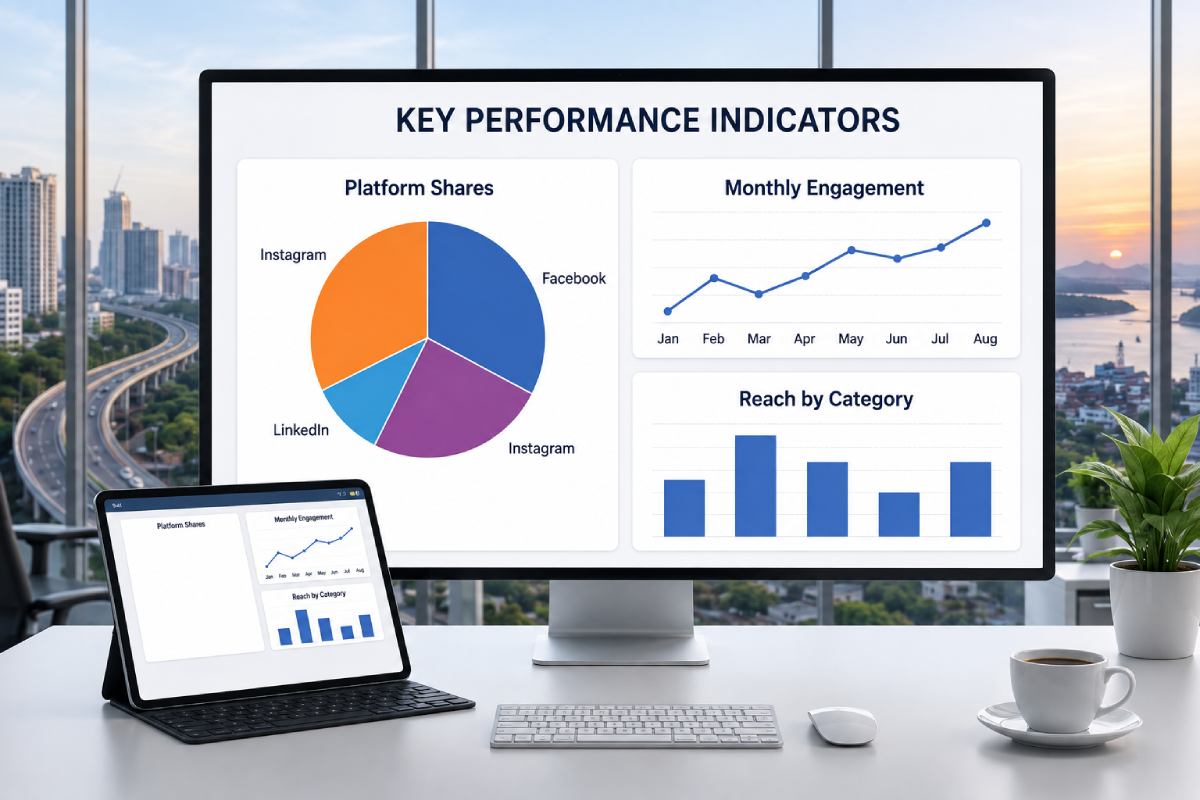
A professional report should answer four questions:
What happened?
Show relevant performance data.
Why did it happen?
Explain the factors behind performance changes.
What did we learn?
Identify audience and creative insights.
What are we doing next?
Provide specific optimization actions.
For example, instead of saying:
“Instagram engagement increased by 18%.”
A useful report might explain:
“Short-form educational Reels generated 2.4× the average engagement of static promotional posts, while videos addressing pricing questions generated the highest number of profile visits. Next month, the content mix will increase educational Reels and use the strongest topics in paid retargeting campaigns.” That is actionable reporting.
How Social Media Marketing Supports the Entire Digital Marketing Funnel
Social media should not operate independently from SEO, paid advertising, website development, and content marketing.
A complete funnel can look like:
Social Discovery
↓
Content Engagement
↓
Website Visit
↓
Educational Content
↓
Remarketing
↓
Lead / Purchase
↓
Sales Follow-Up
↓
Customer
Different channels can contribute at different stages. For example, a customer may discover your company through Instagram, research your website through Google, read a blog, see a remarketing advertisement, and eventually contact your sales team. This is why professional social media marketing in Mumbai should be integrated with the broader digital marketing ecosystem.
How to Choose the Right Social Media Marketing Agency
Before selecting an agency, look beyond its follower count and portfolio.
A suitable agency should demonstrate:
Strategic Understanding
They should understand your business model, customer journey, competitive environment, and commercial goals.
Platform Expertise
They should be able to explain why Instagram, Facebook, LinkedIn, or another platform is appropriate for your specific audience.
Creative Capability
The agency should have the ability to create content that communicates your positioning rather than relying on repetitive templates.
Performance Marketing Expertise
If lead generation or ecommerce is important, the agency should understand paid advertising, tracking, retargeting, and conversion optimization.
Transparent Reporting
You should understand what is being measured and why those metrics matter. Social media marketing services Mumbai can help businesses build a more measurable social presence.
Continuous Optimization
A good agency should be willing to change its strategy when performance data indicates that something isn’t working.
12 Questions to Ask Before Hiring a Social Media Marketing Company
- Which platforms are most relevant to our business and why?
- How will you research our target audience?
- What will our content pillars be?
- Who creates the designs and videos?
- How many Reels, carousels, posts, and Stories are included?
- Is community management included?
- Is paid advertising included separately?
- How will you measure lead quality?
- How do you track social media ROI?
- What does your monthly report contain?
- How often will campaigns and content be optimized?
- What happens if the initial strategy doesn’t produce the expected results?
The agency’s answers should demonstrate a clear process rather than vague promises.
Why Businesses Should Avoid Choosing an Agency Based Only on Price
A low-cost social media package may look attractive initially, but it can become expensive if it produces little business value.
Suppose:
Agency A: ₹25,000/month
Agency B: ₹60,000/month
If Agency A generates 10 qualified enquiries and Agency B generates 50, comparing only the monthly retainer doesn’t make sense.
The correct question is: How much does it cost to acquire a qualified customer?
This changes the conversation from service cost to business value. The right agency should therefore be evaluated based on strategy, execution quality, lead quality, conversion contribution, and long-term growth, not simply the number of deliverables.
How Ideamagix Approaches Social Media Marketing
At Ideamagix, social media is treated as part of a broader digital growth strategy rather than an isolated content-publishing service.
Our approach connects:
Business Strategy
↓
Audience Research
↓
Platform Strategy
↓
Content Creation
↓
Organic Distribution
↓
Paid Advertising
↓
Remarketing
↓
Conversion Optimization
↓
Analytics
↓
Continuous Improvement
The objective is to create a measurable system where content generates attention, paid campaigns amplify successful messages, remarketing captures interested users, and analytics guides future decisions. Depending on the business, our strategy can incorporate Instagram marketing, Facebook Ads, LinkedIn marketing, content creation, influencer marketing, lead generation, and conversion-focused campaigns.
Frequently Asked Questions
1. What do social media marketing services in Mumbai include?
Professional social media marketing services can include strategy, audience research, competitor analysis, content planning, graphic design, video and Reel creation, publishing, community management, paid advertising, influencer campaigns, analytics, reporting, and ongoing optimization. The exact scope depends on the business objectives and selected platforms.
2. How much do social media marketing services cost in Mumbai?
Agency fees can range from approximately ₹15,000 per month for basic management to several lakhs for enterprise-level or performance-focused engagements. Pricing depends on content volume, platforms, creative requirements, paid advertising management, influencer campaigns, and reporting requirements.
3. What is the difference between social media management and social media marketing?
Social media management generally focuses on maintaining and operating social profiles, including content publishing and community management. Social media marketing has a broader scope and can include strategy, paid advertising, lead generation, remarketing, influencer campaigns, conversion optimization, and ROI measurement.
4. Which social media platform is best for my business?
There is no universally best platform. B2B companies may benefit significantly from LinkedIn, visually driven consumer brands may prioritize Instagram, and businesses with broad consumer audiences may use Facebook and Instagram together. Platform selection should be based on where your target customers actually spend time and how they make purchasing decisions.
5. How long does social media marketing take to produce results?
Initial insights can emerge within the first month, but meaningful optimization usually requires several months of consistent activity and data. The timeline depends on audience size, competition, advertising budget, content quality, offer strength, and conversion processes.
6. Does social media marketing guarantee leads or sales?
No legitimate agency should guarantee a fixed number of leads or sales without considering market conditions and the client’s offer, website, budget, and sales process. Professional agencies should instead establish measurable KPIs and continuously optimize campaigns based on performance data.
7. Should I invest in organic social media or paid advertising?
Most businesses can benefit from combining both. Organic content builds credibility, audience relationships, and brand presence, while paid advertising provides targeted distribution and can accelerate lead generation or sales. The appropriate balance depends on the business model and growth objectives.
8. Does social media marketing help SEO?
Social media activity can support broader digital visibility by increasing content distribution, brand awareness, website traffic, and opportunities for people to discover and reference your content. Social signals themselves should not be treated as a direct substitute for traditional SEO, but social and SEO strategies can reinforce each other.
9. Is influencer marketing suitable for every business?
No. Influencer marketing is most effective when a creator has a relevant and trustworthy audience that overlaps with the business’s target customers. B2B businesses may benefit more from industry experts and thought leaders, while consumer brands can often leverage creators with strong product discovery and purchasing influence.
10. How should social media ROI be measured?
ROI should be connected to the business objective. Lead-generation campaigns can be measured using qualified leads, Cost Per Lead, conversion rates, and pipeline value, while ecommerce campaigns should focus on revenue, ROAS, Customer Acquisition Cost, and purchases.
11. Should a social media agency manage comments and messages?
If community management is part of the engagement, the agency can monitor comments, mentions, and direct messages according to agreed response guidelines. Businesses should establish escalation procedures for complaints, technical questions, pricing disputes, and other matters requiring internal involvement.
12. How do I choose the best social media marketing company in Mumbai?
Compare agencies based on strategy, platform expertise, creative quality, paid advertising capability, reporting, community management, conversion tracking, industry experience, and communication. Don’t select an agency solely because it offers the lowest monthly price or the highest number of posts.
Final Thoughts
Effective social media marketing is no longer about maintaining a company’s profiles or publishing a predetermined number of posts every month. It is a combination of strategy, creative communication, audience development, paid distribution, community engagement, measurement, and continuous optimization. The right mix depends on your business.
A B2B company may need LinkedIn authority and lead generation. An ecommerce brand may need Instagram content, Meta Ads, creators, and remarketing. A local Mumbai business may need location-focused content, customer reviews, paid campaigns, and WhatsApp enquiries. The important thing is to build the strategy around business outcomes rather than platform activity.
When evaluating social media management services in Mumbai, ask what the agency will actually do, how those activities connect to your customer journey, how performance will be measured, and how the strategy will evolve based on data. A strong social media program should ultimately answer one question: Is our social media investment helping the business attract, engage, convert, and retain more valuable customers? If the answer is measurable, the strategy is working.
Ready to Build a Results-Driven Social Media Strategy?
If your business needs more than regular posting and wants a structured social media strategy designed around awareness, engagement, leads, and revenue, a strategic audit is a useful starting point.
A Social Media Strategy Review Can Include
- Current social profile audit
- Competitor analysis
- Audience and platform assessment
- Content gap analysis
- Paid campaign review
- Creative performance assessment
- Conversion funnel review
- 90-day social media roadmap
Get Your Social Media Strategy Consultation