
Introduction
One of the first questions businesses ask before launching an online advertising campaign is: “How much does Google Ads cost in India?”
It’s a valid question, but unlike traditional advertising channels, Google Ads doesn’t have a fixed price list. There isn’t a standard package that costs ₹25,000 or ₹1,00,000 per month. Instead, Google Ads operates through a real-time auction where pricing is influenced by several dynamic factors, including your industry, competition, target audience, keyword demand, campaign quality, bidding strategy, and business objectives.
This is why two companies advertising on Google can have completely different advertising costs, even if they’re targeting similar customers. A local dental clinic in Mumbai may pay ₹40–₹120 per click, while a software company targeting enterprise clients could pay ₹500–₹2,000 or more for the same click because of higher customer value and intense competition.
Another common misconception is that Google Ads is “expensive.” In reality, Google Ads is scalable. A startup can begin with a monthly budget of ₹20,000–₹30,000, while an enterprise business may invest several lakhs, or even crores, every month. The platform allows businesses to control budgets, optimize campaigns, and increase investment only when campaigns generate measurable returns.
However, advertising spend alone doesn’t determine success. Businesses also need to consider Google Ads management cost, landing page optimization, conversion tracking, creative assets, and continuous campaign optimization. A poorly managed campaign can waste significant budgets, while a well-optimized campaign often delivers a strong return on investment (ROI) even with modest spending.
This comprehensive guide explains everything you need to know about Google Ads cost in India, including:
- How Google Ads pricing works
- Average Google Ads pricing across industries
- Cost Per Click (CPC) benchmarks
- Google Ads management cost
- Google Ads agency pricing models
- Hidden costs businesses often overlook
- Monthly budget recommendations
- ROI examples and cost optimization strategies
Whether you’re a startup exploring Google Ads for the first time or an established business comparing Google Ads management services, this guide will help you make informed budgeting decisions and maximize the value of your advertising investment.
How Google Ads Pricing Actually Works?
Many businesses assume Google Ads works like newspaper or billboard advertising, where advertisers pay a fixed amount for a specific placement. In reality, Google Ads operates on a sophisticated auction system that evaluates every search in real time.
Every time someone searches on Google, an automated auction determines:
- Which advertisements appear
- In what order they appear
- How much each advertiser pays for a click
- Whether an ad appears at all
This entire process happens within milliseconds before the search results are displayed. The important point is that advertisers do not simply buy the top position. Google evaluates both the advertiser’s bid and the overall quality of the advertisement to decide which ads deserve the highest visibility.
Understanding the Google Ads Auction
Whenever a user enters a search query such as:
- Google Ads agency
- Google Ads management services
- Google Ads pricing
- PPC management services
Google identifies all advertisers targeting that keyword and enters them into an instant auction.
The system then evaluates several factors:
- Maximum bid amount
- Quality Score
- Ad relevance
- Expected Click-Through Rate (CTR)
- Landing page experience
- User context (location, device, time, audience signals)
The advertiser with the highest overall Ad Rank, not necessarily the highest bid, earns the better advertisement position. This means businesses can often outrank competitors while paying less simply by improving campaign quality.
What Is Cost Per Click (CPC)?
The most common Google Ads pricing model is Cost Per Click (CPC). Under this model, businesses pay only when someone clicks on their advertisement. If an ad receives impressions but no clicks, the advertiser is not charged.
For example:
- CPC: ₹40
- Monthly Clicks: 1,000
Advertising Spend = ₹40,000
This pricing model makes Google Ads highly measurable because every click can be tracked, analyzed, and optimized.
However, CPC varies significantly depending on:
- industry competition
- keyword intent
- geographic targeting
- Quality Score
- bidding strategy
- customer value
Highly competitive industries such as finance, insurance, legal services, enterprise software, and healthcare generally experience much higher CPCs than local service businesses or niche markets.
Other Google Ads Pricing Models
Although CPC is the most widely used pricing model, Google Ads supports several bidding methods depending on campaign objectives.
Cost Per Mille (CPM)
CPM stands for Cost Per Thousand Impressions. Instead of paying for clicks, advertisers pay each time their advertisement is displayed 1,000 times.
This model is commonly used for:
- brand awareness campaigns
- Display Ads
- YouTube advertising
- product launches
CPM is useful when increasing visibility is more important than immediate lead generation.
Cost Per Acquisition (CPA)
CPA focuses on the cost required to generate a specific business outcome, such as:
- lead submission
- consultation booking
- online purchase
- phone call
Google’s Smart Bidding algorithms automatically adjust bids to help advertisers achieve their desired Cost Per Acquisition. For businesses with accurate conversion tracking, CPA bidding often delivers more predictable results than manual bidding.
Return on Ad Spend (ROAS)
For ecommerce and revenue-driven campaigns, advertisers often optimize based on Return on Ad Spend (ROAS). Instead of maximizing clicks or conversions alone, Google’s AI prioritizes campaigns likely to generate the highest revenue.
For example:
- Advertising Spend: ₹1,00,000
- Revenue Generated: ₹6,00,000
ROAS = 600% (6:1)
Businesses selling products online frequently use Target ROAS bidding to improve profitability.
Understanding Quality Score
One of the biggest misconceptions about Google Ads is that businesses can simply outbid competitors. In reality, Google rewards advertisements that provide a better user experience. This evaluation is measured through Quality Score, which ranges from 1 to 10.
Quality Score is influenced by:
- advertisement relevance
- expected Click-Through Rate
- landing page quality
- keyword relevance
- user experience
A higher Quality Score often results in:
- lower Cost Per Click
- better advertisement positions
- improved visibility
- higher conversion rates
For example:
- Company A bids ₹150 per click with a poor Quality Score.
- Company B bids ₹110 per click but has highly relevant ads and an optimized landing page.
- Company B may still achieve a higher advertisement position while paying less per click.
This is why businesses should focus on optimization rather than increasing bids alone.
What Is Ad Rank?
Ad Rank determines where your advertisement appears in Google’s search results.
It is calculated using multiple factors, including:
- maximum bid
- Quality Score
- expected impact of ad extensions
- advertisement relevance
- search context
Higher Ad Rank generally leads to:
- greater visibility
- higher click-through rates
- increased traffic
- better lead generation
Importantly, Ad Rank rewards relevance rather than simply rewarding advertisers with the largest budgets.
How Google’s AI Influences Pricing?
Google Ads has evolved significantly over the past few years. Modern campaigns rely heavily on artificial intelligence and machine learning to optimize bidding decisions.
Google’s AI evaluates millions of signals, including:
- user location
- device type
- browsing history
- previous website interactions
- search intent
- demographics
- time of day
- audience behaviour
before deciding how much to bid for each auction. This means two users searching the same keyword may trigger different bids depending on their likelihood of converting. Businesses with accurate conversion tracking and high-quality campaign data generally benefit the most from Google’s AI-powered bidding systems.
Key Insight: Google Ads pricing is no longer determined solely by keyword competition. Campaign quality, user experience, conversion data, and AI-driven optimization all influence how much businesses ultimately pay for each click.
Average Google Ads Cost in India (2026 Overview)
One of the most common misconceptions is that there is a single “average” Google Ads budget suitable for every business.
In reality, advertising budgets vary depending on:
- business size
- industry competition
- target audience
- geographic reach
- customer lifetime value
- revenue objectives
A local service business targeting one city may achieve excellent results with a monthly budget of ₹30,000–₹50,000, while an enterprise software company targeting decision-makers across multiple countries may require several lakhs every month to remain competitive.
Instead of asking “How much should I spend?”, businesses should ask: “How much investment is required to achieve my growth objectives while maintaining a profitable return?”
The following budget ranges provide a practical starting point for businesses planning Google Ads campaigns in India.
| Business Type | Recommended Monthly Ad Spend | Typical Objective |
| Startup / Local Business | ₹20,000 – ₹75,000 | Local lead generation, brand awareness |
| Small & Medium Enterprise (SME) | ₹75,000 – ₹3,00,000 | Consistent lead generation, business growth |
| Growing Business / Multi-Location Brand | ₹3,00,000 – ₹10,00,000 | Market expansion, multi-city campaigns |
| Enterprise Organization | ₹10,00,000+ | National or international customer acquisition |
These figures represent advertising spend paid directly to Google and do not include agency management fees, landing page optimization, creative production, or advanced analytics.
Why There Is No Fixed Google Ads Price?
Every Google Ads account is unique because every business has different goals, competition levels, and customer acquisition costs.
For example:
- A local plumber may target a small geographic area with limited competition.
- A law firm may compete for highly valuable legal keywords where each lead is worth thousands of rupees.
- A B2B SaaS company may invest aggressively because a single customer could generate recurring revenue for several years.
As a result, successful budgeting should always begin with business objectives, expected customer value, and profitability rather than selecting an arbitrary monthly advertising budget.
Key Takeaway: The right Google Ads budget is not defined by industry averages; it is defined by how efficiently your campaigns convert advertising spend into profitable customers. Businesses that combine strategic budgeting with professional Google Ads management services and ongoing optimization consistently achieve stronger ROI than those focusing solely on minimizing advertising costs.
The difference lies in understanding what drives advertising costs and how campaigns are managed.
This section explores the factors that influence Google Ads cost in India, explains Google Ads management cost, compares different Google Ads agency pricing models, highlights hidden expenses businesses often overlook, and provides practical budget recommendations for different business types.
Average Google Ads Cost Per Click (CPC) in India by Industry
One of the most frequently asked questions is: “How much does Google charge per click?”
The answer depends largely on your industry. Google Ads uses an auction system where advertisers compete for the same keywords. Industries with higher customer lifetime values typically experience higher Cost Per Click (CPC) because businesses are willing to pay more to acquire valuable customers.
For example, a legal firm may happily pay ₹500-₹1,500 for a qualified click if one new client generates several lakhs in revenue. In contrast, a local retail store may aim to keep CPC much lower because the average transaction value is significantly smaller.
The table below provides estimated CPC ranges for common industries in India. Actual costs vary based on competition, keyword intent, geographic targeting, Quality Score, and campaign optimization.
Estimated Google Ads CPC by Industry (India – 2026)
| Industry | Average CPC |
| Healthcare & Hospitals | ₹40 – ₹180 |
| Dental Clinics | ₹30 – ₹150 |
| Education & EdTech | ₹20 – ₹120 |
| Finance & Loans | ₹120 – ₹700+ |
| Insurance | ₹100 – ₹600+ |
| Legal Services | ₹150 – ₹800+ |
| Real Estate | ₹40 – ₹250 |
| Interior Design | ₹30 – ₹180 |
| Construction Services | ₹30 – ₹150 |
| Manufacturing | ₹25 – ₹120 |
| Software / SaaS | ₹80 – ₹500+ |
| IT Services | ₹60 – ₹350 |
| Ecommerce | ₹8 – ₹80 |
| Digital Marketing | ₹60 – ₹350 |
| B2B Consulting | ₹80 – ₹500 |
These values should be treated as benchmarks rather than fixed pricing.
Why CPC Varies So Much Between Industries?
Several factors influence keyword pricing.
Customer Lifetime Value
Businesses earning high revenue from each customer can afford higher advertising costs.
For example:
- A dental implant clinic may acquire a patient worth ₹1,50,000.
- A software company may generate recurring subscription revenue for several years.
- A law firm may secure a corporate client worth several lakhs.
Because every customer has significant long-term value, advertisers compete aggressively for relevant searches.
Search Intent
Not all keywords have equal commercial value.
For example:
“what is Google Ads” is informational.
Whereas “Google Ads agency in Mumbai” indicates that the user is actively searching for a service provider. Commercial keywords usually attract higher competition and higher CPC because they are closer to conversion.
Geographic Competition
Advertising costs differ depending on location.
Keywords targeting:
- Mumbai
- Delhi
- Bengaluru
- Hyderabad
- Pune
often have higher CPCs than smaller cities because more businesses compete for the same audience.
Keyword Specificity
Broad keywords generally receive higher search volumes but may attract less qualified traffic.
Long-tail keywords such as:
- Google Ads management services for SaaS
- Google Ads agency for healthcare
- PPC management services for manufacturers
typically have lower competition while generating more qualified leads.
What Determines Google Ads Cost?
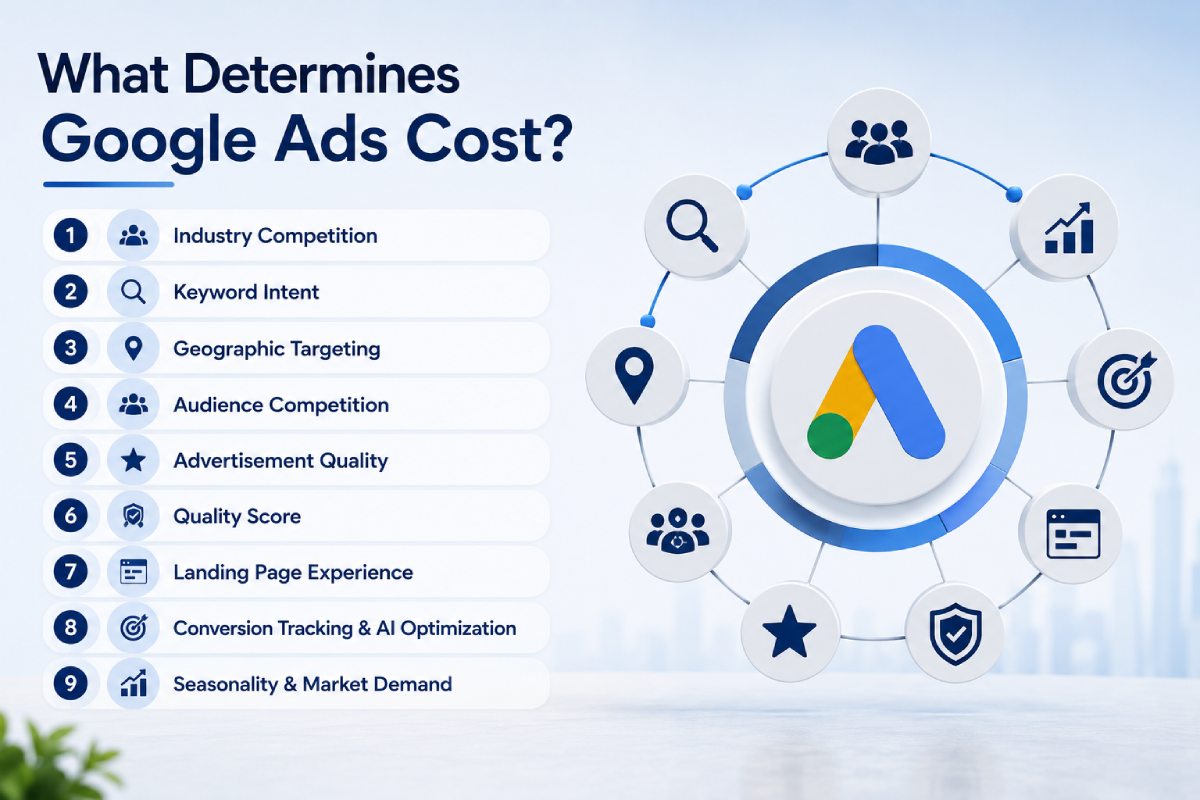
Many businesses assume Google Ads pricing depends only on keyword competition. In reality, Google evaluates dozens of signals before determining how much advertisers pay. Understanding these factors allows businesses to reduce advertising costs while improving campaign performance.
1. Industry Competition
Industry competition is one of the strongest influences on Google Ads pricing. Businesses operating in competitive sectors such as finance, insurance, enterprise software, healthcare, and legal services often experience higher advertising costs because multiple companies compete for the same high-value customers.
Greater competition leads to:
- higher CPC
- increased bidding activity
- more sophisticated campaigns
- greater importance of Quality Score
Rather than avoiding competitive industries, businesses should focus on improving campaign quality and conversion rates.
2. Keyword Intent
Google distinguishes between informational and transactional searches.
Informational searches include:
- what is Google Ads
- how Google Ads works
Transactional searches include:
- Google Ads agency
- Google Ads management services
- PPC management company
Users searching transactional keywords are much closer to making a purchasing decision. Because these searches generate higher business value, advertisers typically bid more aggressively for them.
3. Geographic Targeting
Campaign location directly affects advertising costs. National campaigns generally require larger budgets than local campaigns.
Businesses targeting:
- Mumbai
- Delhi
- Bengaluru
often encounter stronger competition than businesses focusing on smaller regional markets. Local targeting helps improve efficiency by concentrating budgets on areas most likely to generate qualified customers.
4. Audience Competition
Modern Google Ads campaigns extend beyond keywords.
Advertisers can also target audiences based on:
- demographics
- interests
- previous website visits
- purchase intent
- customer lists
Highly competitive audiences often command higher advertising costs because multiple advertisers pursue similar customer segments.
5. Advertisement Quality
Google rewards advertisements that provide a positive user experience.
Well-written advertisements generally achieve:
- higher CTR
- better Quality Score
- improved Ad Rank
- lower CPC
Continuous advertisement testing is therefore essential for long-term performance.
6. Quality Score
Quality Score remains one of the most important cost optimization factors.
It evaluates:
- expected CTR
- keyword relevance
- advertisement quality
- landing page experience
A campaign with a Quality Score of 9 or 10 often pays significantly less than a competitor with a score of 4 or 5. Improving Quality Score frequently produces greater savings than increasing advertising budgets.
7. Landing Page Experience
Many businesses invest heavily in advertising while directing visitors to slow or poorly optimized webpages.
Google evaluates landing pages based on:
- loading speed
- mobile usability
- relevance
- navigation
- user experience
Landing pages that answer user intent clearly often receive better Quality Scores while improving conversion rates.
8. Conversion Tracking & AI Optimization
Google’s machine learning depends on accurate conversion data. Without proper tracking, Google’s bidding algorithms struggle to identify high-quality users.
Professional Google Ads management services typically include:
- Google Analytics 4
- Google Tag Manager
- Enhanced Conversions
- Offline Conversion Tracking
- CRM integration
These tools provide Google’s AI with better data, improving campaign efficiency over time.
9. Seasonality & Market Demand
Advertising costs fluctuate throughout the year.
Examples include:
- festive shopping seasons
- financial year-end
- school admissions
- healthcare campaigns
- holiday travel
Businesses should anticipate higher CPCs during peak demand periods and adjust budgets accordingly.
Key Insight: Google Ads costs are influenced by much more than keyword bids. Improving campaign quality, landing pages, tracking, and audience targeting often reduces advertising costs more effectively than simply lowering bids.
Google Ads Management Cost
Running Google Ads successfully requires more than paying Google for clicks. Campaigns need continuous optimization, reporting, testing, audience refinement, and conversion tracking. This is why businesses often hire a Google Ads management company or experienced Google Ads agency.
Management fees vary depending on:
- campaign complexity
- advertising budget
- number of campaigns
- reporting requirements
- integrations
- landing page optimization
- remarketing strategy
Typical Google Ads Management Cost in India
| Business Size | Monthly Management Cost |
| Small Business | ₹15,000 – ₹30,000 |
| SME | ₹30,000 – ₹75,000 |
| Multi-Location Business | ₹75,000 – ₹1,50,000 |
| Enterprise | ₹1,50,000+ |
These fees generally include:
- campaign strategy
- keyword research
- ad copy creation
- campaign setup
- conversion tracking
- bid optimization
- reporting
- ongoing management
Remember that management fees are separate from advertising spend.
Google Ads Agency Pricing Models
Different agencies use different pricing structures. Understanding each model helps businesses choose the most suitable option.
Fixed Monthly Fee
Clients pay a predetermined monthly management fee regardless of advertising spend.
Advantages
- predictable budgeting
- transparent pricing
- suitable for SMEs
Limitations
- may not reflect campaign complexity
Percentage of Ad Spend
Management fees are calculated as a percentage of advertising expenditure.
Typical ranges: 10%–20%
Example:
- Advertising Budget: ₹5,00,000
- Management Fee: ₹50,000–₹1,00,000
Advantages
- Scales with campaign size
Limitations
- agencies may have incentives to increase spend rather than efficiency
Performance-Based Pricing
Agencies charge based on agreed performance metrics such as:
- qualified leads
- revenue
- ROAS
- conversions
This model works best when tracking systems are mature and objectives are clearly defined.
Hybrid Pricing
Many experienced agencies combine:
- fixed management fee
- performance incentives
This balances predictable budgeting with accountability for results.
Hidden Costs Businesses Often Overlook
When estimating Google Ads pricing, businesses often focus only on advertising spend. However, successful campaigns require supporting investments.
Common hidden costs include:
- Landing page design
- Website development
- Conversion Rate Optimization (CRO)
- Creative design
- Video production
- Call tracking software
- CRM integration
- Marketing automation
- Analytics implementation
- A/B testing tools
These investments improve campaign performance and frequently generate stronger ROI than increasing advertising budgets alone.
Monthly Budget Recommendations by Business Type
Every business has different objectives, customer values, and competitive environments. Instead of selecting a random advertising budget, businesses should align investment with expected customer acquisition costs and revenue potential.
| Business Type | Recommended Monthly Ad Spend | Recommended Strategy |
| Startup | ₹20K–₹50K | Focus on high-intent search campaigns and lead generation |
| Local Service Business | ₹30K–₹75K | Combine local Search Ads, call campaigns, and remarketing |
| SME | ₹75K–₹3L | Search + Performance Max with conversion tracking |
| Ecommerce | ₹1L–₹5L | Shopping Ads, Performance Max, Dynamic Remarketing |
| B2B Company | ₹1L–₹5L | Commercial keywords, LinkedIn support, CRM integration |
| Enterprise | ₹5L+ | Multi-platform campaigns, AI bidding, advanced attribution |
The goal is not to spend the maximum possible amount; it is to invest enough to generate consistent, profitable growth while maintaining a healthy return on investment.
Key Takeaway: Understanding Google Ads cost in India goes beyond estimating CPC or setting a monthly budget. Businesses that combine realistic budgeting with professional Google Ads management services, optimized landing pages, accurate conversion tracking, and continuous campaign optimization consistently achieve lower acquisition costs and higher long-term ROI than those focused solely on minimizing advertising spend.
Google Ads ROI Examples: How Advertising Investment Turns into Business Growth
One of the biggest advantages of Google Ads is its measurability. Unlike traditional advertising channels such as newspapers, billboards, or television, every click, enquiry, phone call, and conversion can be tracked and analysed.
However, measuring success only by clicks or impressions is misleading. The real objective is to understand how advertising investment contributes to revenue, profitability, and long-term customer value.
Let’s look at practical examples.
Example 1: Local Service Business
Consider a plumbing company operating in Mumbai.
Monthly Investment
| Item | Cost |
| Google Ads Spend | ₹40,000 |
| Google Ads Management | ₹20,000 |
| Landing Page Optimization | ₹10,000 |
Total Investment: ₹70,000
Campaign Results
- Website Visitors: 1,800
- Phone Calls: 150
- Qualified Leads: 90
- Customers Acquired: 32
Average Project Value: ₹18,000
Revenue Generated: ₹5,76,000
ROI
Even after marketing costs, the campaign generates several times the original investment because every acquired customer has significant business value.
Example 2: Ecommerce Business
A D2C skincare brand launches Shopping Ads and Performance Max campaigns.
Monthly Investment
- Advertising Spend: ₹2,00,000
- Agency Fee: ₹40,000
- Creative Assets: ₹20,000
Total: ₹2,60,000
Results
- Orders: 620
- Average Order Value: ₹2,400
- Revenue: ₹14,88,000
- Return on Ad Spend (ROAS): 5.7X
In this scenario, the business earns nearly six times its advertising investment before considering repeat purchases and customer lifetime value.
Example 3: B2B Software Company
Enterprise software companies often experience longer buying cycles but significantly higher customer values.
Monthly Investment
- Google Ads: ₹3,00,000
- Management: ₹75,000
- Landing Page Optimization: ₹50,000
Total: ₹4,25,000
Results
- Marketing Qualified Leads: 140
- Sales Qualified Leads: 42
- Customers Closed: 8
- Average Contract Value: ₹9,50,000
- Revenue: ₹76,00,000
Although lead volume appears lower than ecommerce campaigns, each conversion generates substantial business revenue, resulting in exceptional ROI.
Example 4: Healthcare Clinic
A multi-speciality clinic promotes treatment-specific Google Ads campaigns.
Investment
- Monthly Spend: ₹80,000
- Agency Management: ₹25,000
Total: ₹1,05,000
Campaign Performance
- Appointment Requests: 240
- Patient Consultations: 160
- Treatment Conversions: 72
- Average Treatment Value: ₹12,000
- Revenue: ₹8,64,000
Healthcare campaigns demonstrate how well-optimized local search campaigns can consistently generate high-quality patient enquiries.
Key Metrics Every Business Should Track
Instead of focusing only on clicks, monitor metrics that directly influence profitability:
- Cost Per Click (CPC)
- Click-Through Rate (CTR)
- Cost Per Lead (CPL)
- Cost Per Acquisition (CPA)
- Conversion Rate
- Return on Ad Spend (ROAS)
- Customer Lifetime Value (CLV)
- Revenue Generated
- Lead-to-Customer Conversion Rate
Key Insight: The goal of Google Ads is not to generate the cheapest clicks, it is to acquire profitable customers at a sustainable cost.
How to Reduce Google Ads Cost Without Reducing Results?
Many businesses believe lowering advertising costs means reducing budgets. In reality, the most successful advertisers often spend more, but spend smarter. Rather than reducing investment, they improve campaign efficiency.
1. Improve Quality Score
Quality Score directly influences:
- Cost Per Click
- Ad Rank
- Impression Share
Improve Quality Score by:
- writing highly relevant advertisements
- improving landing page experience
- organizing keywords into tightly themed ad groups
- increasing Click-Through Rate
Higher Quality Scores often reduce advertising costs while improving visibility.
2. Focus on High-Intent Keywords
Not every keyword deserves your budget.
Instead of broad informational searches, prioritize commercial keywords such as:
- Google Ads agency
- Google Ads management services
- PPC management services
- Google Ads management company
These keywords typically generate fewer clicks but significantly higher conversion rates.
3. Add Negative Keywords Regularly
One of the easiest ways to reduce wasted spend is by excluding irrelevant searches.
Examples:
- free
- jobs
- course
- tutorial
- salary
Regular search term analysis prevents budgets from being consumed by low-value traffic.
4. Optimize Landing Pages
A better landing page often reduces advertising costs.
Google evaluates:
- relevance
- loading speed
- mobile experience
- navigation
- content quality
Improving these factors increases Quality Score while boosting conversion rates.
5. Implement Accurate Conversion Tracking
Without proper tracking, Google’s AI cannot identify valuable customers.
Essential tools include:
- Google Analytics 4
- Google Tag Manager
- Enhanced Conversions
- Offline Conversion Tracking
- CRM Integration
- Better data leads to better bidding decisions.
6. Use Smart Bidding Strategically
Google’s AI bidding strategies work best when supported by reliable conversion data.
Common strategies include:
- Maximize Conversions
- Target CPA
- Target ROAS
- Maximize Conversion Value
The right bidding strategy depends on campaign maturity and business objectives.
7. Continuously Test Advertisements
Small improvements in ad copy can significantly increase Click-Through Rates.
Test variations of:
- headlines
- descriptions
- CTAs
- value propositions
- offers
Regular testing improves campaign performance over time.
8. Invest in Remarketing
Most visitors do not convert during their first visit. Remarketing allows businesses to reconnect with previous visitors through personalized advertisements.
Benefits include:
- lower acquisition costs
- improved conversion rates
- stronger brand recall
- increased customer lifetime value
Common Google Ads Budget Mistakes Businesses Make
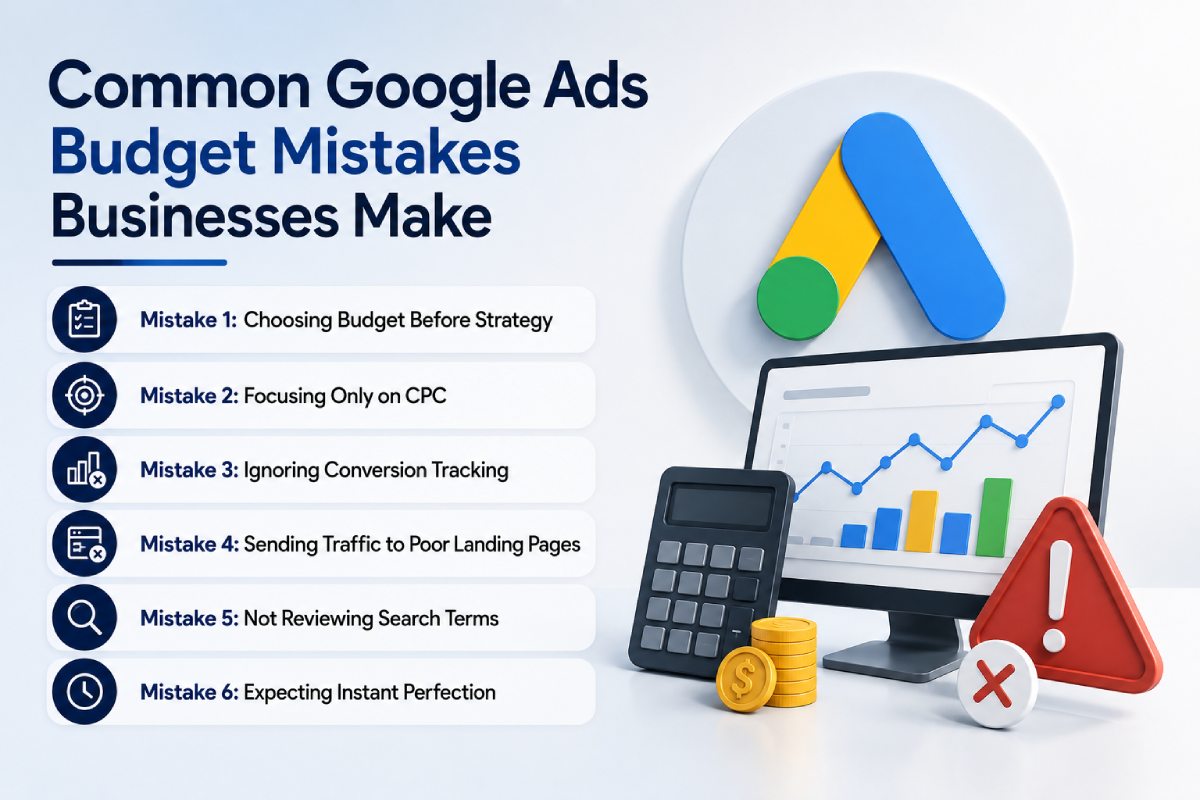
Even well-funded campaigns can fail when budgets are allocated inefficiently. Understanding these mistakes helps businesses avoid unnecessary advertising costs.
Mistake 1: Choosing Budget Before Strategy
- Many businesses ask: “How much should I spend?”
- before asking: “What business outcome do I want?”
Budgets should always align with revenue goals rather than arbitrary monthly figures.
Mistake 2: Focusing Only on CPC
A lower CPC does not automatically mean better performance. A keyword costing ₹200 may generate far greater revenue than one costing ₹20. Always evaluate profitability, not click cost alone.
Mistake 3: Ignoring Conversion Tracking
Without reliable tracking:
- campaigns cannot be optimized effectively
- AI bidding becomes inaccurate
- ROI calculations become unreliable
Tracking should be implemented before campaigns launch.
Mistake 4: Sending Traffic to Poor Landing Pages
Even excellent advertisements cannot compensate for weak landing pages.
Businesses should continuously improve:
- messaging
- trust signals
- page speed
- mobile usability
- forms
- calls-to-action
Mistake 5: Not Reviewing Search Terms
Google continuously matches advertisements with new search queries.
Weekly review of search term reports helps identify:
- irrelevant traffic
- negative keyword opportunities
- new keyword ideas
Mistake 6: Expecting Instant Perfection
Google Ads requires continuous optimization. Successful campaigns improve over weeks and months as more performance data becomes available.
Why Businesses Choose a Google Ads Agency?
While businesses can manage campaigns independently, working with an experienced Google Ads agency often accelerates results and reduces costly mistakes. Professional agencies provide expertise that extends beyond campaign setup.
Strategic Planning
Campaigns begin with:
- business analysis
- competitor research
- keyword planning
- audience segmentation
This ensures advertising aligns with business objectives.
Advanced Campaign Management
A professional Google Ads management company continuously optimizes:
- bids
- advertisements
- audiences
- budgets
- landing pages
- Quality Scores
This ongoing refinement improves campaign efficiency over time.
Better Analytics & Reporting
Experienced agencies implement:
- Google Analytics 4
- CRM integration
- enhanced attribution
- conversion tracking
- This enables more accurate ROI measurement.
Time Savings
Managing Google Ads effectively requires:
- keyword research
- campaign monitoring
- bid adjustments
- testing
- reporting
Outsourcing these activities allows businesses to focus on serving customers and growing operations.
Access to Specialists
A professional Google Ads management services provider typically includes specialists in:
- paid advertising
- landing page optimization
- analytics
- conversion rate optimization
- creative strategy
This multidisciplinary expertise often produces stronger long-term results than managing campaigns internally.
Frequently Asked Questions
1. How much should a small business spend on Google Ads in India?
Most small businesses begin with a monthly advertising budget between ₹20,000 and ₹75,000, depending on industry competition, geographic targeting, and customer value. The ideal budget should be based on your revenue goals and expected customer acquisition cost rather than a fixed industry average.
2. Is ₹10,000 enough to start Google Ads?
For highly targeted local campaigns, ₹10,000 can provide useful initial insights and generate some leads. However, businesses in competitive industries often require larger budgets to collect sufficient performance data and achieve consistent results.
3. What is the average Cost Per Click (CPC) in India?
CPC varies widely by industry. Ecommerce keywords may cost as little as ₹8–₹80 per click, while legal, finance, and enterprise software keywords can exceed ₹500 or more due to higher competition and customer value.
4. How much do Google Ads agencies charge?
Agency pricing depends on campaign complexity and services provided. Many agencies charge a fixed monthly management fee, a percentage of ad spend, or a hybrid model. Management fees are separate from the advertising budget paid directly to Google.
5. Can I run Google Ads without hiring an agency?
Yes. Google Ads can be managed independently, especially for simple campaigns. However, businesses often benefit from working with experienced professionals who can improve campaign structure, tracking, optimization, and ROI while reducing wasted spend.
6. Why are some Google Ads keywords so expensive?
Keywords become expensive when multiple advertisers compete for the same high-value customers. Industries such as finance, insurance, healthcare, legal services, and enterprise software typically experience higher CPCs because acquiring even one customer can generate substantial revenue.
7. Does spending more guarantee better results?
No. Larger budgets increase advertising opportunities but do not guarantee better performance. Campaign quality, landing page experience, conversion tracking, and optimization have a much greater influence on profitability than budget alone.
8. How long does it take for Google Ads to become profitable?
Many campaigns begin generating traffic immediately, but consistent optimization usually requires 30–90 days. During this period, bidding strategies, keywords, audiences, and advertisements are refined to improve conversion rates and reduce acquisition costs.
9. How can I reduce my Google Ads cost?
Focus on improving Quality Score, using high-intent keywords, adding negative keywords, optimizing landing pages, implementing accurate conversion tracking, and regularly reviewing campaign performance. These improvements often reduce costs while increasing conversions.
10. Should I choose SEO or Google Ads?
The best approach depends on your objectives. Google Ads is ideal for immediate lead generation, while SEO builds long-term organic visibility and authority. Many successful businesses combine both strategies to achieve faster growth and more sustainable customer acquisition.
Final Thoughts
There is no universal answer to “How much does Google Ads cost in India?” because every business has different objectives, industries, competition levels, and customer values.
The more important question is: “How much should I invest to achieve profitable business growth?”
Businesses that approach Google Ads strategically, by setting clear goals, implementing accurate tracking, optimizing landing pages, and continuously refining campaigns, often achieve far better ROI than those focused solely on minimizing advertising costs.
Whether you’re launching your first campaign or scaling an existing account, remember that Google Ads is not just an advertising platform. When managed effectively, it becomes a predictable customer acquisition engine capable of delivering qualified leads, measurable revenue, and long-term business growth.
Ready to Maximize Your Google Ads ROI?
If you’re planning to invest in Google Ads or want to improve the performance of your existing campaigns, our team can help you make informed decisions based on your business goals, not guesswork.
At Ideamagix, we combine strategic planning, campaign management, conversion optimization, and advanced analytics to help businesses generate more qualified leads while maximizing return on investment.
Your Free Google Ads Strategy Session Includes
- Google Ads Account Audit
- Budget & CPC Analysis
- Competitor Advertising Review
- Keyword Opportunity Assessment
- Landing Page Performance Review
- ROI Forecast
- 90-Day Google Ads Growth Roadmap