
Introduction: Why Choosing the Wrong Website Package Can Cost Your Business More Than the Package Itself
When businesses start looking for website development services, one of the first questions they ask is: “Which website package should I choose?”
Unfortunately, most agencies answer this question with pricing tables.
- Basic Package
- Business Package
- Premium Package
- Enterprise Package
While pricing matters, choosing a website package based solely on cost often leads to expensive mistakes.
Many businesses invest in websites that are:
- too limited for future growth
- missing critical features
- difficult to scale
- poorly optimized for conversions
- unable to support marketing initiatives
The result is a website that requires redesigning within a year or two, creating unnecessary costs and lost opportunities. A website should not be viewed as a design expense.
It should be viewed as a business asset that supports:
- lead generation
- sales growth
- customer acquisition
- operational efficiency
- brand authority
The right package depends less on budget and more on:
- business goals
- industry requirements
- growth plans
- user expectations
- technical complexity
Whether you’re comparing website development packages for a startup, SME, or enterprise, understanding what each option offers is essential before making an investment. Professional website development services help businesses choose solutions that align with their goals, while custom website development ensures the website can support unique workflows, future scalability, and long-term digital growth.
This guide explains the most common website development packages available in 2026 and helps businesses determine which option aligns with their objectives.
Why Website Development Packages Exist?
Professional website development services are designed to address varying business requirements instead of offering one-size-fits-all solutions. Modern website development packages combine design, development, SEO readiness, and scalability, allowing businesses to invest in a solution that supports both current operations and future expansion.
Many business owners assume website packages are simply pricing structures. In reality, packages exist because different businesses require different levels of functionality, customization, scalability, and support. A local consultant launching a personal brand website has very different requirements than a fast-growing ecommerce company or a large enterprise managing thousands of daily users.
Trying to sell the same website solution to every business would create inefficiencies for both clients and development teams. Website packages provide a structured way to match business requirements with appropriate technology, design effort, and development resources.
The Four Factors That Determine Package Requirements
Before selecting a package, businesses should evaluate four critical areas.
Business Objectives
The purpose of the website significantly influences package selection.
For example:
A brochure website designed to establish credibility requires fewer resources than a lead-generation platform designed to produce qualified inquiries. Similarly, an ecommerce website processing hundreds of transactions daily requires different capabilities than a service business website.
Growth Expectations
One of the biggest mistakes businesses make is choosing a website based solely on current needs. Websites should support future growth as well.
Questions to consider include:
- Will traffic increase significantly?
- Will new services be added?
- Will ecommerce functionality be required later?
- Will multiple locations be added?
Businesses planning aggressive growth often benefit from investing in scalable solutions from the beginning.
User Experience Requirements
User expectations have evolved dramatically.
Visitors now expect:
- fast-loading pages
- mobile optimization
- intuitive navigation
- personalized experiences
- seamless interactions
The greater the user experience requirements, the more sophisticated the website package needs to be.
Technical Complexity
Features dramatically affect development effort.
Examples include:
- payment gateways
- CRM integrations
- booking systems
- customer portals
- membership platforms
- AI chat assistants
The more complex the functionality, the more advanced the package becomes.
Basic Website Package
What Is a Basic Website Package?
A Basic Website Package is designed for businesses that need an online presence but have relatively simple requirements. The objective is typically to establish credibility, provide information, and make it easy for potential customers to contact the business.
These websites generally focus on communicating core information rather than supporting advanced marketing or operational processes. For many startups, freelancers, consultants, and local businesses, a basic website provides a cost-effective starting point.
Typical Features Included
Most basic website development packages include:
- 5–10 pages
- mobile responsive design
- contact form
- basic SEO setup
- image gallery
- service pages
- about page
- contact page
The emphasis is on simplicity and functionality.
Advantages of a Basic Website Package
The primary advantage is affordability. Businesses can establish a professional online presence without making a significant financial commitment.
Other benefits include:
- faster development timelines
- lower maintenance costs
- easier content management
- straightforward user journeys
For businesses operating primarily through referrals or local networks, a basic website may be sufficient during early growth stages.
Limitations of a Basic Website Package
While affordable, basic packages have limitations.
Common constraints include:
- limited scalability
- minimal customization
- fewer integrations
- restricted functionality
- limited automation
As businesses grow, these limitations often become more noticeable. For example, a company generating significant website traffic may eventually require conversion optimization, marketing automation, and advanced analytics.
Who Should Choose a Basic Website Package?
A basic website package is usually suitable for:
Freelancers
Professionals need a portfolio and contact information.
Local Service Providers
Plumbers, electricians, consultants, and similar businesses.
Early-Stage Startups
Businesses validating ideas before investing heavily.
Personal Brands
Coaches, speakers, and independent consultants.
Typical Cost Range
In Mumbai and across India, basic website packages generally range between: ₹15,000 – ₹50,000
depending on:
- design requirements
- Content creation needs
- number of pages
- SEO requirements
Example Scenario
A chartered accountant launching a new practice requires:
- Home page
- About page
- Services page
- Contact page
- Inquiry form
The primary objective is credibility and lead generation. A basic website package would typically meet these requirements effectively.
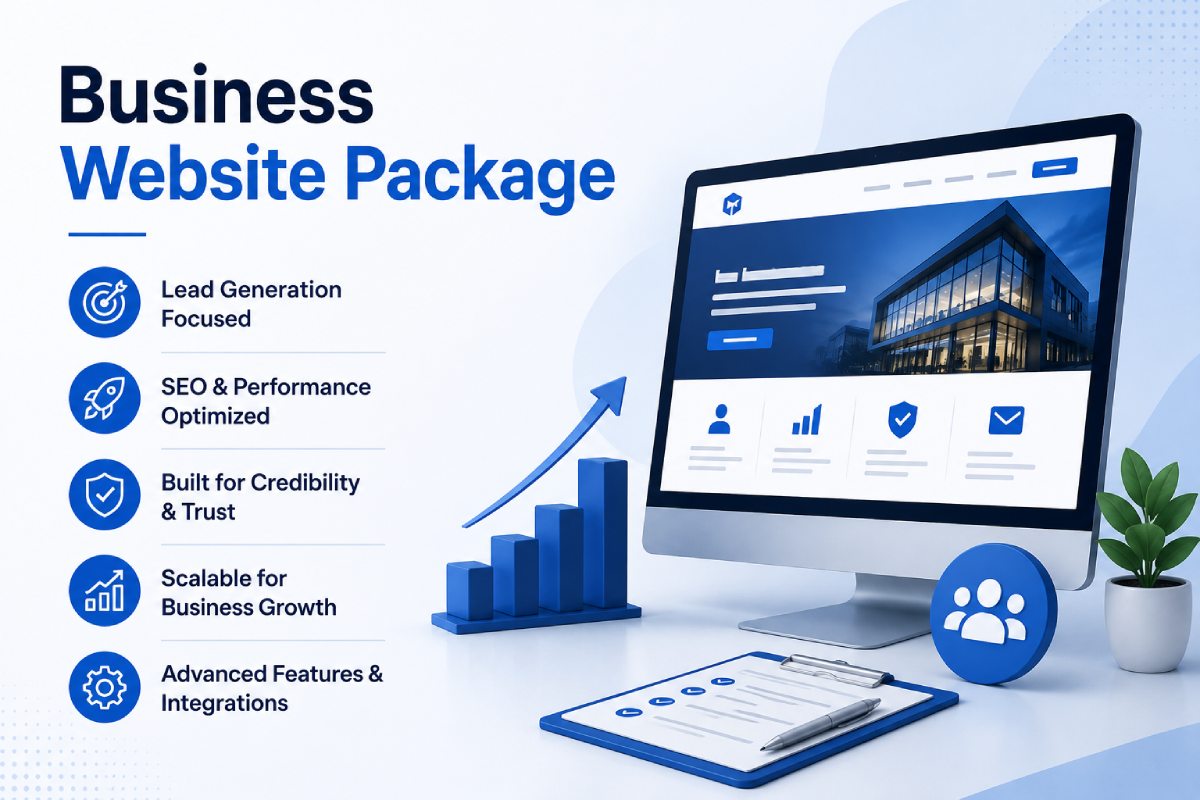
Business Website Package
Businesses investing in growth often compare multiple website development packages before selecting the right solution. While standard packages meet many requirements, organizations with specialized workflows or unique operational needs may benefit from custom website development, which provides greater flexibility, advanced integrations, and a tailored user experience.
What Is a Business Website Package?
A Business Website Package is designed for companies that rely on their website as a lead-generation and customer acquisition tool rather than simply an online brochure.
Unlike basic websites, business websites focus on:
- conversions
- SEO
- credibility
- user experience
- scalability
The goal is not just to present information but to generate measurable business outcomes. This package is often the most popular choice among growing companies because it balances affordability with performance.
Core Features Included
Business website packages typically include:
- custom design
- advanced contact forms
- lead capture systems
- SEO-friendly architecture
- conversion-focused layouts
- blog functionality
- analytics integration
- CRM connectivity
Every feature is designed to support growth and marketing performance.
Why Businesses Upgrade Beyond Basic Packages?
As organizations grow, websites become central to:
- lead generation
- SEO campaigns
- advertising efforts
- content marketing
- brand positioning
A basic website often struggles to support these objectives. Business packages address this gap by creating a stronger foundation for digital growth.
Conversion Optimization Considerations
One of the biggest differences between basic and business websites is the conversion strategy.
Business websites typically include:
- multiple CTAs
- landing page structures
- lead magnets
- trust signals
- case study integration
These elements significantly improve lead generation performance.
Who Should Choose a Business Website Package?
Ideal for:
SMEs
Businesses actively generating leads online.
B2B Service Providers
Consultants, agencies, software firms, and professional services.
Healthcare Organizations
Clinics, hospitals, and healthcare providers.
Real Estate Companies
Developers and property consultants.
Typical Cost Range
₹50,000 – ₹2,00,000+
depending on:
- custom design requirements
- integrations
- content volume
- SEO implementation
- conversion optimization scope
Ecommerce Website Package
What Is an E-commerce Website Package?
An e-commerce website package is designed for businesses that sell products online and require much more functionality than a standard business website. Unlike service-based websites where the primary goal is lead generation, ecommerce websites must support product discovery, shopping experiences, transactions, inventory management, customer accounts, and post-purchase interactions.
A successful e-commerce website is not simply a digital catalog. It functions as a complete online sales system capable of attracting visitors, converting them into customers, processing payments securely, and encouraging repeat purchases. Every component from navigation to checkout flow directly impacts revenue.
In 2026, ecommerce competition continues to increase. Consumers compare prices instantly, expect fast-loading pages, seamless mobile experiences, and frictionless checkout processes. Businesses choosing ecommerce packages should focus not only on development cost but also on long-term sales performance.
Core Features Included
Most ecommerce website packages include:
- product catalog management
- category and collection pages
- payment gateway integration
- shopping cart functionality
- order management systems
- inventory tracking
- coupon and discount systems
- customer account management
- shipping integrations
- abandoned cart recovery
Advanced packages may also include:
- personalized product recommendations
- AI-powered search
- multilingual ecommerce support
- subscription billing
- loyalty programs
- marketplace integrations
Why Ecommerce Development Is More Complex?
Many businesses underestimate the complexity of ecommerce websites because the frontend appears simple.
Behind the scenes, ecommerce systems must manage:
Product Data
Hundreds or thousands of products need structured organization.
Transactions
Secure payment processing is critical.
Customer Information
User accounts, addresses, order history, and preferences require management.
Inventory Synchronization
Stock levels must remain accurate across systems.
Marketing Integrations
Email automation, retargeting, analytics, and CRM systems often connect to ecommerce platforms. Each additional feature increases development effort and long-term scalability requirements.
Who Should Choose an Ecommerce Package?
Ideal for:
D2C Brands
Brands selling directly to consumers.
Retail Businesses
Traditional stores are expanding online.
Manufacturers
Businesses selling products directly rather than through distributors.
Subscription-Based Businesses
Companies offering recurring product deliveries.
Typical Investment Range
₹1,00,000 – ₹5,00,000+
Depending on:
- product volume
- custom functionality
- integrations
- design complexity
- platform choice
Example Scenario
A fashion brand selling 500 products online requires:
- inventory management
- payment gateway integration
- customer accounts
- mobile optimization
- abandoned cart recovery
A business website package would not support these requirements effectively. An e-commerce package becomes necessary.
Enterprise Website Package
Enterprise organizations frequently require custom website development to integrate multiple business systems, automate workflows, and deliver highly personalized digital experiences. Unlike predefined packages, enterprise solutions are designed around complex business processes and long-term scalability.
What Is an Enterprise Website Package?
Enterprise Website Packages are designed for organizations that require advanced functionality, high scalability, multiple integrations, sophisticated security measures, and complex workflows. These websites often serve thousands or even millions of users and become critical business infrastructure rather than simple marketing assets.
Enterprise websites frequently support:
- customer portals
- employee systems
- multi-location operations
- large content ecosystems
- advanced automation
- enterprise-level analytics
The objective is not just visibility but operational efficiency and scalability.
Why Enterprises Have Different Requirements?
Large organizations face challenges that smaller businesses rarely encounter.
Examples include:
High Traffic Volumes
The website must remain stable during traffic spikes.
Multiple Stakeholders
Different departments require access and functionality.
Security Requirements
Sensitive customer and business data must be protected.
Integration Complexity
Systems often connect with:
- CRM platforms
- ERP systems
- HR software
- finance systems
- marketing automation tools
The website becomes part of a much larger digital ecosystem.
Typical Features Included
Enterprise packages commonly include:
- custom development
- role-based access control
- advanced security implementation
- API development
- multi-location support
- enterprise analytics
- workflow automation
- multilingual support
- scalable infrastructure
- cloud deployment
Scalability Considerations
One of the defining characteristics of enterprise development is scalability.
- A website receiving: 10,000 visitors per month
- has very different infrastructure requirements than one receiving: 1,000,000 visitors per month
Enterprise architecture must anticipate growth before it occurs.
This includes:
- load balancing
- distributed systems
- cloud infrastructure
- database optimization
- performance monitoring
Who Should Choose an Enterprise Package?
Ideal for:
Large Corporations
National and multinational businesses.
Financial Institutions
Banks and financial service providers.
Healthcare Networks
Hospitals and healthcare systems.
Government Organizations
Public-facing digital platforms.
Large Educational Institutions
Universities and training networks.
Typical Investment Range
₹5,00,000 – ₹50,00,000+
depending on:
- architecture complexity
- integrations
- security requirements
- scalability objectives
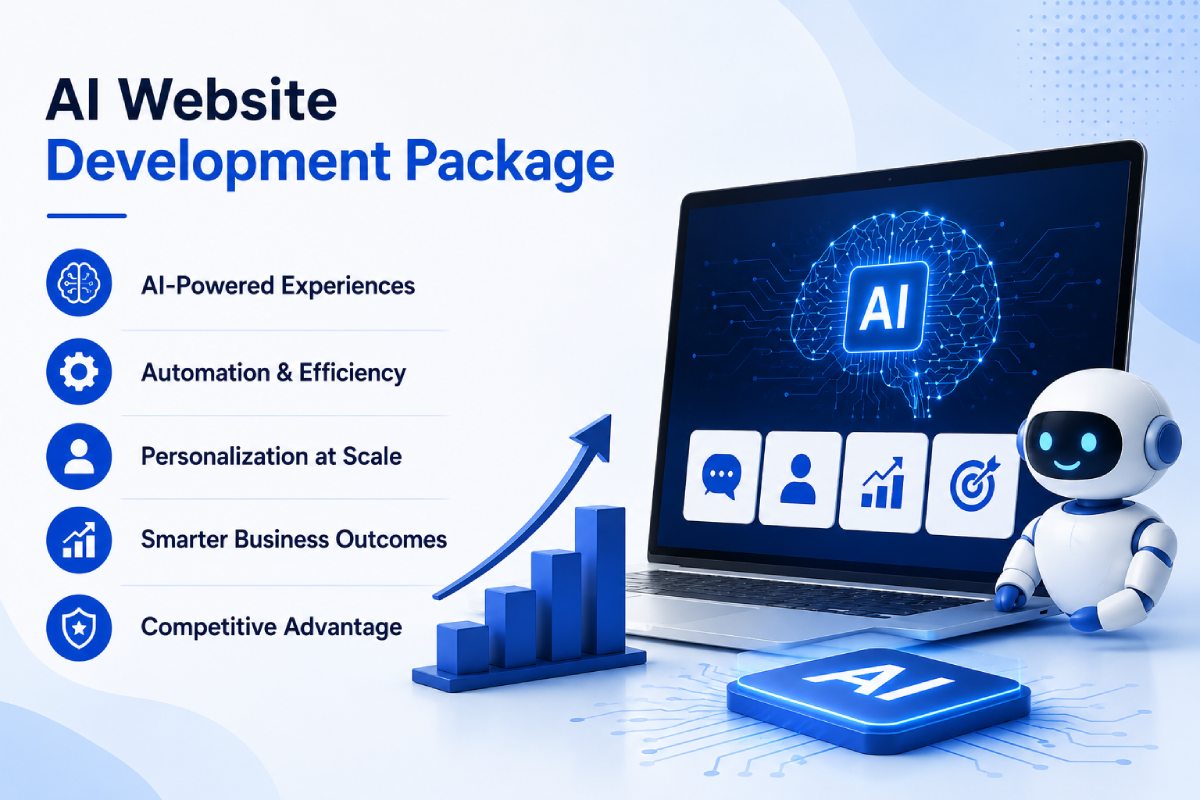
AI Website Development Package
Why AI Website Development Is Becoming a Separate Category?
Artificial Intelligence is rapidly changing how websites interact with users. Historically, websites were static. Users visited pages, consumed content, and completed actions manually. Modern AI-powered websites actively assist visitors throughout the customer journey. This shift is creating a new category of website development packages focused on AI-driven experiences. Businesses adopting AI early often gain significant competitive advantages through automation, personalization, and operational efficiency.
What Is an AI Website Package?
An AI Website Development Package combines traditional website development with artificial intelligence capabilities that improve user experiences and business performance.
The objective is to make websites:
- smarter
- more responsive
- more personalized
- more efficient
AI-powered websites can often provide better customer experiences while reducing operational costs.
Common AI Features
AI Chat Assistants
Answer customer questions instantly.
Personalized Content
Display content based on visitor behavior.
Recommendation Engines
Suggest products or services dynamically.
Lead Qualification Systems
Automatically identify high-quality prospects.
AI Search Functionality
Deliver faster and more relevant search experiences.
Predictive Analytics
Forecast user behavior and conversion potential.
Business Benefits of AI Websites
Improved User Experience
Visitors receive immediate assistance.
Higher Conversion Rates
Personalization increases engagement.
Reduced Operational Costs
Automation reduces manual workload.
Better Lead Quality
AI filters and prioritizes opportunities.
Competitive Differentiation
Businesses stand out in crowded markets.
Example Scenario
A software company receives hundreds of inquiries monthly.
An AI assistant can:
- answer FAQs
- schedule meetings
- qualify leads
- route inquiries
without requiring human intervention. The result is improved efficiency and faster response times.
Typical Investment Range
₹1,50,000 – ₹15,00,000+
depending on:
- AI capabilities
- integrations
- training requirements
- automation complexity
Website Development Package Comparison Table
| Feature | Basic Website | Business Website | Ecommerce Website | Enterprise Website | AI Website |
| Cost Range | ₹15K–₹50K | ₹50K–₹2L | ₹1L–₹5L | ₹5L–₹50L+ | ₹1.5L–₹15L+ |
| Lead Generation | Basic | Advanced | Advanced | Advanced | Advanced |
| SEO Optimization | Basic | Strong | Strong | Enterprise-Level | Enterprise-Level |
| Custom Design | Limited | Extensive | Extensive | Fully Custom | Fully Custom |
| Integrations | Minimal | Moderate | Extensive | Extensive | Extensive |
| Scalability | Low | Medium | High | Very High | Very High |
| Automation | Minimal | Moderate | Moderate | Advanced | AI-Powered |
| Personalization | No | Limited | Moderate | Advanced | AI-Driven |
| Best For | Small Businesses | Growing Businesses | Online Stores | Large Enterprises | Innovation-Focused Businesses |
Website Package ROI Comparison
One of the biggest mistakes businesses make is evaluating website packages based purely on upfront cost.
A website should be evaluated based on its ability to generate:
- leads
- sales
- revenue
- operational efficiency
Example
Basic Website
Investment: ₹30,000
Leads: 5/month
Revenue: ₹50,000/month
Business Website
Investment: ₹1,20,000
Leads: 25/month
Revenue: ₹3,00,000/month
AI Website
Investment: ₹3,50,000
Leads: 60/month
Revenue: ₹10,00,000/month
The most expensive package is not necessarily the highest cost. The package producing the greatest business outcomes often delivers the strongest ROI.
Common Mistakes Businesses Make When Choosing Website Development Packages
Choosing the wrong website package is one of the most expensive digital mistakes a business can make. The problem is not always spending too much money. In many cases, businesses spend too little on critical capabilities, forcing costly redesigns later. The right website package should support both current business needs and future growth objectives.
Mistake #1: Choosing Based Only on Price
Many businesses compare website proposals solely on cost.
Example:
Agency A: ₹40,000
Agency B: ₹1,50,000
Without understanding deliverables, Agency A may appear to offer better value.
However, lower-cost websites often exclude:
- SEO architecture
- conversion optimization
- custom design
- integrations
- scalability planning
The result is a website that looks functional but struggles to generate leads or support growth.
Hidden Cost of Cheap Development
A business may save ₹1 lakh initially but lose far more through:
- poor conversions
- low search visibility
- redesign requirements
- technical limitations
The real question should not be: “What is the cheapest package?”
It should be: “Which package delivers the highest business value?”
Mistake #2: Ignoring Future Growth
One of the most common planning mistakes is building a website only for today’s requirements.
Businesses often underestimate future needs such as:
- additional services
- ecommerce expansion
- CRM integrations
- marketing automation
- multi-location growth
A website that cannot scale eventually becomes a bottleneck.
Example
A company initially needs:
- service pages
- contact forms
Within 12 months they may require:
- landing pages
- lead automation
- booking systems
- CRM connectivity
Choosing a scalable package from the beginning often reduces long-term costs.
Mistake #3: Focusing on Design Instead of Outcomes
Beautiful websites do not automatically generate results.
Many businesses become overly focused on:
- animations
- visual effects
- trendy layouts
while neglecting:
- conversions
- usability
- lead generation
- SEO
A website should first function as a business tool. Design should support business objectives rather than distract from them.
Mistake #4: Underestimating SEO Requirements
Many website packages include only basic SEO setup.
Businesses investing in digital marketing often require:
- technical SEO
- schema implementation
- Core Web Vitals optimization
- structured site architecture
- content scalability
Without these elements, future SEO campaigns become less effective.
Mistake #5: Not Considering AI Readiness
As AI-powered search continues to grow, websites must become machine-readable as well as user-friendly.
Businesses choosing packages today should consider:
- structured data
- content architecture
- entity optimization
- AI-friendly information structures
Websites built without these considerations may struggle to gain visibility in future AI-driven discovery platforms.
Freelancer vs Agency Website Packages
One of the biggest decisions businesses face is whether to hire a freelancer or partner with a website development agency. While both options have advantages, they serve different business needs.
Freelancer Website Development
Freelancers typically offer lower pricing because they operate independently and have lower overhead costs.
Typical Cost Range
₹15,000 – ₹1,00,000
depending on complexity.
Advantages
- lower investment
- direct communication
- flexible engagement
- quick turnaround for simple projects
- Freelancers can be highly effective for businesses with straightforward requirements.
Limitations
Freelancers often specialize in one or two areas.
For example:
A developer may excel at coding but lack expertise in:
- UX strategy
- conversion optimization
- SEO
- branding
- analytics
As projects become more complex, these limitations become more noticeable.
Agency Website Development
Agencies provide multidisciplinary teams capable of handling every stage of the project.
Typical Cost Range
₹50,000 – ₹50,00,000+
depending on scope.
Team Structure Often Includes
- strategists
- UX designers
- UI designers
- developers
- SEO specialists
- content specialists
- project managers
This creates a more comprehensive solution.
Advantages
Strategic Planning
Websites align with business goals.
Better Scalability
Agencies build growth-ready systems.
Integrated Expertise
Design, development, SEO, and marketing work together.
Long-Term Support
Businesses receive ongoing guidance.
When Should You Choose a Freelancer?
A freelancer may be suitable if:
- budget is limited
- requirements are simple
- scalability is not a priority
- website serves primarily as an online brochure
When Should You Choose an Agency?
An agency is generally the better choice if:
- lead generation matters
- SEO is important
- marketing campaigns are planned
- scalability is required
- business growth is a priority
Key Insight
- Freelancers typically build websites.
- Agencies typically build growth platforms.
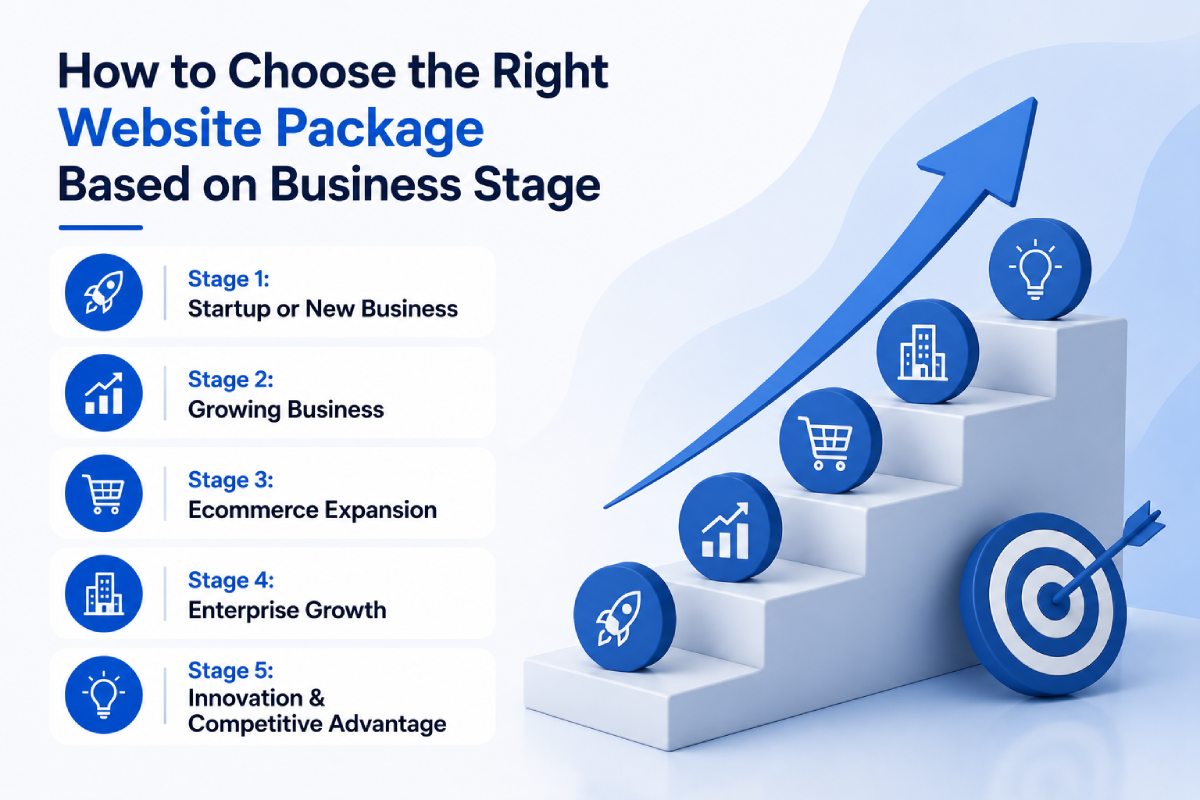
How to Choose the Right Website Package Based on Business Stage?
Different stages of business growth require different website capabilities. The ideal package depends on where your business is today and where it intends to go tomorrow.
Stage 1: Startup or New Business
Primary Goals:
- establish credibility
- build online presence
- generate initial inquiries
Recommended Package:
Basic Website Package
Focus on:
- company information
- services
- contact forms
- foundational SEO
The objective is validation rather than complexity.
Stage 2: Growing Business
Primary Goals:
- generate leads consistently
- improve search visibility
- support marketing campaigns
Recommended Package:
Business Website Package
Focus on:
- conversion optimization
- SEO architecture
- content marketing support
- CRM integration
This stage is often where websites begin producing measurable ROI.
Stage 3: Ecommerce Expansion
Primary Goals:
- increase online sales
- improve customer experience
- automate transactions
Recommended Package:
Ecommerce Website Package
Focus on:
- checkout optimization
- inventory management
- conversion funnels
- customer retention
Revenue generation becomes the primary objective.
Stage 4: Enterprise Growth
Primary Goals:
- operational efficiency
- scalability
- integration ecosystems
Recommended Package:
Enterprise Website Package
Focus on:
- infrastructure
- automation
- security
- performance
The website becomes part of core business operations.
Stage 5: Innovation & Competitive Advantage
Primary Goals:
- personalization
- automation
- AI-powered experiences
Recommended Package:
AI Website Package
Focus on:
- AI assistants
- recommendation engines
- predictive experiences
- intelligent workflows
This stage positions businesses for future digital trends.
Website Package Selection Framework
Before selecting a package, businesses should evaluate the following questions.
Business Goals
- Lead generation?
- Ecommerce sales?
- Branding?
- Customer support?
Growth Expectations
- Stable growth?
- Rapid expansion?
- New markets?
User Requirements
- Simple information access?
- Online transactions?
- Personalized experiences?
Technology Requirements
- CRM integration?
- Marketing automation?
- AI capabilities?
Budget Considerations
- Initial investment?
- Long-term scalability?
- Expected ROI?
The more thoroughly these questions are answered, the easier package selection becomes.
Future-Proofing Your Website Investment
Investing in scalable website development services today helps businesses avoid costly redesigns in the future. Choosing the right website development packages with flexible architecture ensures new features, integrations, and business requirements can be accommodated without rebuilding the entire website. A website should not become obsolete after one or two years. Future-proofing focuses on ensuring long-term relevance and scalability.
Build for Scalability
- Choose technologies that support growth.
- Avoid platforms that limit future capabilities.
Prioritize SEO Foundations
Strong SEO architecture benefits businesses for years.
This includes:
- clean URLs
- structured content
- schema markup
- technical optimization
Consider AI Readiness
AI-driven discovery is becoming increasingly important.
Future-ready websites should support:
- structured data
- machine readability
- semantic content organization
Focus on User Experience
- User expectations continue evolving.
- Businesses that prioritize usability typically maintain stronger performance over time.
How Ideamagix Helps Businesses Choose the Right Website Package
At Ideamagix, we believe website development should start with business objectives not technology. Rather than recommending the most expensive package, we focus on identifying the solution that aligns with growth goals, operational requirements, and budget considerations.
Our Process
Business Discovery
↓
Growth Planning
↓
User Experience Strategy
↓
Technology Selection
↓
Website Development
↓
Optimization
↓
Scaling
What We Focus On
Conversion-Focused Design
Websites built to generate leads and sales.
SEO-Ready Architecture
Designed to support long-term organic growth.
Scalability Planning
Systems that grow with the business.
AI Readiness
Prepared for future search and discovery trends.
Performance Optimization
Fast, reliable, and user-friendly experiences.
Our Goal
Website
↓
Traffic
↓
Engagement
↓
Leads
↓
Revenue
Because a website should be more than a digital presence—it should be a business growth engine.
Conclusion: The Right Package Is the One That Supports Your Growth
There is no universally “best” website development package.
The right package depends on:
- business objectives
- growth plans
- user expectations
- technology requirements
- budget
A startup may succeed with a basic website. An ecommerce brand may require advanced sales functionality. An enterprise may need scalable infrastructure and automation. The key is choosing a package that supports not only where the business is today but where it intends to be in the future. Investing strategically now often prevents expensive redesigns, technical limitations, and missed growth opportunities later.
FAQs About Website Development Packages
1. What is included in a website development package?
A website development package typically includes everything required to plan, design, develop, test, and launch a website. However, the exact deliverables vary depending on the package level and business requirements.
Most packages include:
- website design
- responsive development
- content management system (CMS)
- contact forms
- basic SEO setup
- mobile optimization
More advanced packages may also include:
- custom functionality
- CRM integrations
- ecommerce features
- AI-powered tools
- analytics setup
- conversion optimization
Businesses should always review the scope carefully because two packages with similar pricing may offer very different deliverables. Understanding what is included helps prevent unexpected costs later in the project.
Key Insight: A website package should be evaluated based on business outcomes and capabilities rather than simply the number of pages included.
2. Which website development package is best for a small business?
The best package for a small business depends on growth goals, industry competition, and customer acquisition strategy. For businesses primarily seeking an online presence and credibility, a Basic Website Package is often sufficient. However, businesses planning to invest in SEO, Google Ads, or content marketing usually benefit more from a Business Website Package because it includes stronger foundations for lead generation.
Small businesses should think beyond immediate requirements and consider where they want the company to be within the next two to three years. Choosing a package with room for growth often reduces future redevelopment costs. For service-based businesses such as consultants, clinics, law firms, and agencies, a business website package generally provides the best balance between affordability and performance.
Key Insight: The best package is not always the cheapest—it is the one that supports future business growth.
3. How much does a website development package cost in India?
Website development costs vary significantly based on design complexity, functionality, technology stack, integrations, and customization requirements.
Typical pricing ranges include:
| Website Type | Estimated Cost |
| Basic Website | ₹15,000 – ₹50,000 |
| Business Website | ₹50,000 – ₹2,00,000 |
| Ecommerce Website | ₹1,00,000 – ₹5,00,000 |
| Custom Website | ₹2,00,000 – ₹10,00,000+ |
| Enterprise Website | ₹5,00,000 – ₹50,00,000+ |
| AI Website | ₹1,50,000 – ₹15,00,000+ |
The final cost depends on business requirements rather than package labels. Features such as payment gateways, booking systems, AI integrations, and custom workflows can significantly increase project scope.
Key Insight: Website development should be viewed as an investment in lead generation and business growth rather than a one-time expense.
4. What is the difference between a business website and a custom website?
A business website package typically uses predefined structures and proven frameworks to support lead generation, content marketing, and SEO. While customization is possible, the overall architecture follows established patterns that reduce development time and cost. A custom website, on the other hand, is built specifically around unique business requirements. It may include custom workflows, integrations, dashboards, portals, or user experiences that cannot be achieved through standard templates or CMS functionality.
Custom websites often require extensive planning, UX design, development, and testing. As a result, they are generally more expensive but offer greater flexibility and scalability. Businesses should choose custom development when their operational requirements exceed the capabilities of standard website packages.
Key Insight: Business websites focus on growth; custom websites focus on unique functionality and competitive differentiation.
5. When should a business choose an ecommerce website package?
Businesses should choose an ecommerce package whenever they plan to sell products, subscriptions, or digital goods online.
Unlike standard business websites, ecommerce websites must manage:
- products
- inventory
- payments
- shipping
- customer accounts
- order processing
An ecommerce website is essentially an online sales platform rather than a digital brochure. It requires advanced functionality to ensure secure transactions and positive user experiences. Businesses expecting online sales growth should invest in ecommerce-specific development rather than attempting to modify a standard website package later.
Key Insight: Ecommerce websites are designed for revenue generation and require infrastructure that standard business websites typically do not provide.
6. Is custom website development worth the investment?
For many businesses, custom website development provides substantial long-term value because it allows the website to align perfectly with business operations and growth objectives.
Custom development becomes particularly valuable when businesses require:
- unique customer experiences
- advanced integrations
- proprietary workflows
- specialized functionality
Although the initial investment is higher, custom websites often deliver stronger scalability and flexibility. Businesses avoid the limitations commonly associated with templates and generic website builders. The decision should be based on business requirements rather than design preferences alone.
Key Insight: Custom development is most valuable when standard solutions cannot support business goals effectively.
7. What is an AI website development package?
An AI website package incorporates artificial intelligence features into the website experience. These features help businesses automate interactions, improve personalization, and increase operational efficiency.
Common AI capabilities include:
- AI chatbots
- recommendation engines
- lead qualification systems
- predictive analytics
- intelligent search
- automated customer support
AI-powered websites can improve user experiences by providing faster responses and more relevant content. They can also reduce workload for internal teams by automating repetitive tasks. As AI adoption continues growing, businesses increasingly view AI-enabled websites as strategic advantages rather than experimental technologies.
Key Insight: AI websites focus on creating smarter customer experiences and more efficient business processes.
8. How long does website development take?
Project timelines vary depending on complexity, scope, and approval processes.
Typical timelines include:
| Website Type | Estimated Timeline |
| Basic Website | 2–4 Weeks |
| Business Website | 4–8 Weeks |
| Ecommerce Website | 6–12 Weeks |
| Custom Website | 2–6 Months |
| Enterprise Platform | 3–12 Months |
Factors affecting timelines include:
- content readiness
- design revisions
- integrations
- feature complexity
- stakeholder approvals
Businesses should prioritize quality and planning rather than rushing development. A well-planned project typically produces better long-term outcomes.
Key Insight: Faster development is not always better if critical business requirements are overlooked.
9. Should I hire a freelancer or a website development agency?
The answer depends on project complexity, budget, and business objectives.
Freelancers are often suitable for:
- simple websites
- limited budgets
- short-term projects
Agencies are generally more suitable for:
- lead-generation websites
- SEO-focused projects
- ecommerce platforms
- enterprise systems
- growth-focused businesses
An agency provides access to multiple specialists including designers, developers, SEO experts, strategists, and project managers. This collaborative approach often produces stronger outcomes for businesses planning long-term growth.
Key Insight: Freelancers build websites; agencies build digital growth systems.
10. How do I choose the right website development company?
Choosing the right development partner requires evaluating more than pricing.
Businesses should assess:
Experience
Have they delivered similar projects successfully?
Technical Expertise
Can they handle future scalability requirements?
SEO Knowledge
Will the website support organic growth?
UX Capability
Can they create conversion-focused experiences?
Support Structure
Do they provide ongoing maintenance and optimization?
The best website development company acts as a strategic partner rather than simply a vendor. Their focus should extend beyond launch and include long-term business growth.
Key Insight: The right partner helps businesses achieve outcomes, not just complete projects.