
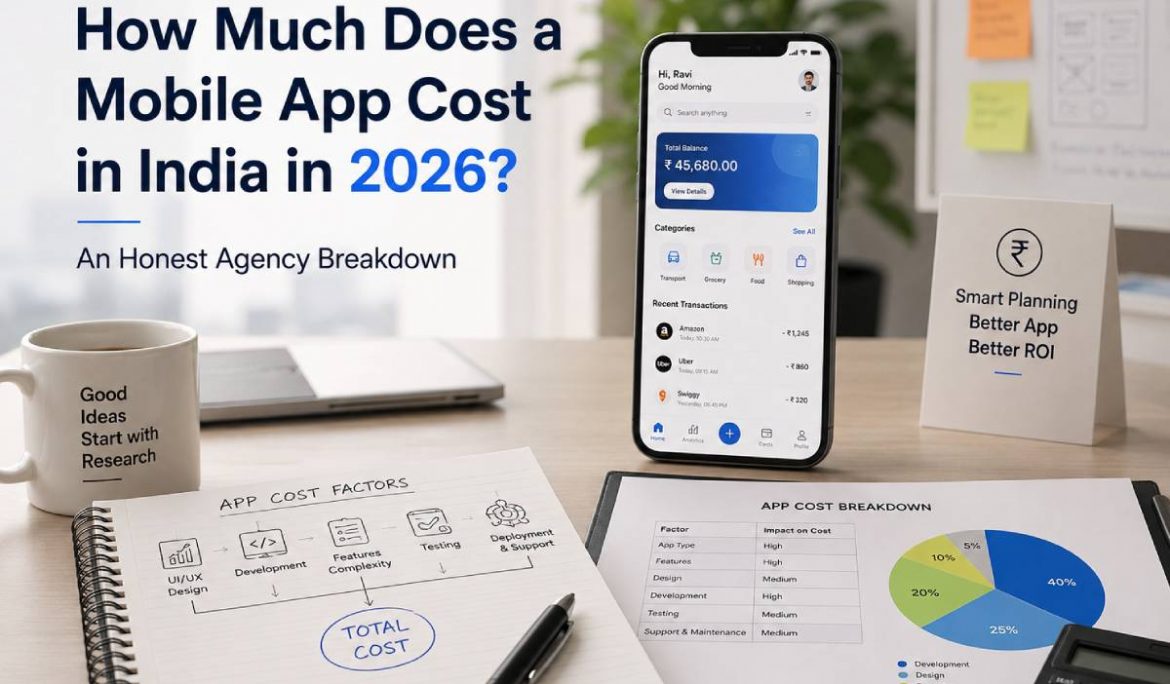
You’ll get quotes from ₹50,000 to ₹50 lakhs for what sounds like the same app. Here’s why, and how to know which number is real for what you’re actually building. Understanding the real Mobile App Cost in India starts with choosing scalable mobile app development services tailored to your specific business requirements and long-term product goals.
Range in plain language: Simple app: ₹3L–₹8L · Mid-complexity: ₹8L–₹25L · Complex product: ₹25L–₹80L+ · “Full Zomato” equivalent: ₹1Cr+ (and 18 months)
Someone asks a developer friend how much an app costs. The friend says, “Maybe 5 lakhs.” They ask a Mumbai agency for ₹18 lakhs. They post in an entrepreneur WhatsApp group, someone says their cousin built one for ₹80,000. They try Upwork, a developer in Pune quotes ₹6 lakhs, and one in Ukraine quotes $8,000.
Every number is technically defensible because “app” is not a defined unit of measurement. A to-do list app and a real-time logistics platform are both “apps.” Asking how much an app costs is like asking how much a building costs; it depends entirely on what you’re building, with what materials, and for how many people.
This guide cuts through the confusion. We break down mobile app development costs by feature complexity, platform choice, and team type, specific to the Indian market in 2026. We also tell you where quotes go wrong and how to protect yourself.
Why quotes vary by 10x for the same brief
You show the same app brief to three teams. You get quotes of ₹4L, ₹14L, and ₹28L. All three teams are being sincere. Here is why:
- Different assumptions about scope.
The ₹4L quote assumes you described the minimum viable product. The ₹14L quote includes admin dashboard, analytics, and proper error handling. The ₹28L quote also includes QA, design, API integrations, and 3 months of post-launch support.
- Different quality standards.
A quote that gets you a working prototype is different from a quote that gets you a production-ready app that won’t crash under real user load. Both “work” in a demo.
- Different developer rates.
A Tier-3 city freelancer charges ₹15,000–₹25,000/month. A senior developer at a Mumbai product agency costs ₹80,000–₹1.5L/month of billing. Same feature, very different cost.
- Different approaches to risk.
An experienced team prices for the unexpected, the third-party API that behaves differently in production, the requirement that changes in month two, and the performance issue that appears at 10x user load. An inexperienced team prices the optimistic scenario.
An experienced mobile app development company in Mumbai evaluates real business requirements carefully, helping founders understand realistic mobile app cost in India without misleading low-budget assumptions.
The golden rule
A quote without a detailed scope document is not a quote; it is a number. Before accepting any app development quote, ask for a feature list, a technical architecture overview, and a milestone plan. If a team cannot produce these, they cannot produce the app reliably either.
Feature-by-feature cost breakdown
The most useful way to understand app cost is by building up from features. Every app is a collection of features, and each feature has a development cost that can be reasonably estimated.
| Feature / Functionality | Complexity | Estimated Cost (India, 2026) | Notes |
|---|---|---|---|
| User authentication (email + password) | Low | ₹40K–₹80K | Standard login/register/forgot password |
| Social login (Google, Facebook, Apple) | Low–Medium | ₹30K–₹60K | Per provider. Apple login required for iOS App Store |
| OTP-based login (Indian mobile numbers) | Low | ₹25K–₹50K | Via Twilio or MSG91. Preferred by Indian users. |
| User profile + settings | Low | ₹35K–₹70K | Basic CRUD profile management |
| Push notifications | Low | ₹30K–₹60K | Firebase FCM. Add ₹20K for rich notifications. |
| In-app chat (basic) | Medium | ₹1L–₹2.5L | Real-time using Firebase or Socket.io |
| In-app chat (WhatsApp-grade) | High | ₹4L–₹10L | Media sharing, read receipts, encryption |
| Payment gateway (Razorpay / Paytm) | Medium | ₹75K–₹1.5L | Includes UPI, cards, netbanking, and wallets |
| Subscription billing | Medium–High | ₹1.5L–₹3L | Recurring payments + webhook handling |
| Map integration + location tracking | Medium | ₹1L–₹2.5L | Google Maps API. Live tracking adds high cost. |
| Real-time live tracking (driver/delivery) | High | ₹3L–₹7L | WebSocket infrastructure + battery optimisation |
| Product listing + catalogue | Low–Medium | ₹75K–₹1.5L | Static catalogue is simpler; dynamic with variants adds cost |
| Shopping cart + checkout flow | Medium | ₹1L–₹2L | Address management, promo codes, order summary |
| Order management + tracking | Medium | ₹1.5L–₹3L | Status updates, returns, history |
| Search + filters | Medium | ₹1L–₹2.5L | Elasticsearch adds cost but significantly improves quality |
| Ratings and reviews | Low | ₹40K–₹80K | Star rating + text review + moderation |
| Admin panel/dashboard | Medium–High | ₹2L–₹6L | Almost always underestimated. Often adds 30% to the project cost. |
| Analytics integration | Low | ₹30K–₹60K | Firebase Analytics or Mixpanel. Custom events add cost. |
| Video upload + streaming | High | ₹3L–₹8L | Encoding pipeline + CDN. Costs vary significantly with volume. |
| AI / ML features (basic recommendation) | High | ₹3L–₹10L+ | Highly variable, define exactly what “AI” means in your brief |
A trusted mobile app development company in Mumbai helps businesses estimate realistic mobile app cost in India based on feature complexity, scalability requirements, integrations, and long-term product performance expectations.
Platform choice: what it costs
Choosing the right framework directly impacts Mobile App Cost in India, making experienced mobile app development services essential for balancing scalability, performance, launch speed, and future maintenance requirements effectively.
Native iOS (Swift) + Native Android (Kotlin)
Two separate codebases. Two separate teams. Two separate testing cycles. You get the best possible performance and access to every platform feature. You also pay roughly 1.7–2x what a cross-platform approach costs. For consumer apps at a serious scale, Zomato, Swiggy, and CRED, native makes sense. For most Indian startups building their first product, it is rarely the right starting point.
React Native (cross-platform)
One JavaScript codebase deploys to both iOS and Android. The most popular choice for Indian startups in 2026. Significant performance improvements in recent versions mean the gap with native is now acceptable for most app categories. Razorpay, Flipkart Wholesale, and Myntra have used React Native for major features. Good developer availability in India, large community, well-understood tooling. Development cost: typically 40–55% less than native for equivalent functionality.
Flutter (cross-platform)
Google’s Dart-based framework. Excellent UI consistency across platforms. Flutter apps look identical on iOS and Android, which native and React Native cannot guarantee. Strong performance, particularly for animation-heavy apps. Developer availability in India is lower than React Native, but it is growing fast. Cost is comparable to React Native. Google Pay, Dream11, and Nykaa Fashion have used Flutter for parts of their apps.
| Platform | Relative Cost | Performance | Developer Availability India | Best For |
|---|---|---|---|---|
| Native iOS + Android | 1.7–2x | Best | High but expensive | Consumer apps at scale, hardware-intensive |
| React Native | 1x (baseline) | Very good | Very high | Most startup apps, social, and ecommerce |
| Flutter | 1–1.1x | Excellent | Growing fast | Design-heavy apps, UI-focused products |
Real cost ranges by app category
Abstract feature lists are useful, but most founders think in app categories. Here are realistic all-in estimates for common Indian startup app types, including design, development, QA, and backend:
- Simple informational / directory app: ₹3L–₹6L · 8–12 weeks · No real-time, no transactions
- Basic ecommerce app (catalogue + cart + Razorpay + order tracking): ₹6L–₹14L · 12–20 weeks
- Service booking app (Dunzo / UrbanCompany style, basic version): ₹10L–₹22L · 16–28 weeks
- Hyperlocal delivery (live tracking, driver + customer app): ₹18L–₹45L · 20–36 weeks
- Social / community app (feed, profiles, DMs, notifications): ₹12L–₹30L · 18–30 weeks
- Fintech app (lending, investment, insurance aggregator): ₹20L–₹60L+ · 24–42 weeks (regulatory complexity adds significantly)
- EdTech app (video content + live classes + assessments): ₹14L–₹35L · 20–32 weeks
- Healthcare/telemedicine app: ₹15L–₹40L · 20–34 weeks (HIPAA-adjacent compliance for global markets)
An experienced mobile app development company in Mumbai can accurately estimate Mobile App Cost in India by aligning app features, scalability requirements, platform choices, and long-term business objectives with realistic development timelines.
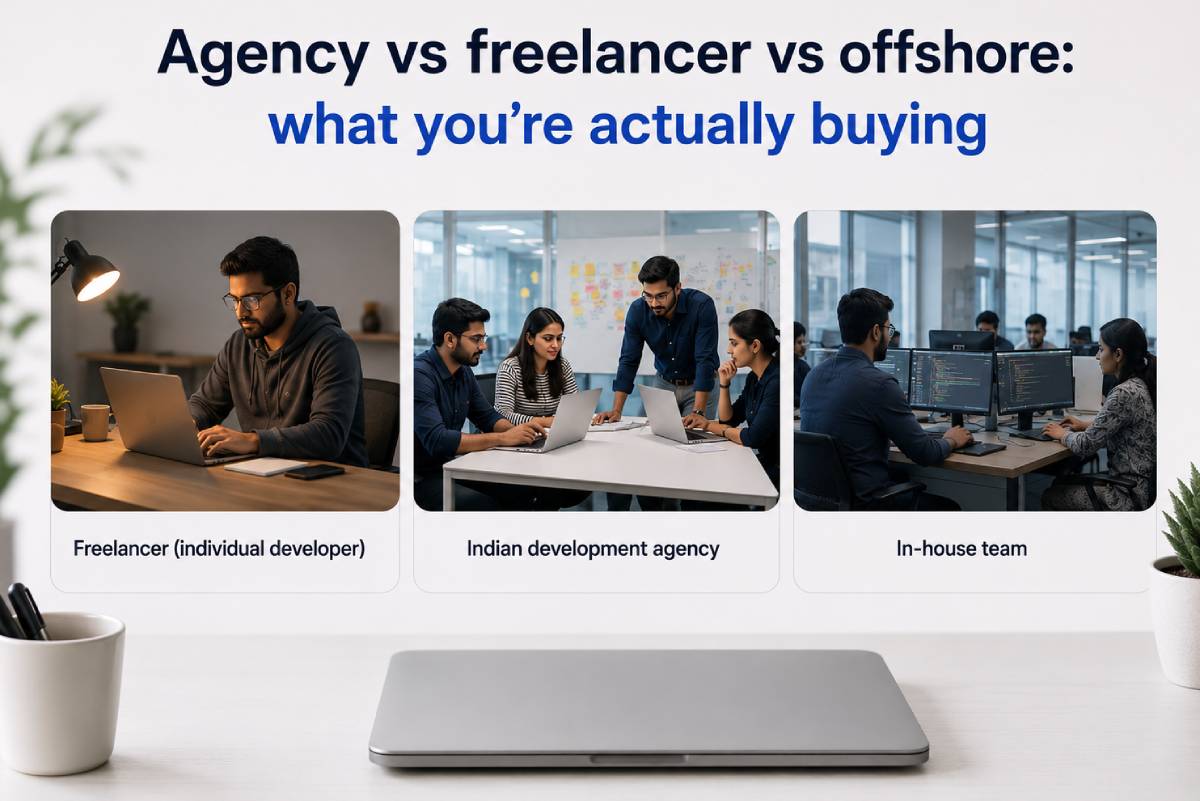
Agency vs freelancer vs offshore: what you’re actually buying
Choosing a reliable mobile app development company in Mumbai ensures businesses receive scalable mobile app development services, structured project management, long-term technical support, and realistic cost planning from the beginning.
Freelancer (individual developer)
Rate: ₹800–₹2,500/hour. For a 1,000-hour app: ₹8L–₹25L, but scope risk is all yours. A single developer is a single point of failure. If they get sick, take on another project, or simply lose interest, your timeline collapses. Design, QA, and project management are often additional costs or absent entirely. For very well-scoped, technically simple apps with a founder who can manage the process, this works. For anything complex, the risk is not worth the savings.
Indian development agency
Rate: ₹1,500–₹4,000/hour effective. A dedicated team (PM + designer + 2 developers + QA). Accountability structures. Contractual commitments. Design integrated with development. The right choice for most serious app projects. Quality varies enormously between agencies, evaluated on the depth of their scoping process and the quality of their case studies, not just their client logos.
In-house team
For a minimum viable team (1 senior + 1 junior developer, 1 designer): ₹3.5L–₹6L/month in Mumbai, all-in including PF, office, equipment, and management overhead. For a 9-month app build, that’s ₹31.5L–₹54L before the product exists and generates revenue. Makes sense when you are building a technology product company, not a business that uses technology as a tool.
Red flags in any app development quote
No milestone plan or only a final delivery date. No mention of QA or testing. No UI/UX design in scope (or “you give us the designs”). Time-and-material billing with no cap. No source code ownership clause in the agreement. These are not minor omissions; they are structural problems that will cost you money.
The costs nobody mentions: post-launch
Building the app is the beginning, not the end. Plan for:
- App Store fees: Apple Developer Programme: $99/year (~₹8,200). Google Play Developer: $25 one-time (~₹2,100). Not optional.
- Cloud infrastructure: AWS, Google Cloud, or Azure for your backend. A properly scaled backend for a growing Indian app costs ₹8,000–₹50,000/month, depending on traffic.
- Third-party services: Razorpay (2%), Firebase (usage-based), Twilio/MSG91 for SMS OTP (₹0.10–₹0.25 per OTP), push notification service, crash monitoring (Sentry), analytics (Mixpanel). Budget ₹10,000–₹40,000/month for a mid-sized app.
- Maintenance and updates: iOS and Android release major OS updates annually. Your app needs to be tested and updated to stay compatible. Budget ₹1.5L–₹4L/year for ongoing maintenance from your development team.
- Feature development: The version you launch is never the version your users want. Budget for at least two meaningful feature releases in the first year, expect to spend 25–35% of your initial build cost annually on new development.
Frequently asked questions
Should I build an app first, or start with a mobile-optimised website?
For most Indian D2C and service businesses, a well-built Progressive Web App (PWA) or a mobile-first website is the right first step. It costs 30–50% of an app, works on every device without an App Store download, and can be updated instantly. Build an app when you have evidence that app-specific features (push notifications, offline capability, hardware access like camera or GPS) are driving meaningful user outcomes that a web experience cannot match. Don’t build an app because it seems more legitimate; build it when you have proof that it serves your users better.
How do I protect myself from scope creep?
Write a detailed scope document before signing any agreement. Every feature should be explicitly listed. Every integration should be named. Anything not in the scope document is a change request, and change requests should require written agreement on additional cost before work begins. The most professional agencies will help you write this document. If an agency is reluctant to commit to a detailed scope, that tells you something important about how they will manage your project.
How long does it take to publish an app on Google Play vs. the Apple App Store?
Google Play review is typically 1–3 days for initial submission and subsequent updates. Apple App Store review takes 1–3 days for updates and 3–7 days for initial submissions, but can extend to 2–4 weeks if Apple requests additional information or if your app is in a regulated category (finance, health, gambling). Factor this into your launch timeline — the review period is not development time, but it does affect your go-live date.
What is the minimum viable version of a service booking app for the Indian market?
The absolute minimum for a functional Indian service booking app: OTP login (mobile number-based), service catalogue with pricing, booking flow with calendar/slot selection, Razorpay payment integration, basic order tracking, and push notifications for booking confirmation and updates. On React Native for both platforms: approximately ₹8L–₹12L, 14–18 weeks. Everything else, reviews, in-app chat, live tracking, and the admin panel, is important but can be Phase.
Tell us what you’re building: we’ll tell you what it actually costs
No round numbers. No vague estimates. A detailed feature breakdown and a realistic cost range, specific to your idea.
Ideamagix App Development Team
React Native · Flutter · iOS · Android · Mumbai We’ve built mobile applications for Indian startups and enterprises since 2012, from founder-led MVPs to high-traffic consumer products. Every cost figure in this guide is grounded in real project data from real builds in the Indian market.
Free App Scoping Session
45 minutes. We’ll help you figure out what to build first and what it will realistically cost.