
Introduction: Why Performance Marketing Has Become the Growth Engine for Modern Brands
Over the last five years, digital marketing has undergone a structural shift. Traditional marketing strategies focused heavily on reach, impressions, and brand visibility. While these metrics helped build awareness, they often failed to provide a clear connection between marketing spend and business outcomes. Today, companies operate in a far more demanding environment where leadership teams expect measurable returns from every marketing investment.
This expectation has accelerated the adoption of performance marketing as the primary growth engine for many modern brands. Instead of measuring marketing success through vanity metrics, performance marketing focuses on tangible outcomes such as revenue, customer acquisition cost, and return on ad spend. Every campaign, creative asset, and audience segment is optimized to generate measurable business impact.
For companies operating in highly competitive markets like Mumbai, this shift has been particularly significant. Businesses must compete not only with local companies but also with national and global brands that aggressively invest in digital channels. In this environment, scaling growth requires more than running advertising campaigns. It requires a systematic approach to experimentation, data analysis, and continuous optimization.
This is where performance marketing in Mumbai has evolved into a specialized discipline. Brands are no longer satisfied with basic campaign management. Instead, they seek structured growth frameworks that combine advanced analytics, creative experimentation, and automation technologies to drive sustainable revenue expansion.
Companies that partner with a specialized performance marketing agency in Mumbai often experience significant improvements in their marketing efficiency. Instead of relying on guesswork, they implement systems that continuously test new ideas, analyze customer behavior, and optimize campaigns in real time. These systems allow brands to scale revenue without proportionally increasing marketing spend.
The purpose of this guide is not to present a single success story. Instead, it provides a multi-industry growth playbook based on real frameworks used by high-growth brands. By examining how companies implement performance marketing strategies across different sectors, we can identify the common patterns that enable businesses to achieve threefold revenue growth.
In this article, we explore how leading brands structure their growth systems, manage creative experimentation, and address emerging challenges in attribution and privacy. We will also examine the role of first-party data and automation technologies in shaping the next generation of performance marketing trends.
Understanding the Revenue Mechanics Behind Performance Marketing
To understand how businesses scale revenue using performance marketing, it is important to examine the financial mechanics that drive growth. Unlike traditional advertising models that focus on exposure, performance marketing revolves around a measurable relationship between marketing investment and revenue outcomes.
At its core, the success of any performance marketing strategy depends on four key variables:
- traffic volume generated through marketing channels
- conversion rate of visitors into customers
- average revenue per customer
- customer acquisition cost
When these variables are optimized together, businesses create a scalable growth system. Increasing traffic alone does not guarantee revenue growth if conversion rates remain low. Similarly, improving conversion rates may not produce a significant impact if customer acquisition costs are excessively high.
A well-structured performance marketing strategy in Mumbai addresses all of these variables simultaneously.
For example, consider a mid-sized ecommerce brand selling lifestyle products. Before implementing advanced performance marketing frameworks, the company might operate with the following metrics:
- Monthly marketing budget: ₹15,00,000
- Monthly website visitors: 40,000
- Conversion rate: 1.5%
- Average order value: ₹2,500
Revenue generated from marketing campaigns:
- 40,000 visitors × 1.5% conversion rate = 600 orders
- 600 orders × ₹2,500 = ₹15,00,000 monthly revenue
In this scenario, the company is breaking even on its marketing investment. Growth is limited because marketing spend produces only proportional revenue increases.
When a strategic performance marketing agency begins optimizing this system, several improvements typically occur simultaneously:
- Improved audience targeting increases traffic quality
- Landing page optimization improves conversion rates
- Creative testing improves click-through rates
- Retargeting campaigns increase repeat purchases
After six months of systematic optimization, the metrics may evolve as follows:
- Monthly marketing budget: ₹15,00,000
- Monthly website visitors: 60,000
- Conversion rate: 2.5%
- Average order value: ₹2,800
Revenue calculation:
- 60,000 visitors × 2.5% conversion rate = 1,500 orders
- 1,500 orders × ₹2,800 = ₹42,00,000 revenue
This transformation illustrates the power of performance marketing when executed through structured frameworks rather than isolated tactics. Revenue growth does not come from increasing marketing budgets alone. Instead, it emerges from incremental improvements across multiple variables within the growth system.
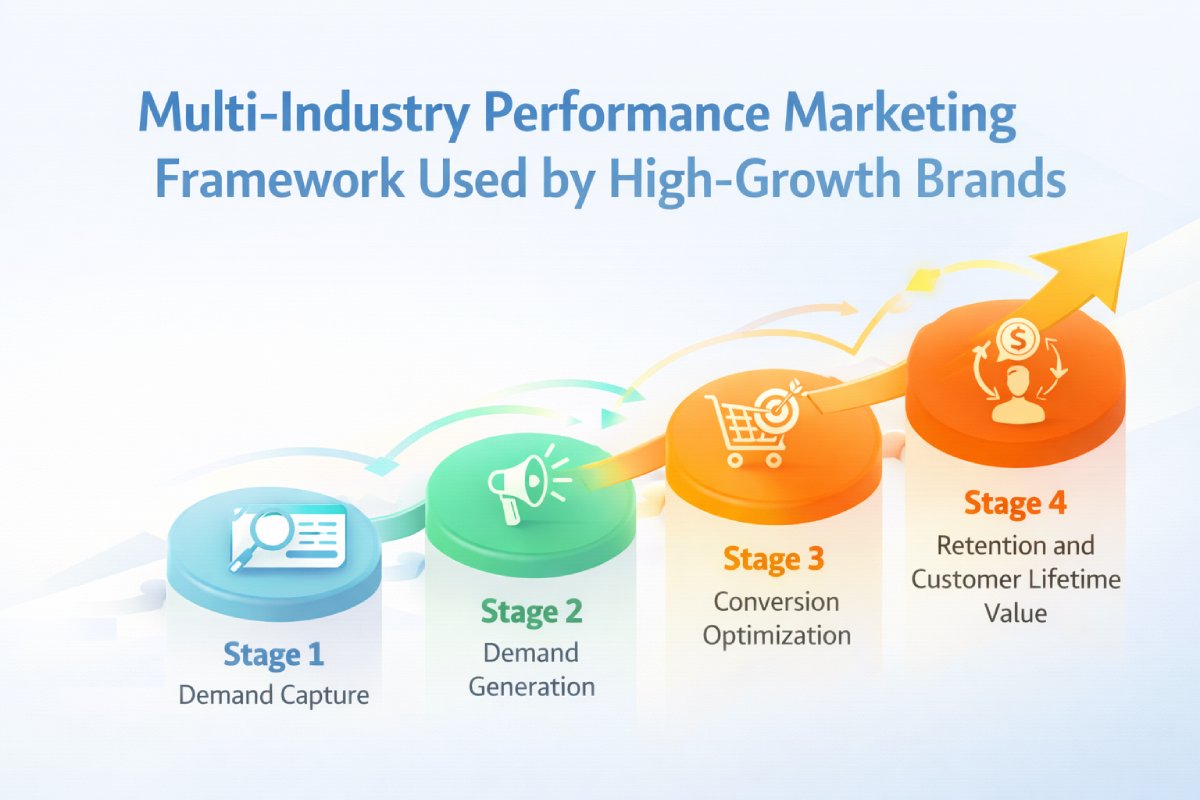
Multi-Industry Performance Marketing Framework Used by High-Growth Brands
Across industries, successful companies often rely on similar frameworks to scale revenue using performance marketing. Although each industry has unique characteristics, the underlying growth systems share common structural principles.
One of the most effective frameworks used by many performance marketing agencies in Mumbai teams consists of four sequential stages.
Stage 1: Demand Capture
The first stage focuses on capturing existing market demand. Many potential customers are already searching for solutions online. The goal of demand capture is to ensure the brand appears prominently in these searches.
Demand capture channels typically include:
- Google Search advertising targeting transactional keywords
- SEO content targeting high-intent search queries
- marketplace advertising for ecommerce products
By focusing on users actively searching for solutions, companies can generate high-quality traffic with strong conversion potential.
Stage 2: Demand Generation
While demand capture focuses on existing intent, demand generation aims to create new demand among audiences who may not yet be actively searching for a product.
Demand generation channels include:
- social media advertising campaigns
- video marketing initiatives
- influencer collaborations
- educational content marketing
These campaigns introduce the brand to new audiences and build awareness that eventually translates into purchase intent.
Stage 3: Conversion Optimization
Once traffic begins flowing through marketing channels, the next focus becomes conversion optimization. This stage ensures that visitors complete desired actions such as purchasing products or submitting inquiries.
Conversion optimization typically involves:
- landing page improvements
- simplified checkout processes
- trust-building elements such as testimonials and reviews
- personalized messaging based on user behavior
Even small improvements in conversion rates can dramatically increase revenue without increasing traffic.
Stage 4: Retention and Customer Lifetime Value
The final stage of the framework focuses on increasing customer lifetime value. Instead of acquiring new customers repeatedly, brands encourage existing customers to make repeat purchases.
Retention strategies often include:
- email marketing campaigns
- loyalty programs
- personalized product recommendations
- retargeting advertising campaigns
When these four stages work together, companies create a sustainable growth system capable of significantly scaling revenue.
Creative Testing Velocity: The Hidden Driver of Performance Growth
One of the most important factors determining the success of performance marketing campaigns is creative experimentation. Advertising platforms such as Meta, Google, and YouTube rely heavily on machine learning algorithms that evaluate the performance of creative assets in real time.
Brands that produce and test new creative variations frequently outperform competitors who rely on a limited set of advertisements.
Creative testing velocity is the pace at which marketing teams generate and evaluate new creative ideas. A high-performing performance marketing agency often implements structured testing frameworks that continuously evaluate new creative variations.
Typical creative testing frameworks involve experimenting with multiple variables simultaneously.
Examples of variables tested include:
- headline variations emphasizing different benefits
- video advertisements demonstrating product use cases
- emotional storytelling versus product-focused messaging
- different visual styles or brand aesthetics
High-growth brands often test 10–30 creative variations per month across their advertising campaigns. Each variation generates data that helps marketing teams identify patterns in audience behavior.
Over time, this experimentation produces valuable insights such as:
- which messaging resonates with specific audience segments
- Which creative formats produce the highest engagement
- Which visual styles generate the strongest conversion rates
These insights enable marketing teams to continuously refine campaigns and allocate budgets to the most effective creatives. Creative experimentation is therefore a critical component of modern performance marketing trends, especially in industries where consumer preferences evolve rapidly.
Budget → Revenue → ROAS: The Real Economics of Performance Marketing
One of the most misunderstood aspects of performance marketing is how revenue scales with advertising budgets. Many businesses assume that increasing ad spend automatically produces proportional revenue growth. In reality, scaling profitably requires a structured framework that connects budget allocation, customer acquisition cost, and revenue expansion.
Successful companies treat performance marketing as a financial system rather than simply a marketing activity. Every campaign is evaluated through measurable metrics that link advertising investment directly to revenue outcomes.
The most important metric in this system is Return on Ad Spend (ROAS). ROAS measures how much revenue a business generates for every unit of currency invested in advertising.
The formula is straightforward:
Revenue generated from ads ÷ Advertising cost = ROAS
However, the simplicity of the formula hides the complexity of achieving strong results. Scaling ROAS requires a combination of precise targeting, creative experimentation, conversion optimization, and data infrastructure.
Consider a realistic example from an ecommerce brand implementing advanced performance marketing in Mumbai.
Initial Campaign Metrics
- Monthly Ad Budget: ₹10,00,000
- Monthly Revenue from Ads: ₹20,00,000
- ROAS: 2.0x
At this stage, the company generates revenue, but profit margins remain limited because advertising costs absorb a large share of it. A specialized performance marketing agency in Mumbai typically begins by identifying inefficiencies across the marketing funnel.
These inefficiencies often include:
- poorly defined audience targeting
- weak creative messaging
- slow website performance
- low conversion rates
- limited retargeting strategies
By systematically addressing these issues, the marketing team improves the efficiency of the entire acquisition system.
Optimized Campaign Metrics After 6 Months
- Monthly Ad Budget: ₹10,00,000
- Monthly Revenue from Ads: ₹40,00,000
- ROAS: 4.0x
The marketing budget remains the same, but the system produces significantly more revenue because every stage of the funnel performs better.
High-performing performance marketing teams constantly analyze this budget-to-revenue relationship. Instead of scaling advertising budgets immediately, they first optimize the efficiency of each campaign component.
Once strong ROAS metrics are achieved, businesses can increase budgets with confidence, knowing that each additional investment yields predictable returns.
This disciplined approach explains why many high-growth companies rely on structured frameworks rather than intuition when scaling performance marketing campaigns.
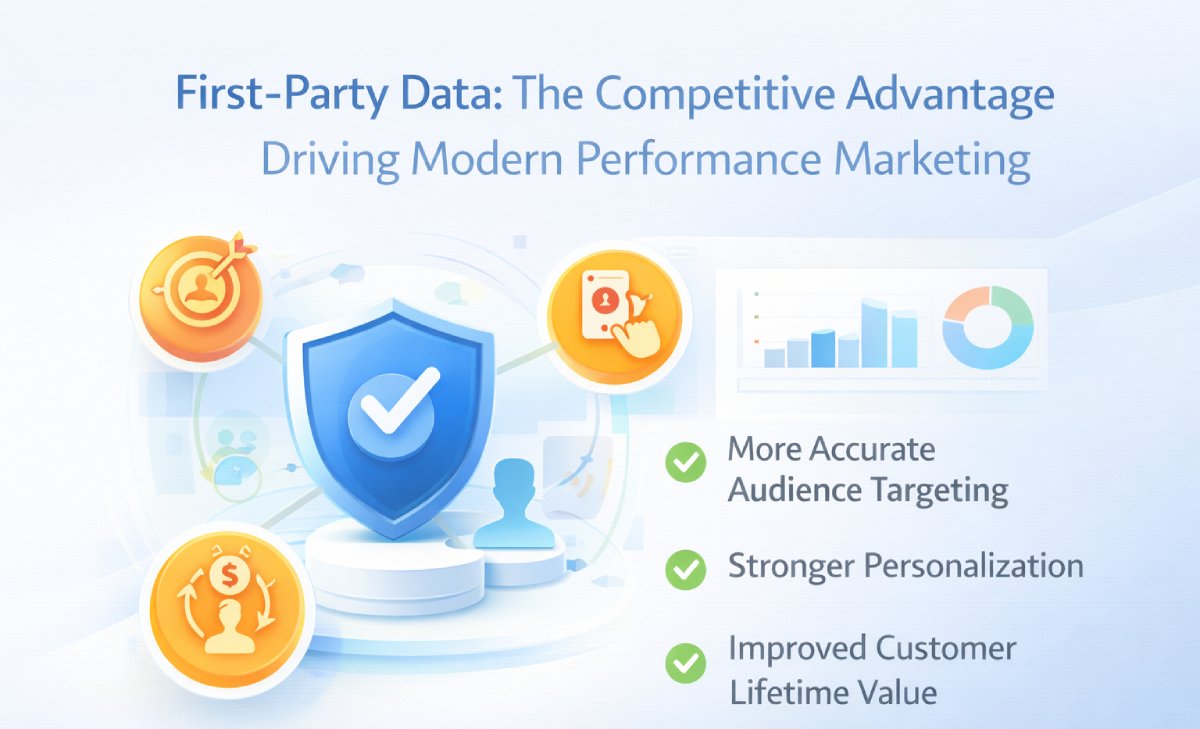
First-Party Data: The Competitive Advantage Driving Modern Performance Marketing
The digital advertising landscape has changed dramatically in recent years. Privacy regulations, browser restrictions, and platform updates have reduced the effectiveness of traditional tracking methods. As a result, businesses must rely increasingly on their own data rather than third-party tracking signals.
This shift has made first-party data one of the most important strategic assets in performance marketing.
First-party data refers to information collected directly from customers through interactions with a company’s digital platforms. Examples include website activity, purchase history, email engagement, and customer support interactions.
When businesses build robust first-party data systems, they gain several powerful advantages.
More Accurate Audience Targeting
Advertising platforms use machine learning algorithms to identify potential customers. When campaigns rely on high-quality first-party data, these algorithms can identify patterns more effectively.
For example, a company might upload its customer database into advertising platforms to create “lookalike audiences.” These audiences consist of users whose behavior mirrors that of existing customers.
This approach significantly improves targeting accuracy.
Stronger Personalization
First-party data allows businesses to personalize marketing messages based on user behavior. Instead of showing the same advertisement to every user, campaigns can display tailored content depending on previous interactions.
Examples include:
- showing product recommendations based on past purchases
- offering discounts to returning visitors
- highlighting specific benefits relevant to a user’s interests
These personalized experiences improve both engagement and conversion rates.
Improved Customer Lifetime Value
One of the most powerful applications of first-party data is improving customer lifetime value. Instead of focusing only on acquiring new customers, companies can nurture existing relationships through targeted campaigns.
Retention strategies include:
- automated email sequences
- loyalty rewards programs
- personalized product suggestions
- targeted upselling campaigns
These strategies often generate significant revenue because existing customers typically convert at higher rates than new prospects.
For brands operating in Mumbai that implement performance marketing, building strong first-party data systems has become essential to maintaining a competitive advantage.
Performance Measurement Challenges in 2026
While performance marketing offers powerful growth opportunities, it also presents new measurement challenges. As privacy regulations evolve and digital ecosystems become more complex, accurately attributing conversions to specific marketing channels becomes increasingly difficult.
These challenges are often described collectively as performance measurement challenges 2026, reflecting the next phase of marketing analytics. Several factors contribute to these challenges.
Cross-Device User Journeys
Modern consumers interact with brands across multiple devices. A user might discover a brand through a mobile advertisement, research products on a laptop, and finally complete a purchase on a tablet.
Traditional attribution models often struggle to connect these interactions into a single user journey.
Privacy Regulations and Tracking Restrictions
Regulations such as GDPR and evolving privacy frameworks limit how companies collect and process user data. Browser updates have also restricted third-party cookies, making traditional tracking methods less reliable.
These changes force marketers to rely more heavily on aggregated data models rather than individual tracking.
Platform Data Silos
Major advertising platforms such as Google, Meta, and TikTok each provide their own analytics systems. While these tools offer valuable insights, they often operate independently, making it difficult to obtain a unified view of performance.
High-performing performance marketing agencies in Mumbai teams address these challenges by implementing advanced analytics frameworks.
These frameworks typically include:
- server-side tracking systems
- first-party data warehouses
- marketing mix modeling
- unified attribution dashboards
By combining multiple data sources, businesses can build a clearer picture of marketing performance despite tracking limitations. Understanding these performance measurement challenges in 2026 is critical for organizations that want to maintain accurate visibility into their marketing investments.
Automation and AI: The Next Phase of Performance Marketing Growth
Another major evolution shaping the industry is the rise of artificial intelligence and automation. These innovations are redefining how marketing campaigns are managed and optimized.
Many emerging performance marketing automation trends focus on leveraging machine learning algorithms to analyze large datasets and identify optimization opportunities faster than human teams alone.
Automation technologies are now used across several areas of marketing operations.
Automated Bidding Systems
Modern advertising platforms automatically adjust bids based on conversion probability. Instead of manually setting bid values, algorithms evaluate thousands of signals in real time.
These signals may include:
- user behavior patterns
- device type
- geographic location
- time of day
- previous interactions with the brand
Automated bidding systems continuously optimize campaigns to achieve specific performance goals such as target cost per acquisition or target ROAS.
AI-Driven Creative Optimization
Artificial intelligence tools can analyze creative performance data to identify which messaging elements resonate most strongly with audiences.
For example, AI systems might evaluate:
- headline effectiveness
- visual engagement rates
- emotional tone of messaging
- call-to-action performance
These insights allow marketing teams to refine creative strategies rapidly.
Predictive Customer Insights
AI models can also analyze historical data to predict future customer behavior. These predictions help businesses identify high-value prospects and allocate marketing budgets more effectively.
For brands adopting advanced performance marketing automation trends, AI technologies become an essential component of the growth system.
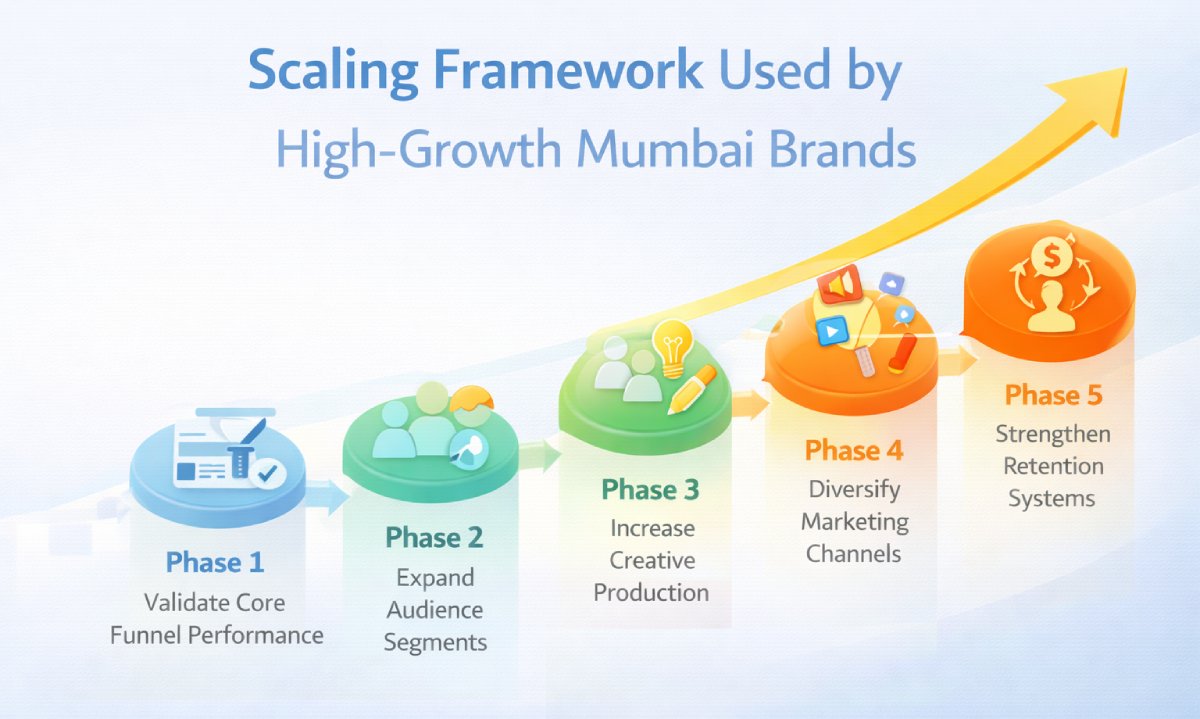
Scaling Framework Used by High-Growth Mumbai Brands
After establishing efficient acquisition systems, businesses can begin scaling their performance marketing operations. Scaling does not simply mean increasing budgets. Instead, it involves expanding the reach of proven strategies while maintaining profitability.
A typical scaling framework used by many performance marketing agencies in Mumbai teams includes several phases.
Phase 1: Validate Core Funnel Performance
Before increasing budgets, marketing teams ensure that acquisition funnels operate efficiently. Key metrics such as conversion rate, cost per acquisition, and ROAS must reach sustainable levels.
Phase 2: Expand Audience Segments
Once campaigns perform consistently, teams expand targeting to additional audience segments. These segments may include new geographic regions, demographic groups, or interest categories.
Phase 3: Increase Creative Production
Scaling campaigns requires a continuous supply of new creative assets. As advertising budgets grow, creative fatigue can reduce performance. High-growth brands, therefore, invest heavily in ongoing creative production.
Phase 4: Diversify Marketing Channels
Relying on a single advertising platform creates risk. Successful scaling strategies diversify across multiple channels, including search advertising, social media platforms, and programmatic networks.
Phase 5: Strengthen Retention Systems
Finally, companies reinforce retention systems to maximize lifetime customer value. By encouraging repeat purchases, businesses increase revenue without proportionally higher acquisition costs.
When these phases work together, businesses can confidently expand marketing investments while maintaining strong profitability.
Conclusion: The System Behind 3x Revenue Growth
The idea of tripling revenue through performance marketing may appear ambitious, but the underlying principles are surprisingly consistent across industries. High-growth companies do not rely on isolated tactics or short-term campaigns. Instead, they build structured systems that continuously improve marketing performance.
These systems integrate several key components:
- data-driven audience targeting
- continuous creative experimentation
- optimized conversion funnels
- first-party data infrastructure
- advanced analytics and attribution models
- automation technologies for campaign optimization
Businesses implementing these frameworks transform marketing from an unpredictable expense into a measurable growth engine.
For organizations competing in dynamic markets, adopting advanced performance marketing in Mumbai strategies can significantly improve efficiency and scalability. Companies that invest in structured frameworks often discover that marketing becomes one of the most powerful drivers of revenue expansion.
FAQs
What is performance marketing?
Performance marketing is a digital marketing approach focused on measurable outcomes such as leads, conversions, and revenue rather than impressions or brand awareness.
Why is performance marketing important for modern businesses?
Performance marketing allows companies to track the exact relationship between marketing investment and business results, making it easier to optimize campaigns and scale growth.
How does performance marketing work in Mumbai markets?
Performance marketing in Mumbai focuses on targeting high-intent audiences, rapidly testing creative campaigns, and leveraging data analytics to optimize advertising performance in competitive industries.
What does a performance marketing agency in Mumbai do?
A performance marketing agency in Mumbai manages digital advertising campaigns, analyzes performance data, optimizes targeting strategies, and improves conversion rates to maximize return on marketing investment.
What are the latest performance marketing automation trends?
Key performance marketing automation trends include AI-driven bidding systems, automated creative optimization, predictive analytics, and advanced attribution models.