
Introduction
For nearly two decades, businesses have relied on traditional SEO agencies to improve rankings, increase organic traffic, and generate leads from Google Search. The formula was relatively straightforward: optimize pages around keywords, build backlinks, improve technical SEO, and create content that ranks.
However, 2026 is introducing a new challenge. People are no longer relying exclusively on Google to discover businesses, products, and services. Millions of users now ask questions directly to AI platforms such as ChatGPT, Gemini, Claude, Perplexity, and Google AI Overviews. Instead of clicking through ten search results and comparing websites manually, users increasingly trust AI-generated recommendations.
This shift is creating a new category of service providers: AI SEO Agencies. Unlike traditional SEO agencies that primarily optimize for search engine rankings, AI SEO agencies focus on helping brands become visible inside AI-generated answers, recommendation engines, and Large Language Model (LLM) ecosystems.
For business owners, founders, CMOs, and marketing leaders, this raises an important question:
Does traditional SEO still work, or do businesses now need AI SEO services to stay competitive?
The reality is that SEO is not disappearing. It is evolving. Companies that understand how AI search works and adapt early are likely to gain a significant visibility advantage over competitors that continue using outdated optimization strategies.
In this guide, we’ll compare AI SEO agencies and traditional SEO agencies, examine how search behavior is changing, explore pricing differences, and help you determine which approach is best for your business in 2026 and beyond.
What Is Traditional SEO?
Traditional SEO refers to the process of improving a website’s visibility in search engines such as Google and Bing. The goal is to rank higher for target keywords, increase organic traffic, and drive conversions. For years, traditional SEO has been one of the highest ROI marketing channels because it captures users actively searching for solutions.
When someone searches:
- SEO company in Mumbai
- website development company
- CRM software for small business
- best accounting firm
Traditional SEO helps businesses appear in search results for those queries. The process involves multiple disciplines working together.
Core Components of Traditional SEO
Most SEO agencies focus on five major areas:
Keyword Research
Keyword research helps identify the terms users search for before making purchasing decisions.
Example:
Informational Intent:
- What is enterprise SEO?
- How does local SEO work?
Commercial Intent:
- Best SEO agency in Mumbai
- Enterprise SEO services
Transactional Intent:
- Hire an SEO consultant
- SEO company near me
Traditional SEO campaigns typically revolve around identifying and targeting these keywords.
On-Page SEO
On-page SEO focuses on optimizing individual pages.
Typical activities include:
- title tag optimization
- meta descriptions
- internal linking
- heading structure
- content optimization
- image optimization
The goal is to make pages easier for search engines to understand and rank.
Technical SEO
Technical SEO improves website performance and crawlability.
Activities include:
- Core Web Vitals optimization
- crawl budget management
- XML sitemaps
- schema markup
- mobile optimization
- page speed improvements
Technical SEO ensures search engines can efficiently discover and index content.
Content Marketing
Content remains the backbone of SEO.
Traditional agencies create:
- blogs
- service pages
- landing pages
- pillar pages
- topical clusters
These assets help websites build authority around specific topics.
Link Building
Backlinks remain one of Google’s strongest ranking signals.
SEO agencies acquire links through:
- digital PR
- guest posting
- outreach campaigns
- content partnerships
Strong backlink profiles help improve domain authority and rankings.
Why Traditional SEO Still Works in 2026?
Some marketers mistakenly believe AI will replace SEO entirely. That assumption is incorrect. Google still processes billions of searches daily, and search remains one of the highest-intent marketing channels available.
When someone searches:
- best CRM software
- accounting services near me
- website development company Mumbai
They are often much closer to making a purchasing decision than someone casually browsing social media.
Traditional SEO continues to provide:
Predictable Traffic Growth
Businesses can estimate potential traffic based on:
- search volume
- keyword difficulty
- ranking improvements
This creates a relatively predictable growth model.
Long-Term Asset Creation
Unlike paid advertising, SEO assets continue generating traffic long after publication. A high-ranking article can generate leads for years.
For example:
A guide targeting: “website development cost in Mumbai”
might generate qualified leads every month without ongoing advertising costs.
Strong Conversion Intent
Search users actively seek solutions.
That intent often results in:
- higher conversion rates
- lower customer acquisition costs
- stronger lead quality
Compared to interruption-based marketing channels, SEO traffic typically converts better.
What Is an AI SEO Agency?
An AI SEO Agency goes beyond traditional search rankings. Its primary objective is to help brands become visible within AI-powered discovery platforms.
This includes:
- ChatGPT
- Gemini
- Perplexity
- Claude
- Google AI Overviews
- future AI agents
Instead of asking: “How do we rank #1 on Google?”
AI SEO agencies ask: “How do we become the source that AI systems recommend?”
This is a fundamental shift.
How AI Search Works
Traditional Search:
User Search
↓
Google Results
↓
Website Visit
↓
Conversion
AI Search:
User Question
↓
AI Analysis
↓
Recommendation
↓
Decision
In many cases, users never visit multiple websites. The AI does the comparison for them. That means businesses must optimize not only for search engines but also for AI systems.
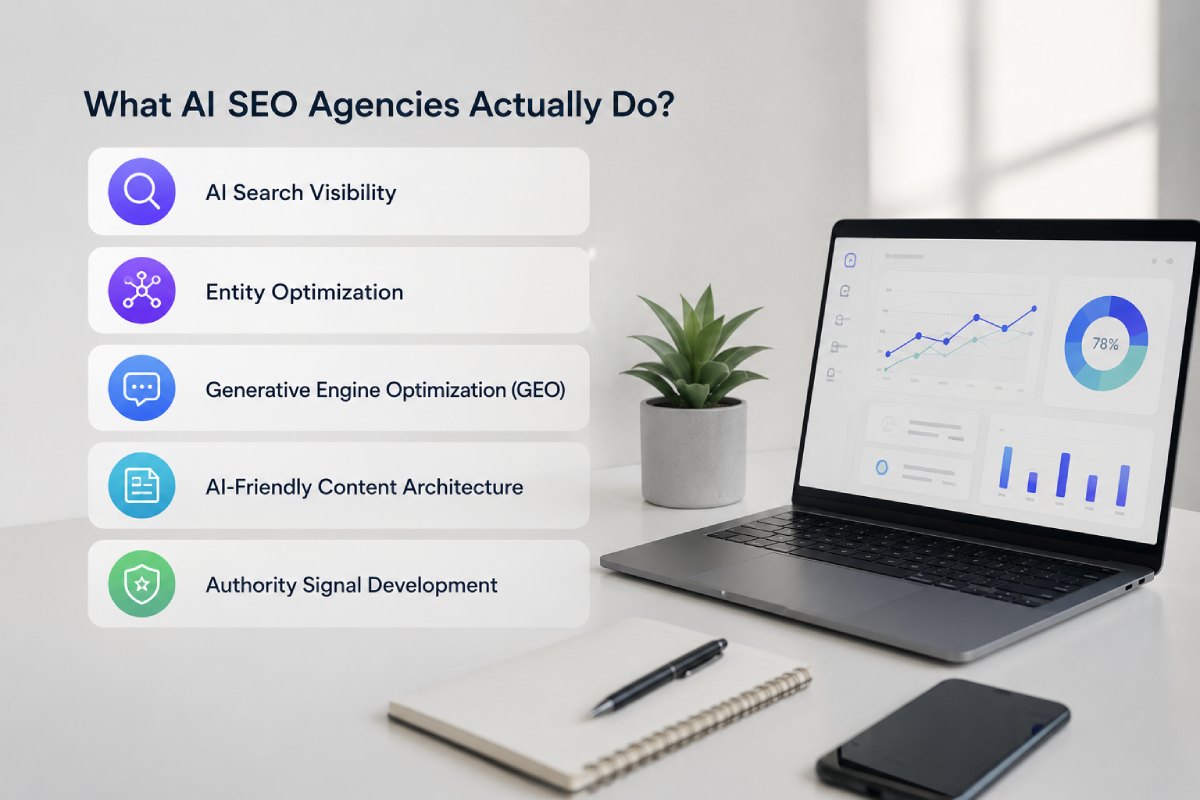
What AI SEO Agencies Actually Do?
Many business owners assume AI SEO is simply traditional SEO with AI-generated content. That is not true. Modern AI SEO services focus on several additional layers.
AI Search Visibility
Helping brands appear inside:
- ChatGPT recommendations
- Perplexity citations
- Gemini answers
- AI Overviews
Entity Optimization
AI systems understand entities more than keywords.
An entity can be:
- company
- person
- product
- service
- brand
AI SEO agencies work on strengthening entity recognition across the web.
Generative Engine Optimization (GEO)
GEO focuses on optimizing content specifically for AI-generated answers.
This includes:
- structured explanations
- answer-first content
- comparison frameworks
- semantic depth
AI-Friendly Content Architecture
Content must become machine-readable.
This involves:
- schema markup
- FAQ structures
- definitions
- tables
- frameworks
- comparison sections
AI systems prefer content that is easy to extract and summarize.
Authority Signal Development
AI systems evaluate:
- reviews
- mentions
- citations
- backlinks
- trust signals
An AI SEO agency actively strengthens these signals.
Traditional SEO vs AI SEO Agency: Core Differences
| Factor | Traditional SEO Agency | AI SEO Agency |
| Main Goal | Google Rankings | AI Recommendations |
| Focus | Keywords | Entities & Authority |
| Content Style | Search Optimized | Search + AI Optimized |
| Visibility | SERPs | SERPs + AI Platforms |
| Schema Usage | Moderate | Extensive |
| Entity SEO | Limited | Core Focus |
| GEO Optimization | Rare | Essential |
| AI Citations | Not Focused | Major Objective |
The biggest misconception is believing AI SEO replaces traditional SEO.
In reality:
AI SEO builds on top of traditional SEO.
The strongest agencies today combine both approaches.
Why Businesses Are Moving Toward AI SEO Services?
Several market trends are accelerating adoption.
Trend 1: AI Search Usage Is Growing
More users now ask:
- ChatGPT
- Gemini
- Perplexity
before opening Google.
This behavior is especially common among:
- founders
- marketers
- researchers
- software buyers
Trend 2: AI Compresses the Funnel
Previously:
Search
- Website Visit
- Comparison
- Decision
Now:
Question
- AI Recommendation
- Decision
This dramatically reduces opportunities for businesses that are not visible within AI systems.
Trend 3: Brand Visibility Is Becoming More Important
AI systems do not rely only on keywords.
They evaluate:
- authority
- trust
- citations
- reputation
Businesses with stronger digital footprints gain an advantage.
Trend 4: AI Agents Are Emerging
Future AI agents will:
- compare vendors
- evaluate pricing
- analyze reviews
- make recommendations
Businesses optimized for AI visibility will benefit disproportionately.
Framework Diagram
Traditional SEO Model
Keyword
↓
Ranking
↓
Traffic
↓
Leads
AI SEO Model
Entity Authority
↓
AI Recommendation
↓
Trust
↓
Leads
Ranking Factors: Traditional SEO vs AI SEO
One of the biggest misconceptions businesses have in 2026 is believing that AI search platforms use the same ranking signals as Google. While there is some overlap, AI systems evaluate content differently because their goal is not simply to rank pages; they need to generate trustworthy answers.
Traditional SEO focuses on helping a page appear in search results when users enter a query. AI SEO focuses on helping a brand become part of the answer itself. This difference changes how websites should be structured, how content should be written, and how authority should be built online.
Traditional SEO Ranking Factors
Google’s algorithm continues to rely heavily on ranking signals that have evolved over the last two decades.
Keyword Relevance
Google still uses keywords as an important indicator of topical relevance. A page optimized for “SEO services in Mumbai” should clearly communicate that topic through:
- page titles
- headings
- content structure
- internal links
- anchor text
However, keyword stuffing no longer works. Google now evaluates context, intent, and semantic relationships between topics.
Backlink Authority
Backlinks remain one of Google’s strongest trust signals. When authoritative websites link to your content, Google interprets this as a vote of confidence.
For example:
A backlink from:
- Forbes
- HubSpot
- Search Engine Journal
typically carries more weight than dozens of low-quality links. This is why traditional SEO agencies continue investing heavily in digital PR and link-building campaigns.
Technical SEO
Technical SEO ensures that search engines can efficiently crawl, understand, and index a website.
Important factors include:
- Core Web Vitals
- mobile responsiveness
- site architecture
- crawlability
- XML sitemaps
- canonicalization
Without a strong technical foundation, even great content may struggle to rank.
User Experience Signals
Google increasingly evaluates:
- engagement metrics
- page speed
- user behavior
- navigation quality
A website that loads slowly or frustrates users will struggle to maintain rankings.
AI SEO Ranking Factors
AI search engines evaluate many traditional SEO signals but place greater emphasis on authority, clarity, and machine readability.
Entity Recognition
AI systems think in terms of entities rather than keywords.
For example: Traditional SEO sees: “best SEO company in Mumbai”
AI systems see:
- Ideamagix
- SEO services
- Mumbai
- digital marketing
and the relationships between them. The stronger your entity presence across the web, the more likely AI platforms are to recognize and recommend your brand.
Structured Data
Schema markup is becoming one of the most important optimization techniques for AI visibility.
Schema helps AI systems understand:
- business information
- services
- reviews
- pricing
- FAQs
- authorship
Without structured data, AI systems must infer meaning from raw text, which reduces accuracy and visibility.
Topical Authority
AI systems prefer sources that demonstrate deep expertise across an entire topic.
For example:
A company with one article about SEO is less authoritative than a company with:
- 50 SEO articles
- local SEO content
- technical SEO guides
- enterprise SEO resources
- AI SEO content
This is why topical clusters have become critical.
Citation Frequency
AI platforms increasingly reward brands that are repeatedly referenced across trusted sources.
These citations may come from:
- industry publications
- review platforms
- research reports
- podcasts
- case studies
The more frequently a brand appears in relevant contexts, the more confidence AI systems have in recommending it.
AI Search Visibility: How Businesses Get Recommended by AI
The goal of AI SEO is not simply ranking. The goal is a recommendation.
When a user asks: “Who is the best SEO agency for enterprise businesses?”
The AI system must decide which companies deserve to appear in its answer. This decision is based on a combination of trust signals, authority indicators, and content quality.
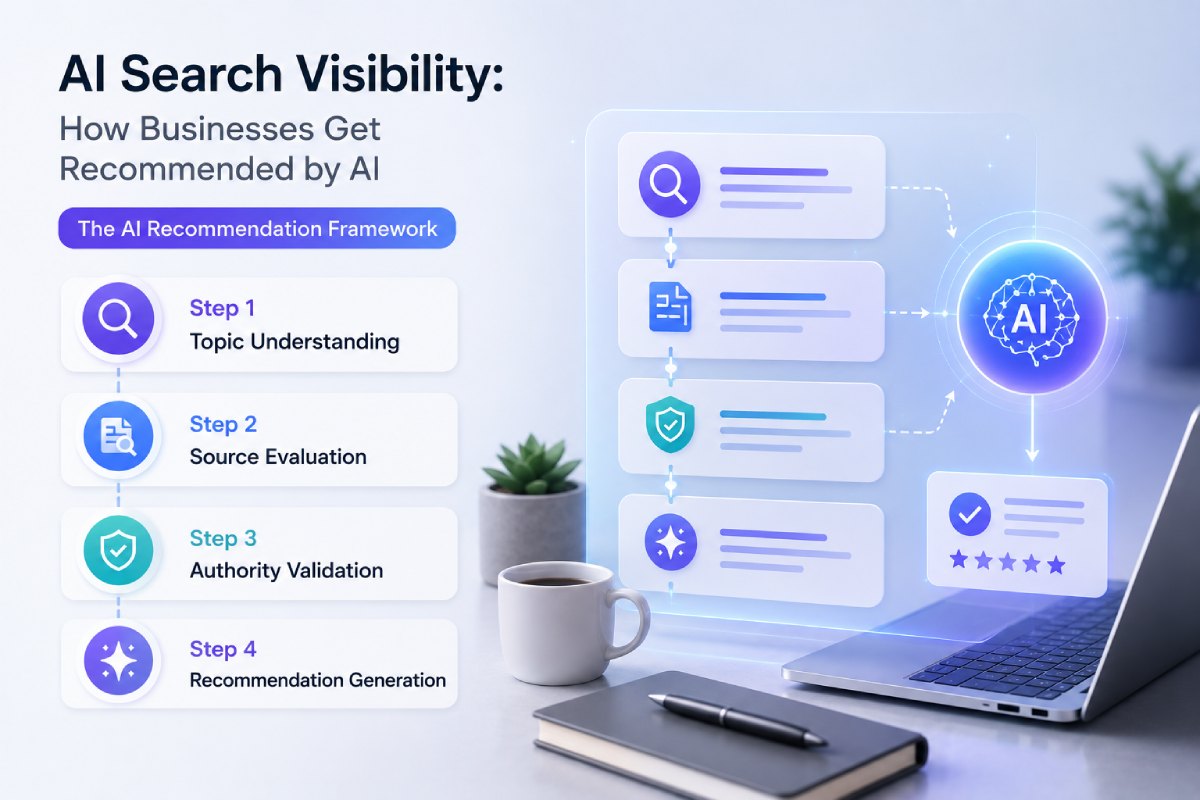
The AI Recommendation Framework
Step 1: Topic Understanding
The AI first determines the user’s intent.
Example: “Best AI SEO agency”
Intent:
- comparison
- evaluation
- purchase consideration
The AI identifies which type of businesses can satisfy that request.
Step 2: Source Evaluation
The AI reviews available information across the web.
This includes:
- websites
- review platforms
- directories
- news mentions
- case studies
It evaluates which sources appear most trustworthy.
Step 3: Authority Validation
AI systems cross-reference information from multiple locations.
For example:
If a company claims to be an SEO expert but has:
- no reviews
- no mentions
- no backlinks
- no industry references
The AI may reduce confidence. Authority is increasingly validated externally rather than solely through a company’s own website.
Step 4: Recommendation Generation
Only after evaluating trust signals does the AI generate recommendations. This means visibility is no longer controlled entirely by rankings.
It is controlled by:
- authority
- credibility
- reputation
- expertise
AI Search Optimization Framework for 2026
Businesses that want visibility in ChatGPT, Gemini, Perplexity, and future AI agents should follow a structured optimization framework.
Framework Diagram
Brand Entity
↓
Technical SEO
↓
Structured Data
↓
Topical Authority
↓
External Mentions
↓
AI Recommendation
Layer 1: Technical Foundation
AI optimization begins with technical SEO.
This includes:
- crawlability
- page speed
- schema implementation
- mobile optimization
Without a strong foundation, AI systems may struggle to interpret website content accurately.
Layer 2: Content Clarity
AI systems reward websites that explain concepts clearly.
Strong AI-friendly content includes:
- definitions
- comparisons
- frameworks
- step-by-step explanations
This is one reason long-form educational content performs exceptionally well in AI search.
Layer 3: Authority Building
Authority is established through:
- backlinks
- digital PR
- case studies
- expert content
The stronger your authority signals, the more likely AI systems will trust your brand.
Layer 4: Entity Expansion
Businesses should actively strengthen their entity presence across:
- Google Business Profile
- Crunchbase
- Clutch
- review platforms
AI systems often connect these sources together when evaluating trustworthiness.
AI SEO Agency vs Traditional SEO Agency: Cost Comparison
Pricing varies significantly depending on the scope of services. However, many businesses evaluate agencies based solely on monthly fees instead of expected business outcomes. This often leads to poor decisions.
Traditional SEO Agency Pricing
Small Business SEO
₹20,000–₹50,000/month
Typically includes:
- keyword targeting
- content creation
- basic technical SEO
- reporting
Suitable for:
- local businesses
- startups
- service providers
Mid-Market SEO
50,000–₹2,00,000/month
Typically includes:
- advanced content strategy
- link building
- technical audits
- conversion optimization
Suitable for:
- SMEs
- ecommerce brands
- regional businesses
Enterprise SEO
₹2,00,000–₹10,00,000+/month
Includes:
- large-scale content operations
- enterprise audits
- international SEO
- advanced reporting
AI SEO Agency Pricing
AI SEO agencies typically charge more because they combine traditional SEO with AI visibility optimization.
AI SEO Starter Programs
₹50,000–₹1,50,000/month
Includes:
- schema implementation
- entity optimization
- AI content structuring
- topical authority planning
Growth Programs
₹1,50,000–₹5,00,000/month
Includes:
- AI search visibility campaigns
- GEO optimization
- authority building
- AI citation tracking
Enterprise AI SEO
₹5,00,000–₹25,00,000+/month
Includes:
- global AI visibility
- multilingual AI optimization
- entity management
- enterprise content systems
Key Insight
Businesses should compare agencies based on:
- revenue impact
- lead generation
- AI visibility growth
rather than the monthly cost alone. A higher-priced agency generating 10X ROI is ultimately cheaper than a low-cost agency producing no measurable business growth. The debate around AI SEO Agency vs Traditional SEO Agency should focus on long-term visibility, authority building, and measurable business outcomes rather than pricing alone.
Which Businesses Need AI SEO Services in 2026?
One of the biggest misconceptions surrounding AI SEO is that it only matters for technology companies or AI startups. In reality, AI-driven search is changing how customers discover businesses across almost every industry.
The question is no longer: “Should we invest in AI SEO?”
The better question is: “How quickly will AI influence our customer acquisition process?”
For some industries, the impact is already significant. For others, it will become unavoidable within the next 12–24 months. Businesses that rely heavily on online discovery, education, comparisons, or trust-building should prioritize AI SEO earlier than others.
B2B Service Businesses
B2B buyers conduct extensive research before making purchasing decisions. Traditionally, they would search Google, visit multiple websites, read case studies, compare vendors, and speak with sales teams. Today, many buyers begin their research using ChatGPT, Gemini, or Perplexity.
Consider a query like:
- Best ERP software company in India
- Top enterprise SEO agencies
- CRM development company for startups
- Digital transformation consulting firms
AI systems are increasingly providing summarized recommendations rather than simply displaying search results. For B2B businesses, this means visibility inside AI-generated answers may become as important as ranking on Google’s first page.
Industries that should prioritize AI SEO include:
- SaaS companies
- consulting firms
- software development companies
- IT service providers
- marketing agencies
- enterprise solution providers
Healthcare & Medical Businesses
Healthcare searches are among the most researched and trust-sensitive categories online.
Patients increasingly ask AI platforms questions such as:
- Best dermatologist in Mumbai
- IVF treatment options
- Knee replacement cost in India
- Spine specialist near me
AI systems evaluate expertise, trustworthiness, authority, and content quality before surfacing recommendations.
Medical businesses with strong:
- E-E-A-T signals
- doctor profiles
- structured medical content
- patient reviews
are likely to gain a significant advantage.
Ecommerce Brands
AI-powered shopping assistants are becoming increasingly common.
Future purchasing journeys may look like:
“Find the best running shoes under ₹8,000.”
or
“Recommend the best office chair for back pain.”
Instead of manually browsing dozens of websites, consumers may rely on AI-generated recommendations.Ecommerce brands that invest in:
- product schema
- review schema
- structured product information
- comparison content
will be more likely to appear in AI-driven shopping experiences.
Local Service Businesses
AI search is also impacting local discovery.
Users increasingly ask:
- Best dentist near me
- Top SEO company in Mumbai
- Best accounting firm in Thane
- Local web development company
AI systems combine:
- Google Business Profile data
- reviews
- local citations
- website authority
to generate recommendations. Local businesses that optimize these assets gain greater visibility.
Industries Seeing the Biggest AI Search Impact
Not every industry will experience AI disruption at the same pace. Some sectors are already seeing AI influence customer decisions.
Marketing & SEO
Marketing agencies are among the first industries affected because marketers themselves are early AI adopters.
Potential clients regularly ask:
- Best SEO agency
- Best AI SEO services
- Top digital marketing companies
inside AI platforms. Agencies that establish topical authority early will benefit significantly.
Software & SaaS
Software buyers increasingly use AI to compare:
- pricing
- features
- integrations
- alternatives
Companies with strong educational content and structured product information gain visibility.
Finance
Financial products often require extensive research.
Users frequently ask:
- Best investment platform
- Business loan options
- Tax consultant recommendations
AI search can dramatically influence financial buying decisions.
Healthcare
Patients trust AI-generated summaries for preliminary research. Healthcare providers that publish authoritative, expert-led content are likely to gain visibility.
Education
Educational institutions and training providers increasingly compete for visibility in AI-generated answers.
Users ask:
- Best MBA programs
- Top coding bootcamps
- Online certification courses
AI search influences decision-making long before users visit a website.
AI SEO ROI Framework
Many businesses evaluate SEO using outdated metrics such as rankings or traffic. The true objective of AI SEO is business growth. The measurement framework should evolve accordingly.
Traditional SEO ROI Model
Keyword Rankings
↓
Organic Traffic
↓
Leads
↓
Revenue
This model still works. However, it doesn’t capture visibility inside AI-generated experiences.
AI SEO ROI Model
Authority
↓
AI Recommendations
↓
Qualified Traffic
↓
Leads
↓
Revenue
Notice that visibility is increasingly driven by authority rather than rankings alone.
Example ROI Scenario
A B2B software company invests: ₹3,00,000/month
into:
- AI SEO
- authority building
- content clusters
- schema optimization
Results after 12 months:
- Organic traffic: 50,000 → 1,80,000/month
- AI citations: 0 → 250+ monthly references
- Leads: 200 → 900/month
- Average deal value: ₹1,50,000
- Annual revenue impact: ₹1.5 Cr → ₹8 Cr+
This demonstrates why leading companies increasingly view SEO as a revenue system rather than a traffic channel.
Key Metrics to Track
Businesses should monitor:
Traditional Metrics
- keyword rankings
- organic traffic
- backlinks
- impressions
AI SEO Metrics
- AI citations
- brand mentions
- entity visibility
- AI recommendation frequency
Business Metrics
- qualified leads
- customer acquisition cost
- revenue generated
- pipeline contribution
The businesses that win in 2026 will be those that connect SEO performance directly to business outcomes.
Common Mistakes Businesses Make When Adopting AI SEO
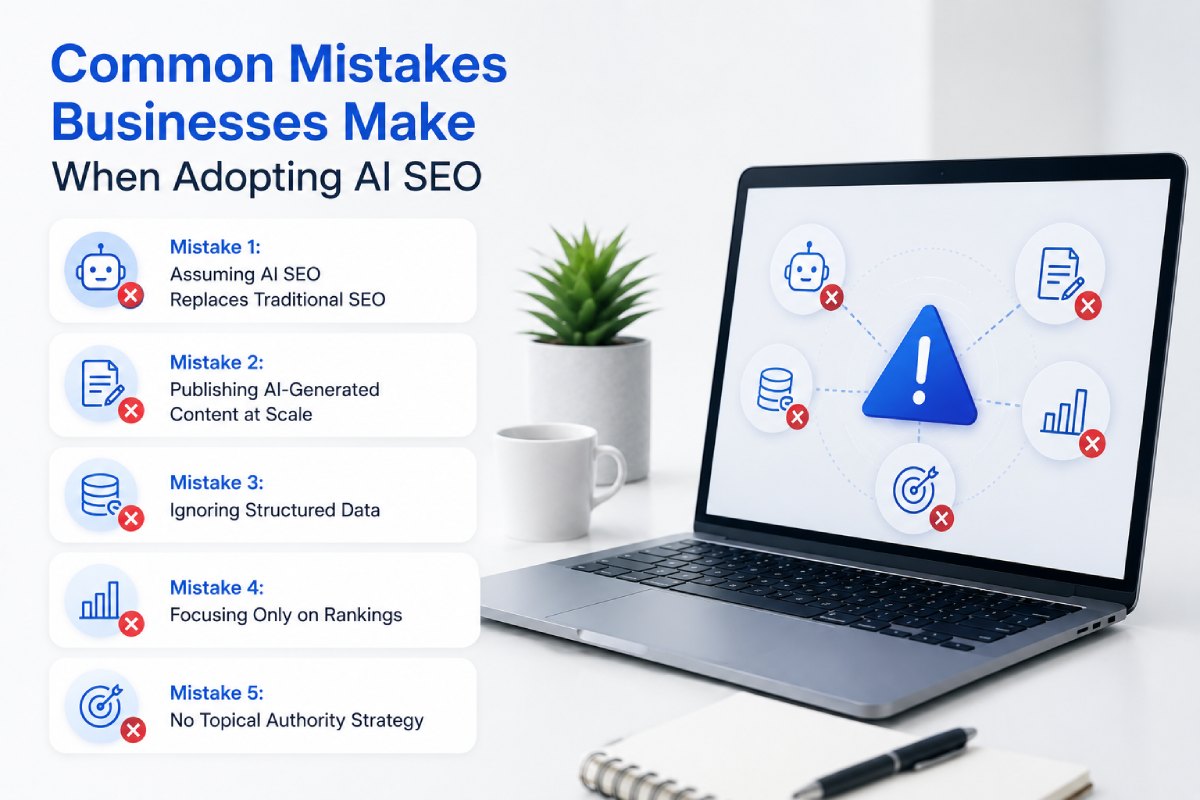
Many organizations recognize the importance of AI search but make implementation mistakes that limit results.
Mistake 1: Assuming AI SEO Replaces Traditional SEO
This is the biggest mistake. AI SEO is not a replacement for traditional SEO. It is an evolution.
Without:
- technical SEO
- content quality
- authority
AI visibility becomes difficult. The strongest strategies combine both approaches.
Mistake 2: Publishing AI-Generated Content at Scale
Many companies believe publishing hundreds of AI-written articles will improve visibility.
In reality:
- AI systems increasingly prioritize:
- expertise
- originality
- unique insights
- Mass-produced content often lacks authority.
Mistake 3: Ignoring Structured Data
- Many websites still lack:
- FAQ schema
- organization schema
- review schema
- service schema
This reduces machine readability and AI understanding.
Mistake 4: Focusing Only on Rankings
Ranking #1 for a keyword does not guarantee AI recommendations.
Visibility now depends on:
- trust
- authority
- citations
- reputation
Businesses must optimize beyond rankings.
Mistake 5: No Topical Authority Strategy
Publishing random blogs without a structured content architecture weakens authority.
Winning brands build:
Pillar Pages
↓
Cluster Content
↓
Supporting Content
↓
Entity Authority
This creates stronger AI and Google signals.
How to Choose the Right AI SEO Agency
As AI SEO becomes more popular, many agencies will claim expertise despite lacking actual capabilities. Choosing the wrong partner can delay results and waste marketing budgets.
Evaluate Their Understanding of AI Search
Ask:
- How do you measure AI visibility?
- How do you optimize for ChatGPT?
- What is your GEO strategy?
- How do you improve entity authority?
A genuine AI SEO agency should provide clear answers.
Assess Technical SEO Expertise
AI optimization begins with technical foundations.
Evaluate their capabilities in:
- schema markup
- crawlability
- Core Web Vitals
- entity optimization
Review Their Content Strategy
Ask how they build topical authority.
Strong agencies typically use:
Pillar Pages
↓
Cluster Articles
↓
Internal Linking
↓
Authority Building
Instead of publishing random blog content.
Look for Business-Focused Metrics
Avoid agencies that only report:
- rankings
- impressions
Instead, prioritize agencies that track:
- leads
- pipeline
- revenue impact
How Ideamagix Helps Businesses Win in Google and AI Search?
At Ideamagix, we believe the future of search belongs to businesses that combine traditional SEO excellence with AI visibility optimization. Our approach goes beyond rankings.
We focus on building digital authority systems that help businesses become discoverable wherever customers search whether through Google, ChatGPT, Gemini, Perplexity, or future AI agents.
The Ideamagix Growth Framework
Technical SEO
↓
Content Authority
↓
Entity Optimization
↓
AI Search Visibility
↓
Lead Generation
↓
Revenue Growth
What We Focus On
Traditional SEO Excellence
- Technical SEO
- Local SEO
- Enterprise SEO
- Ecommerce SEO
AI Search Optimization
- Generative Engine Optimization (GEO)
- AI-friendly content architecture
- schema implementation
- entity building
Authority Building
- topical authority clusters
- digital PR
- backlink acquisition
- thought leadership content
Conversion Optimization
Visibility alone does not generate revenue.
We help businesses improve:
- conversion rates
- landing page performance
- lead generation systems
The result is a strategy designed around:
Traffic → Authority → AI Visibility → Leads → Revenue
FAQs: AI SEO Agency vs Traditional SEO Agency
1. What is the difference between an AI SEO agency and a traditional SEO agency?
A traditional SEO agency primarily focuses on improving rankings in search engines like Google and Bing. Their strategies revolve around keyword optimization, content creation, technical SEO, and link building to increase organic traffic. An AI SEO agency, on the other hand, goes beyond search rankings and focuses on helping businesses become visible inside AI-powered platforms such as ChatGPT, Gemini, Claude, Perplexity, and Google AI Overviews.
AI SEO agencies optimize content for machine understanding, entity recognition, structured data, and AI citation opportunities. They build topical authority systems designed not only to rank pages but also to increase the likelihood of being referenced by AI-generated answers. In 2026, the strongest agencies combine both traditional SEO and AI SEO rather than treating them as separate disciplines.
Key Insight: Traditional SEO helps users find your website. AI SEO helps AI systems recommend your business.
2. Is traditional SEO still relevant in 2026?
Absolutely. Traditional SEO remains one of the most effective digital marketing channels because Google still processes billions of searches every day. People continue searching for products, services, and solutions using traditional search engines, especially for high-intent commercial queries.
What has changed is that traditional SEO alone may no longer be enough. As AI-powered search platforms become more widely used, businesses must expand their visibility strategy beyond search rankings. Technical SEO, content quality, backlinks, and user experience continue to matter, but AI visibility is becoming an additional layer of optimization.
The businesses achieving the best results in 2026 are not abandoning traditional SEO, they are enhancing it with AI-focused strategies.
Key Insight: SEO is evolving, not disappearing.
3. What are AI SEO services?
AI SEO services are specialized optimization strategies designed to improve visibility within AI-generated search experiences. These services focus on helping businesses appear in responses generated by platforms such as ChatGPT, Gemini, Claude, Perplexity, and Google AI Overviews.
Typical AI SEO services include:
- entity optimization
- schema markup implementation
- Generative Engine Optimization (GEO)
- AI-friendly content structuring
- topical authority development
- AI citation optimization
- semantic SEO
Unlike traditional SEO, which focuses primarily on rankings, AI SEO focuses on recommendation visibility. The objective is to increase the chances that AI systems recognize, trust, and recommend your brand when users ask relevant questions.
Key Insight: AI SEO is the process of optimizing your business for AI recommendations, not just search rankings.
4. How do AI search engines choose which businesses to recommend?
AI systems evaluate a wide range of trust and authority signals before generating recommendations. They do not simply rank websites based on keywords. Instead, they analyze structured information, content quality, brand reputation, topical expertise, and external validation.
AI platforms typically consider:
- website authority
- structured data
- reviews and ratings
- backlinks
- brand mentions
- content depth
- topical authority
- freshness of information
For example, if multiple trusted sources consistently mention a particular SEO agency, AI systems are more likely to recommend that agency when users ask relevant questions.This is why businesses must think beyond rankings and focus on becoming recognized authorities within their industries.
Key Insight: AI systems reward trust, expertise, and authority rather than keyword optimization alone.
5. Which businesses should invest in AI SEO right now?
Businesses that rely on online discovery, educational content, comparison searches, or trust-based purchasing decisions should prioritize AI SEO as early as possible.
Industries already benefiting include:
- SaaS companies
- software development firms
- digital marketing agencies
- healthcare providers
- ecommerce businesses
- consulting firms
- financial services companies
- education providers
For example, when users ask AI systems questions like “best CRM software,” “top digital marketing agency,” or “recommended SEO company,” businesses with strong AI visibility are more likely to be included in the response. The earlier businesses invest in AI SEO, the stronger their authority signals become as AI adoption accelerates.
Key Insight: If customers research before purchasing, AI SEO should be part of your strategy.
6. How much do AI SEO services cost?
The cost of AI SEO services varies depending on business size, competitiveness, and objectives. Most agencies combine traditional SEO activities with AI-specific optimization strategies.
Typical pricing ranges include:
| Service Level | Monthly Cost |
| Starter AI SEO | ₹50,000 – ₹1,50,000 |
| Growth AI SEO | ₹1,50,000 – ₹5,00,000 |
| Enterprise AI SEO | ₹5,00,000 – ₹25,00,000+ |
Pricing usually depends on:
- content production requirements
- authority-building campaigns
- technical implementation
- schema optimization
- AI visibility monitoring
- International expansion requirements
Businesses should evaluate AI SEO investments based on expected lead generation and revenue impact rather than monthly fees alone.
Key Insight: AI SEO should be measured as a growth investment, not a marketing expense.
7. How long does it take to see results from AI SEO?
AI SEO is not an overnight strategy. Like traditional SEO, it requires time to build authority, strengthen trust signals, and improve visibility.
Typical timelines include:
First 1–3 Months
- technical improvements
- schema implementation
- content restructuring
- authority planning
3–6 Months
- increased topical authority
- improved search visibility
- stronger entity recognition
6–12 Months
- Higher AI citation frequency
- stronger recommendation potential
- measurable lead growth
The timeline depends on factors such as competition, website authority, content quality, and industry maturity.
Key Insight: Businesses that start early gain a significant compounding advantage as AI adoption grows.
8. What is Generative Engine Optimization (GEO)?
Generative Engine Optimization (GEO) is the practice of optimizing content specifically for AI-generated search experiences. While traditional SEO focuses on ranking webpages, GEO focuses on helping AI systems understand, trust, and reference content when generating answers.
A GEO strategy typically includes:
- answer-focused content
- semantic optimization
- structured data
- authority building
- comparison content
- expert insights
As AI-powered search continues growing, GEO is becoming an increasingly important component of modern SEO strategies.
Key Insight: GEO helps businesses become sources of answers rather than just search results.
9. Can AI SEO replace traditional SEO?
No. AI SEO should not replace traditional SEO. The most successful businesses combine both approaches because traditional SEO provides the foundation for AI visibility.
Without:
- strong technical SEO
- authoritative content
- backlinks
- search visibility
AI systems have fewer trust signals to evaluate. AI SEO builds on top of traditional SEO by expanding visibility into AI-generated experiences. The future belongs to businesses that optimize for both search engines and AI platforms simultaneously.
Key Insight: AI SEO and traditional SEO work best together.
10. How do I choose the best AI SEO agency?
Choosing the right AI SEO agency requires evaluating more than rankings and traffic reports. Businesses should look for agencies that understand both traditional SEO and AI search optimization.
Questions to ask include:
- How do you measure AI visibility?
- What is your GEO framework?
- How do you optimize for ChatGPT and Gemini?
- How do you build entity authority?
- What metrics do you track beyond rankings?
The best agencies focus on business outcomes such as:
- qualified leads
- revenue growth
- authority building
- AI recommendation visibility
- rather than rankings alone.
Key Insight: The best AI SEO agency is one that can connect visibility directly to business growth.