
Introduction
A business website is no longer just a digital brochure; it has become one of the most important business assets for attracting customers, generating leads, building credibility, and driving long-term growth. Whether you’re a startup launching your first online presence, a manufacturing company expanding into new markets, a healthcare provider building patient trust, or an enterprise looking to streamline customer interactions, your website often becomes the first impression potential customers have of your business.
However, while businesses spend significant time comparing office spaces, hiring employees, or selecting software solutions, many choose a website development company based solely on the lowest quotation. This often leads to delayed projects, poor-quality websites, weak search engine visibility, security issues, slow loading speeds, and expensive redevelopment within just a few years.
Choosing the right website development company in Mumbai is therefore not simply about finding someone who can build webpages. It is about selecting a long-term technology partner capable of understanding your business objectives, designing exceptional user experiences, implementing scalable technology, optimizing for search engines, ensuring security, and supporting future business growth.
Today’s websites must satisfy far more than visual expectations. They need to perform exceptionally across desktops and mobile devices, integrate with CRM systems and third-party applications, meet Core Web Vitals standards, support AI-powered search experiences, and convert visitors into paying customers. A visually attractive website that fails to generate enquiries ultimately becomes a business expense instead of a business investment.
This comprehensive guide will help you understand how to evaluate a website development company in Mumbai, what questions to ask before hiring, how to compare agencies, common mistakes businesses make, pricing considerations, technology selection, and the key qualities that distinguish an average web developer from the best web development company.
Whether you’re planning a business website, ecommerce platform, enterprise application, or custom web solution, this guide will help you make a confident and informed decision. Comprehensive website development services ensure your website is built to support both your current business goals and future digital growth.
Why Choosing the Right Website Development Company Matters
Understanding how to choose web developer partners carefully can help businesses avoid costly redevelopment and long-term technical challenges. Many businesses think of website development as a one-time project focused on aesthetics. In reality, your website directly influences how customers perceive your brand, interact with your business, and decide whether to contact you or your competitors.
A professionally developed website functions as a 24/7 sales representative. It answers customer questions, showcases your expertise, captures enquiries, builds trust, and supports every digital marketing activity, from SEO and Google Ads to social media and email campaigns.
Choosing the wrong development partner can affect every one of these areas, creating problems that become increasingly expensive to fix over time.
Your Website Is Often the First Business Interaction
Before contacting a business, most customers research online.
They typically evaluate:
- your website
- Google reviews
- services
- pricing information
- case studies
- client testimonials
- portfolio
- contact details
If your website appears outdated, loads slowly, or is difficult to navigate, visitors often assume the same about your business operations. Research consistently shows that users form an opinion about a website within seconds. During this brief window, design quality, speed, content clarity, and usability determine whether visitors continue exploring or leave for a competitor.
A professional website development company Mumbai understands these behavioural patterns and designs websites that immediately establish credibility.
A Website Directly Impacts Lead Generation
Many business owners measure website success by appearance alone. However, the real purpose of a business website is to generate measurable business outcomes.
A high-performing website should encourage visitors to:
- request quotations
- book consultations
- submit enquiry forms
- make purchases
- schedule demonstrations
- call your business
- subscribe to newsletters
Achieving these outcomes requires strategic planning rather than simply attractive design.
Professional development agencies carefully optimize:
- information architecture
- user journeys
- call-to-action placement
- landing page structure
- trust elements
- conversion-focused layouts
Every design decision should support business goals. Effective business website development focuses on creating digital experiences that encourage visitors to become qualified leads.
Website Performance Affects Search Engine Rankings
Search engines evaluate far more than content.
Google also considers technical performance signals such as:
- loading speed
- mobile responsiveness
- HTTPS security
- Core Web Vitals
- structured data
- crawlability
- site architecture
Poor development practices can significantly limit SEO performance, regardless of how much content you publish.
For example:
- A slow website increases bounce rates.
- Higher bounce rates reduce user satisfaction.
- Reduced user satisfaction affects search performance.
- Lower rankings generate less organic traffic.
- Less traffic means fewer enquiries.
This chain reaction demonstrates why development quality directly influences digital marketing success.
Modern Websites Must Support Business Growth
Business requirements evolve continuously.
You may begin with:
- service pages
- contact forms
- company information
Later, you may require:
- ecommerce
- CRM integration
- customer portals
- payment gateways
- appointment booking
- ERP integration
- multilingual functionality
- AI-powered chatbots
If your website is built without scalability in mind, adding these features later becomes expensive and technically challenging. An experienced web development agency plans for future growth from the beginning.
Security Is a Business Requirement
Cybersecurity threats continue increasing every year.
Websites store valuable information including:
- customer enquiries
- payment details
- employee information
- business documents
- CRM data
Poorly developed websites often become vulnerable due to:
- outdated plugins
- insecure coding
- weak authentication
- missing security updates
- improper server configuration
A professional development company implements security best practices throughout the development lifecycle rather than treating security as an afterthought.
Better User Experience Improves Revenue
User experience influences nearly every business metric.
An intuitive website encourages visitors to:
- stay longer
- explore services
- trust your brand
- complete enquiries
- return in the future
Conversely, confusing navigation, slow loading, and poor mobile experiences reduce conversions regardless of marketing investment.
Businesses investing in Google Ads or SEO particularly benefit from optimized websites because higher conversion rates improve return on investment across every marketing channel.
The Business Impact of Choosing the Wrong Development Partner
Choosing an inexperienced developer often results in problems that extend far beyond technical issues.
Common consequences include:
- project delays
- budget overruns
- poor communication
- weak SEO foundations
- low-quality code
- slow websites
- security vulnerabilities
- limited scalability
- ongoing maintenance issues
Many businesses eventually rebuild their websites within two or three years because the original solution cannot support future growth.
Selecting the right partner from the beginning reduces these long-term costs.
How the Right Website Development Company Creates Business Value
Professional website development services combine strategy, technology, design, and ongoing support to deliver measurable business outcomes. A professional development partner contributes far more than coding expertise.
They help businesses:
- understand customer needs
- improve digital strategy
- enhance user experience
- optimize conversion rates
- strengthen SEO
- integrate business systems
- improve performance
- prepare for future expansion
Instead of delivering only a website, they build a digital platform that supports long-term business objectives. Partnering with the best web development company enables businesses to build secure, scalable, and high-performing websites that support long-term growth.
Key Insight: The true value of a website is not measured by how it looks; it is measured by how effectively it helps your business attract visitors, build trust, generate leads, and support sustainable growth.
When Does Your Business Need a Professional Website Development Company?
Many business owners initially believe that a website builder or freelance developer will meet all their requirements. While these options may work for very small projects, growing businesses often reach a stage where they need structured planning, technical expertise, scalability, and ongoing support.
A professional website development company in Mumbai becomes valuable when your website is expected to contribute directly to business growth rather than simply provide an online presence. Different businesses have different development requirements, and understanding these differences helps you choose the right partner.
Startups Launching Their First Website
Startups often require more than a basic website.
Their website must:
- establish credibility
- explain the business clearly
- generate investor confidence
- attract early customers
- support future scaling
A professional agency helps startups create a flexible digital foundation capable of growing alongside the business.
Growing Small and Medium Businesses
As businesses expand, websites must support increasing marketing activities.
Common requirements include:
- SEO optimization
- Google Ads landing pages
- lead generation
- CRM integration
- blog management
- analytics
- conversion optimization
Professional development ensures these systems work together efficiently. Strategic business website development supports marketing efforts by providing a strong foundation for SEO, advertising, and customer engagement.
Ecommerce Businesses
Online stores require specialized expertise.
Beyond product pages, ecommerce websites must support:
- secure payments
- inventory management
- shipping integrations
- customer accounts
- order tracking
- performance optimization
- high traffic handling
Choosing developers experienced in ecommerce significantly reduces implementation risks. Successful ecommerce website development requires careful planning to deliver secure, fast, and seamless online shopping experiences.
Manufacturing Companies
Manufacturers increasingly use websites for:
- international enquiries
- product catalogues
- distributor management
- technical documentation
- export marketing
These websites often require multilingual functionality and advanced content organization.
Healthcare Organizations
Healthcare websites require additional considerations including:
- appointment booking
- patient forms
- doctor profiles
- treatment pages
- privacy compliance
- accessibility
Trust, security, and user experience become especially important.
SaaS and Technology Companies
Technology businesses frequently require:
- custom applications
- API integrations
- subscription management
- user dashboards
- secure authentication
- cloud infrastructure
These projects demand deeper technical expertise than standard business websites.
Enterprise Organizations
Large organizations typically require:
- complex workflows
- ERP integrations
- CRM connectivity
- enterprise security
- scalable infrastructure
- multi-user management
- advanced analytics
Enterprise development should always prioritize long-term scalability and maintainability.
Key Takeaway: The more important your website becomes to your business operations, lead generation, customer experience, and revenue growth, the greater the value of partnering with an experienced website development company Mumbai that can deliver strategic guidance alongside technical expertise.
Freelancer vs Website Development Company: Which Is the Better Choice?
One of the most common questions businesses ask before starting a web development project is whether they should hire an independent freelancer or work with a professional website development company. Both options have their advantages, but the right choice depends on your business goals, project complexity, long-term plans, and required level of support.
A freelancer may be suitable for simple brochure websites or minor updates, while an agency is generally better equipped to deliver scalable, secure, and business-focused solutions.
Comparison Table
| Evaluation Criteria | Freelancer | Website Development Company |
| Initial Cost | Lower | Higher but more structured |
| Team Expertise | Individual skillset | Designers, developers, SEO specialists, QA, project managers |
| Project Scalability | Limited | High |
| UI/UX Design | Depends on experience | Dedicated UI/UX experts |
| SEO Implementation | Often basic | Built into the development process |
| Security Practices | Varies | Standardized security procedures |
| Quality Assurance | Limited testing | Dedicated QA and testing process |
| Technology Expertise | Usually focused on a few technologies | Multiple technology stacks and specialists |
| Project Management | Informal | Structured timelines and communication |
| Long-Term Support | Availability may vary | Ongoing maintenance and support contracts |
When a Freelancer May Be Suitable
Consider a freelancer if:
- You need a simple landing page or portfolio website.
- Your budget is limited.
- The project has a short timeline and minimal complexity.
- You already have someone managing SEO, hosting, and maintenance.
When a Website Development Company Is the Better Choice
Partner with an agency if you require:
- A business-critical website
- Ecommerce functionality
- Custom web applications
- CRM or ERP integrations
- SEO-ready architecture
- Long-term technical support
- High security standards
- Scalability for future growth
A professional agency also brings cross-functional expertise, reducing the risks associated with relying on a single individual.
Business Insight: Choosing between a freelancer and a development company isn’t just about budget; it’s about selecting the level of expertise, collaboration, and long-term support your business requires to achieve its digital goals.
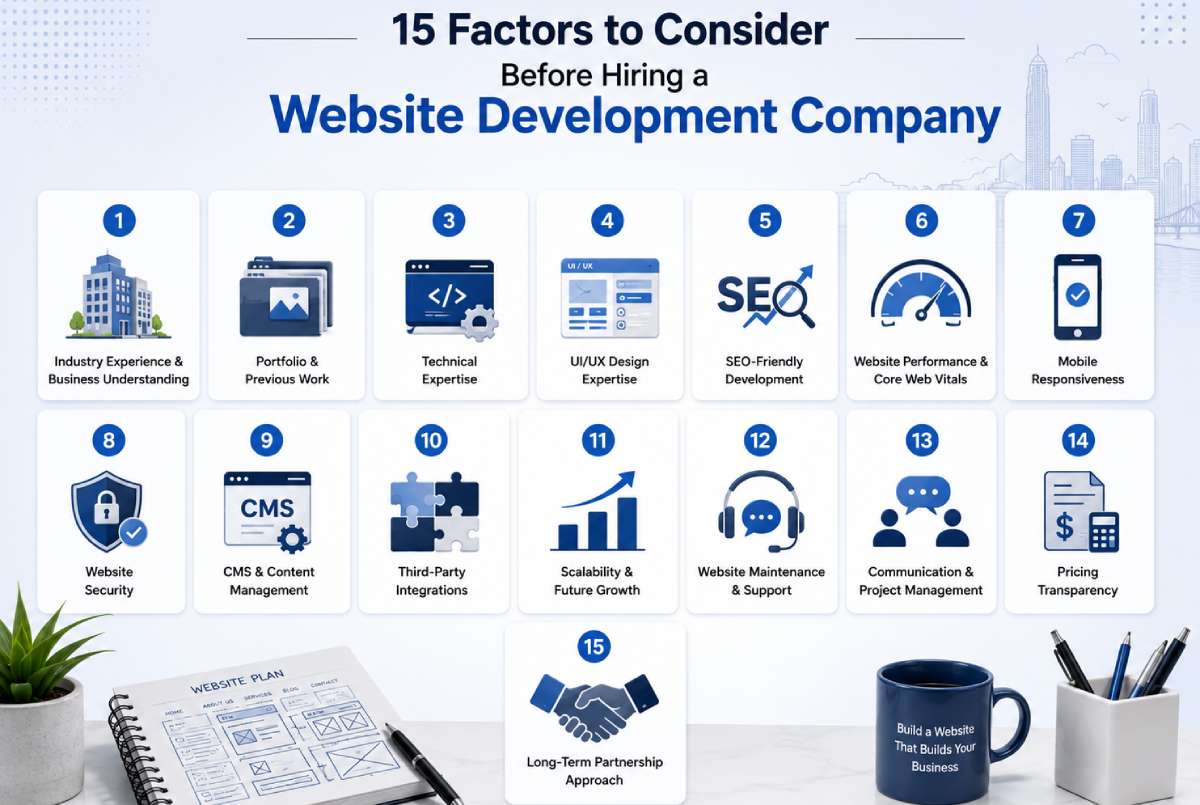
15 Factors to Consider Before Hiring a Website Development Company
Rather than choosing an agency based on price or visual design alone, evaluate them using the following fifteen criteria.
1. Industry Experience & Business Understanding
A web development company should understand more than programming languages and design tools. They should understand how businesses generate leads, sell products, and build customer relationships online.
An experienced agency asks questions such as:
- What are your business goals?
- Who are your target customers?
- What actions should visitors take?
- How will success be measured?
- What systems should the website integrate with?
Instead of immediately discussing colours and layouts, they focus on understanding your business processes first.
Why It Matters
Different industries have unique requirements.
For example:
- Healthcare websites require appointment booking and patient trust.
- Manufacturing websites require product catalogues and distributor enquiries.
- Ecommerce businesses require payment integration and inventory management.
A developer familiar with your industry can recommend features, user journeys, and technical solutions that align with your business objectives.
Questions to Ask
Have you worked with businesses similar to ours?
Can you show projects from our industry?
What business challenges did you solve?
Warning Signs
- Generic responses
- No understanding of your industry
- Focus only on website appearance
- No questions about business goals
2. Portfolio & Previous Work
Every reputable website development company in Mumbai should have a strong portfolio demonstrating different types of projects.
However, don’t simply judge websites by visual appearance.
Evaluate:
- navigation
- loading speed
- responsiveness
- usability
- functionality
- conversion elements
- technical quality
Visit several live websites they’ve developed. Use tools like Google PageSpeed Insights to evaluate performance.
Why It Matters
A portfolio reflects the agency’s practical experience rather than marketing claims.
It also demonstrates:
- design consistency
- technical capability
- project diversity
- problem-solving ability
Questions to Ask
- Which projects are most similar to ours?
- Which technologies were used?
- Are these websites still actively maintained?
Warning Signs
- Only screenshots instead of live websites
- Outdated designs
- Broken pages
- Slow websites
- Very limited portfolio
3. Technical Expertise
Technology decisions influence website performance, scalability, security, and maintenance costs for years.
An experienced agency should recommend technology based on your business requirements rather than personal preference. Common technologies include:
Frontend
- React
- Next.js
- Vue.js
Backend
- Node.js
- Laravel
- PHP
- .NET
CMS
- WordPress
- Headless CMS
- Shopify
Cloud
- AWS
- Azure
- Google Cloud
Why It Matters
The wrong technology can:
- increase maintenance costs
- reduce flexibility
- limit scalability
- affect performance
Questions to Ask
- Why are you recommending this technology?
- How will it support future growth?
- Can features be added later?
4. UI/UX Design Expertise
Many businesses confuse attractive design with good user experience. Beautiful websites can still perform poorly if visitors struggle to find information or complete important actions. A trusted website design company in Mumbai also ensures that every design decision aligns with your brand identity and business objectives.
Professional UI/UX design focuses on:
- intuitive navigation
- readability
- accessibility
- conversion optimization
- customer behaviour
Why It Matters
Good UX improves:- engagement
- lead generation
- customer satisfaction
- conversion rates
Poor UX increases bounce rates and reduces enquiries.
Questions to Ask
- Do you create wireframes?
- How do you plan user journeys?
- How do you validate designs?
5. SEO-Friendly Development
A website should be developed with SEO in mind from the beginning. Many businesses spend months improving rankings only to discover their website has technical SEO problems created during development.
A professional web development agency should implement:
- SEO-friendly URLs
- schema markup
- XML sitemap
- robots.txt
- clean code
- optimized page speed
- heading hierarchy
- image optimization
- internal linking structure
Why It Matters
SEO improvements become significantly easier when technical foundations are implemented during development rather than after launch.
Questions to Ask
- Is technical SEO included?
Will the website meet Core Web Vitals?
Do you implement schema markup?
6. Website Performance & Core Web Vitals
Combining performance optimization with responsive website development improves both search visibility and user satisfaction.
Website speed directly affects:
- SEO
- user experience
- conversions
- advertising performance
Visitors expect pages to load within seconds. Slow websites often lose customers before they even view the content.
Performance Areas
Evaluate whether the agency optimizes:
- image compression
- caching
- code minification
- lazy loading
- server performance
- CDN implementation
Questions to Ask
- What performance scores do you target?
- How do you optimize loading speed?
7. Mobile Responsiveness
More than half of website visitors now browse using smartphones. Google also primarily indexes mobile versions of websites. Responsive website development ensures users enjoy a consistent browsing experience across desktops, tablets, and smartphones.
A responsive website should:
- adapt to different screen sizes
- load quickly
- display readable text
- provide touch-friendly navigation
- simplify enquiry forms
Why It Matters
Poor mobile usability negatively affects:
- SEO
- user experience
- conversions
- Google Ads Quality Score
Questions to Ask
- Is development mobile-first?
- How is responsive testing performed?
8. Website Security
Cybersecurity should never be an optional feature.
A secure website protects:
- customer information
- business data
- enquiry forms
- payment details
- administrator accounts
Professional developers implement:
- HTTPS
- secure authentication
- firewall configuration
- malware protection
- regular updates
- backup systems
Questions to Ask
- How do you secure websites?
- Are backups automated?
- How frequently are updates performed?
9. CMS & Content Management
Your team should be able to update content without depending on developers for every minor change.
An effective CMS should allow you to:
- publish blogs
- edit pages
- update images
- manage products
- create landing pages
Why It Matters
Easy content management reduces long-term maintenance costs and supports marketing teams.
Questions to Ask
- Which CMS do you recommend?
- Can non-technical users manage content?
10. Third-Party Integrations
Modern business websites rarely operate independently.
Common integrations include:
- CRM
- ERP
- Payment gateways
- Marketing automation
- Live chat
- Analytics
- Booking systems
- Inventory software
Why It Matters
Integration improves operational efficiency by reducing manual work.
Questions to Ask
- Which integrations have you implemented previously?
- Can custom APIs be developed?
11. Scalability & Future Growth
Your website should support future expansion without requiring complete redevelopment. Investing in scalable ecommerce website development makes it easier to expand your online store as your product catalogue and customer base grow.
Potential future additions include:
- ecommerce
- multilingual support
- customer portals
- mobile applications
- AI chatbots
- subscription systems
Why It Matters
Scalable architecture protects your long-term investment.
Questions to Ask
- Can new modules be added later?
- Is the architecture modular?
12. Website Maintenance & Support
Launching a website is only the beginning.
Websites require:
- security updates
- plugin updates
- backups
- bug fixes
- performance optimization
- server monitoring
Professional agencies usually offer maintenance packages covering these activities.
Questions to Ask
- Do you provide post-launch support?
- What is included?
- What are response times?
13. Communication & Project Management
Many projects fail because of poor communication rather than technical issues. Professional agencies follow structured project management processes.
Expect:
- kickoff meetings
- project timelines
- milestone reviews
- weekly updates
- testing stages
- documented approvals
Why It Matters
Transparent communication reduces misunderstandings and project delays.
14. Pricing Transparency
Low quotations often exclude important services.
Always request detailed proposals explaining:
- design
- development
- testing
- revisions
- hosting
- maintenance
- licensing
- support
Questions to Ask
- Are there hidden charges?
- What happens if project scope changes?
- How many revisions are included?
15. Long-Term Partnership Approach
Your relationship with a web development company shouldn’t end after launch.
As your business grows, you may require:
- SEO improvements
- new landing pages
- integrations
- performance optimization
- feature enhancements
Choose an agency interested in becoming a long-term technology partner rather than simply completing one project.
Key Insight: The best web development company doesn’t just build websites; it helps businesses continuously improve digital performance, customer experience, and revenue over time.
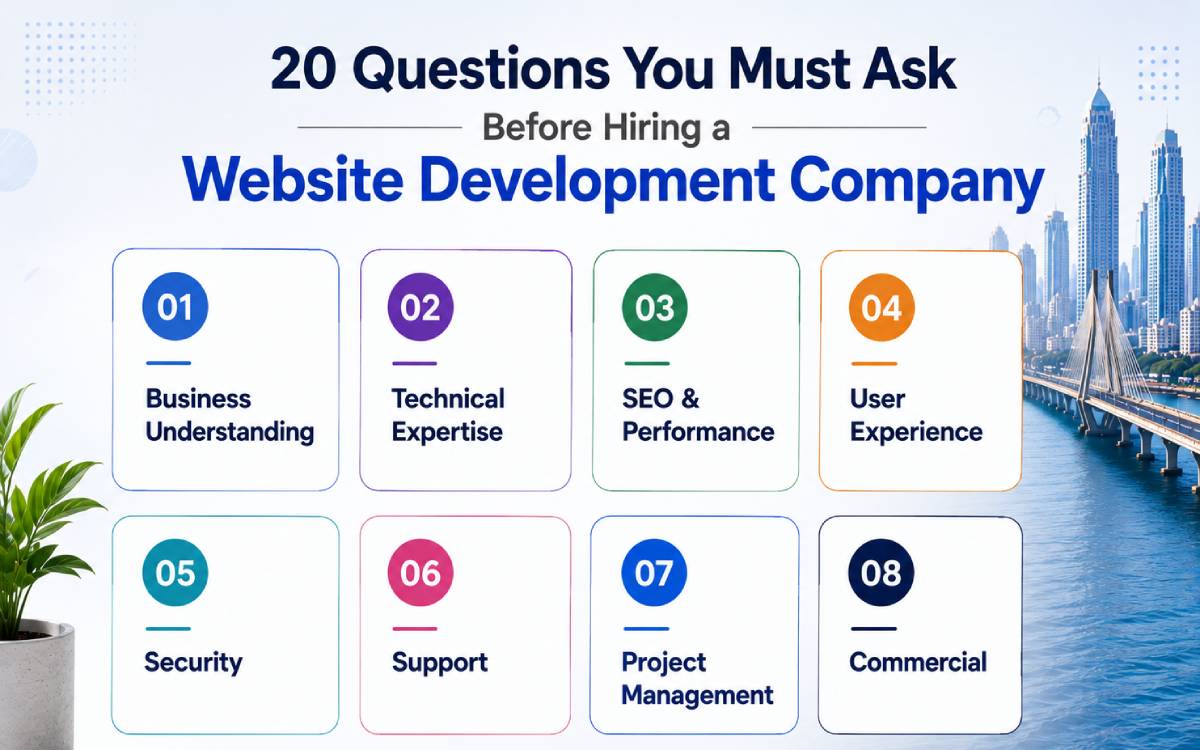
20 Questions You Must Ask Before Hiring a Website Development Company
If you’re wondering how to choose web developer professionals, asking the right technical and business questions is an essential first step. Before signing any agreement, schedule a discovery meeting and ask these questions.
Business Understanding
- Have you worked with companies in our industry?
- How will you understand our business goals?
- How do you define project success?
Technical Expertise
- Which technology stack do you recommend?
- Why is it suitable for our project?
- Will the website be scalable?
SEO & Performance
- Is technical SEO included?
- Will the website meet Core Web Vitals?
- How do you optimize loading speed?
User Experience
- Do you create wireframes before design?
- How do you improve conversions?
Security
- How is website security handled?
- What backup strategy do you use?
Support
- Do you provide maintenance?
- What happens after launch?
Project Management
- Who will manage the project?
- How often will progress be communicated?
Commercial
- What exactly is included in the quotation?
- Are there ongoing costs?
- What is the estimated project timeline?
Red Flags That Indicate a Poor Website Development Company
Not every agency that markets itself as the best web development company delivers consistent results. Recognizing warning signs early can save your business significant time, money, and frustration.
No Clear Discovery Process
If an agency sends a quotation without understanding your business goals, target audience, required features, or long-term objectives, it is likely treating your project as a generic website rather than a strategic business solution.
Unrealistically Low Pricing
Extremely cheap proposals often exclude essential services such as SEO, testing, security, documentation, or post-launch support. These omissions usually result in additional costs later.
No Live Portfolio
A reputable agency should be able to show functioning websites, not just design mock-ups. Review live projects to assess performance, usability, and overall quality.
No Technical Documentation
Professional projects include documentation covering features, integrations, credentials, deployment processes, and maintenance guidelines. Lack of documentation makes future updates difficult.
No SEO Considerations
If the proposal doesn’t mention technical SEO, structured data, mobile responsiveness, or performance optimization, your website may struggle to rank in search engines after launch.
Poor Communication
Delayed responses, unclear timelines, vague deliverables, and inconsistent communication during the sales process often indicate larger project management issues later.
No Post-Launch Support
Websites require ongoing maintenance. Agencies that offer no support after launch leave businesses vulnerable to security issues, compatibility problems, and downtime.
Key Takeaway: The right website development company Mumbai combines technical expertise, strategic thinking, transparent communication, and long-term support. Evaluate agencies using structured criteria rather than price alone, and choose a partner capable of helping your website evolve alongside your business.
Website Development Cost in Mumbai (2026 Guide)
One of the most common questions businesses ask is:
“How much does website development cost in Mumbai?”
The honest answer is that there is no fixed price.
Website development costs vary depending on several factors, including:
- project complexity
- number of pages
- custom functionality
- technology stack
- design requirements
- third-party integrations
- ecommerce capabilities
- AI features
- maintenance requirements
A professionally developed website should be viewed as a business investment rather than an expense. The right website generates leads, supports marketing campaigns, improves conversions, and creates long-term value.
Average Website Development Cost in Mumbai
| Website Type | Estimated Cost |
| Basic Business Website | ₹25,000 – ₹75,000 |
| Corporate Website | ₹75,000 – ₹2 Lakhs |
| Ecommerce Website | ₹1.5 Lakhs – ₹5 Lakhs |
| Custom Web Application | ₹3 Lakhs – ₹15 Lakhs+ |
| Enterprise Website | ₹10 Lakhs – ₹50 Lakhs+ |
| AI-Powered Website | ₹5 Lakhs – ₹25 Lakhs+ |
These estimates vary depending on project scope and business requirements.
What Influences Website Development Cost?
Number of Pages
A five-page company website requires significantly less effort than a website containing:
- service pages
- blogs
- case studies
- product catalogues
- multilingual content
- customer portals
More pages require additional planning, design, development, testing, and content organization.
Custom Functionality
Basic websites display information. Custom websites perform business operations. Businesses requiring custom website development often benefit from tailored features, scalable architecture, and seamless integrations that support long-term growth.
Examples include:
- customer dashboards
- appointment booking
- payment gateways
- quotation systems
- CRM integration
- ERP integration
- membership portals
The more functionality required, the greater the development effort.
Design Complexity
Pre-built templates reduce costs but offer limited flexibility.
Custom UI/UX design requires:
- research
- wireframes
- prototypes
- user testing
- responsive layouts
- accessibility improvements
Businesses focused on lead generation generally benefit from custom conversion-focused designs.
Technology Stack
Different technologies require different development expertise.
Examples:
- WordPress
- React
- Next.js
- Laravel
- Node.js
- Shopify
- Headless CMS
Technology selection should be based on long-term business requirements rather than short-term development costs. Modern ecommerce website development also benefits from flexible technologies that support integrations, automation, and future enhancements.
Third-Party Integrations
Many businesses require integrations with:
- CRM systems
- payment gateways
- ERP software
- marketing automation
- analytics platforms
- email systems
Integration complexity influences both project timelines and pricing.
Hidden Costs Businesses Often Ignore
Many quotations exclude ongoing costs.
Common hidden expenses include:
- hosting
- domain renewal
- SSL certificates
- website maintenance
- security monitoring
- software licensing
- content creation
- SEO
- backups
- performance optimization
Discuss these costs before signing a contract.
Key Insight: The cheapest proposal is rarely the most affordable in the long run. Consider total ownership cost, scalability, maintenance, and business value rather than comparing initial development prices alone.
Website Development Process: From Strategy to Launch
A successful website is not built by jumping directly into design or coding. High-performing websites follow a structured development process that aligns technology decisions with business objectives.
Professional agencies use a phased approach to minimize risk, improve collaboration, and ensure quality at every stage. Every stage of business website development should align with your company’s long-term goals and customer expectations.
Phase 1: Discovery & Business Analysis
Every successful project begins with understanding the business.
Activities include:
- stakeholder workshops
- business goal definition
- audience research
- competitor analysis
- feature planning
- technical requirement gathering
The objective is to define what the website should achieve, not simply how it should look.
Phase 2: Information Architecture & Wireframing
Before visual design begins, developers organize content and user journeys.
Wireframes define:
- page hierarchy
- navigation
- user flow
- CTA placement
- content structure
This stage reduces redesign costs later.
Phase 3: UI/UX Design
Designers transform wireframes into visually engaging interfaces.
Focus areas include:
- branding
- readability
- accessibility
- responsive layouts
- conversion optimization
- user engagement
Every design decision should improve usability while supporting business goals.
Phase 4: Website Development
Once designs are approved, developers begin implementation.
Typical activities include:
- frontend development
- backend development
- CMS integration
- API integration
- database configuration
- authentication
- business logic implementation
Coding standards and documentation become especially important during this phase.
Phase 5: Testing & Quality Assurance
Testing ensures the website performs reliably before launch.
Testing includes:
- functionality testing
- browser compatibility
- mobile responsiveness
- performance testing
- security testing
- SEO validation
- accessibility checks
A dedicated QA process reduces post-launch issues.
Phase 6: Launch & Deployment
Deployment involves more than uploading files to a server.
Professional deployment includes:
- hosting configuration
- SSL implementation
- redirects
- DNS updates
- sitemap submission
- analytics setup
- search console configuration
The goal is a smooth transition with minimal downtime.
Phase 7: Ongoing Maintenance & Growth
Websites require continuous improvement after launch.
Post-launch activities include:
- security updates
- performance optimization
- SEO improvements
- content updates
- feature enhancements
- analytics review
The most successful websites evolve continuously based on customer behaviour and business growth.
Key Insight: Website development should be viewed as an ongoing business process rather than a one-time project. Continuous optimization helps maintain performance, security, and competitiveness.
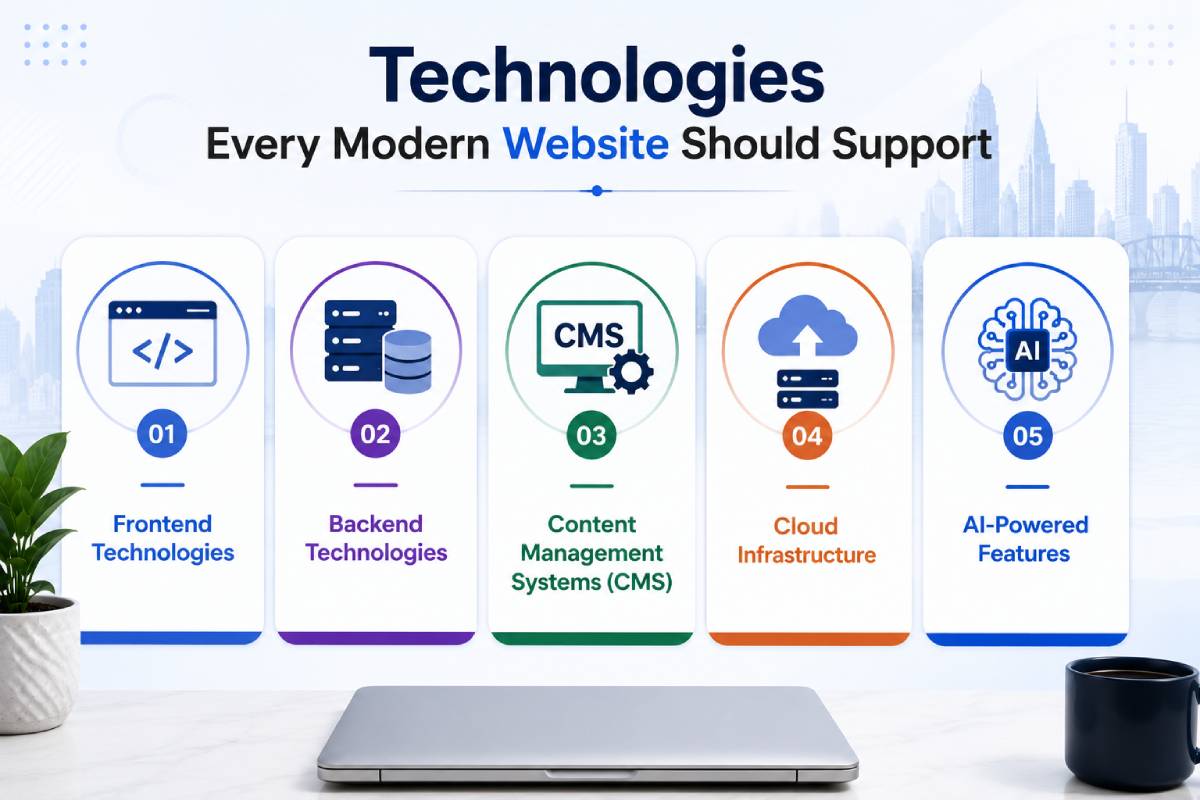
Technologies Every Modern Website Should Support
Technology decisions influence how efficiently your website performs today and how easily it can evolve tomorrow. The best technology is not necessarily the newest; it is the one that aligns with your business goals, scalability requirements, budget, and long-term maintenance strategy.
Frontend Technologies
Modern user interfaces often use:
- React
- Next.js
- Vue.js
- HTML5
- CSS3
- JavaScript
Benefits include:
- faster performance
- interactive user experiences
- improved scalability
- better SEO (with SSR frameworks like Next.js)
Backend Technologies
Common backend technologies include:
- Node.js
- Laravel
- PHP
- ASP.NET
- Python (Django / Flask)
Backend systems manage:
- business logic
- databases
- authentication
- APIs
- integrations
Content Management Systems (CMS)
Popular CMS options include:
- WordPress
- Headless CMS
- Shopify
- Webflow
- Strapi
- Contentful
The right CMS depends on content requirements, flexibility, and editorial workflows.
Cloud Infrastructure
Professional websites increasingly use cloud hosting platforms such as:
- AWS
- Microsoft Azure
- Google Cloud
Cloud infrastructure offers:
- scalability
- reliability
- security
- automated backups
- global availability
AI-Powered Features
Modern business websites increasingly incorporate AI capabilities, including:
- intelligent chatbots
- AI-powered search
- recommendation engines
- personalization
- automated lead qualification
- predictive analytics
Planning for AI readiness today helps future-proof your digital presence.
Common Website Development Mistakes Businesses Make
Even well-funded projects can fail when fundamental planning mistakes are overlooked. Understanding these issues helps businesses avoid unnecessary costs and delays.
Choosing the Cheapest Proposal
Low-cost development often excludes:
- SEO
- testing
- documentation
- security
- maintenance
The result is additional expenses after launch.
Ignoring SEO During Development
SEO should be integrated from day one. Retrofitting technical SEO later is often more expensive and less effective.
Focusing Only on Design
An attractive website that fails to generate enquiries provides limited business value.
Balance aesthetics with:
- usability
- performance
- accessibility
- conversion optimization
No Content Strategy
Development and content should progress together. Waiting until launch to create content often delays projects and reduces quality.
Poor Hosting Decisions
Even well-developed websites perform poorly on unreliable hosting.
Invest in hosting that supports:
- performance
- security
- scalability
No Long-Term Maintenance Plan
Every website requires:
- updates
- backups
- monitoring
- performance improvements
Ignoring maintenance increases technical risk over time.
How Ideamagix Builds High-Performance Websites
At Ideamagix, we believe successful websites begin with business strategy, not templates.
Our process combines technology, design, SEO, and conversion optimization to create digital platforms that support measurable business growth.
Rather than focusing solely on aesthetics, we build websites that attract qualified visitors, improve engagement, and convert traffic into enquiries and customers.
Our Website Development Framework
Business Discovery
↓
Market & Competitor Research
↓
Information Architecture
↓
UI/UX Design
↓
Technical Development
↓
SEO Implementation
↓
Performance Optimization
↓
Security & Testing
↓
Launch
↓
Continuous Improvement
What We Focus On
- Business-first strategy
- Custom website development
- Responsive design
- Technical SEO
- High-performance architecture
- AI-ready websites
- Security best practices
- Conversion optimization
- Scalability
- Long-term support
Our objective is to deliver websites that become long-term business assets rather than static online brochures. Businesses researching how to choose web developer services should compare experience, communication, technical expertise, and post-launch support before making a decision.
Frequently Asked Questions
1. How much does website development cost in Mumbai?
Website development costs vary depending on the scope, technology, features, and complexity of the project. Basic business websites generally start around ₹25,000, while enterprise platforms and custom web applications may require investments of several lakhs or more.
2. How long does website development take?
Simple business websites can often be completed within 3–6 weeks, while ecommerce websites, custom applications, and enterprise solutions may require 3–6 months or longer depending on functionality and integrations.
3. Should I choose WordPress or custom development?
WordPress is suitable for many marketing websites and blogs because it offers flexibility and ease of content management. Businesses requiring advanced workflows, complex integrations, or highly customized functionality may benefit more from custom development.
4. How do I compare website development companies?
Evaluate agencies based on industry experience, technical expertise, portfolio quality, SEO capabilities, communication, security practices, scalability, maintenance support, and transparent pricing, not just cost.
5. Will my website be SEO-friendly?
A professionally developed website should include technical SEO fundamentals such as optimized site architecture, clean URLs, schema markup, XML sitemaps, mobile responsiveness, fast loading speeds, and Core Web Vitals optimization.
6. What technologies are best for modern websites?
The ideal technology depends on your business needs. Common choices include React, Next.js, Laravel, Node.js, WordPress, Shopify, and cloud platforms such as AWS or Google Cloud. Your development partner should recommend the most appropriate stack based on long-term requirements.
7. Does a web development company provide website maintenance?
Many professional agencies offer maintenance packages that include security updates, backups, bug fixes, performance monitoring, and ongoing technical support. Clarify the scope and response times before signing a contract.
8. Why is website speed important?
Fast-loading websites improve user experience, increase conversion rates, reduce bounce rates, and support better search engine rankings. Performance also influences Google Ads Quality Score and overall marketing ROI.
9. Should I hire a freelancer or a website development company?
Freelancers may be suitable for smaller projects with limited functionality. Businesses requiring custom development, SEO-ready architecture, integrations, scalability, and ongoing support generally benefit from working with an experienced website development company.
10. How do I know if my website can scale with my business?
Ask whether the architecture supports future features such as ecommerce, multilingual content, CRM integration, AI functionality, customer portals, and increased traffic. A scalable solution reduces redevelopment costs as your business grows.
Final Thoughts
Choosing the right website development company in Mumbai is about much more than selecting a vendor it is about choosing a long-term digital partner who understands your business, aligns technology with your goals, and builds a platform capable of supporting future growth.
The most successful websites are not judged solely by their appearance. They are measured by how effectively they attract qualified visitors, provide exceptional user experiences, generate enquiries, and adapt as business needs evolve.
Take the time to evaluate agencies carefully, ask the right questions, review their work critically, and prioritize long-term value over short-term cost. The right decision today can save significant time, money, and effort in the years ahead. Choosing expert website development services helps businesses create scalable websites that continue delivering value long after launch.
Ready to Build a Website That Drives Business Growth?
If you’re planning a new website or considering a redesign, our team can help you develop a solution that combines strategy, design, technology, SEO, and performance.
Your Free Website Strategy Session Includes
- Website Requirement Analysis
- Technology Stack Recommendation
- SEO & Technical Review
- UX and Conversion Assessment
- Competitor Website Analysis
- Project Roadmap & Cost Estimate