
Introduction: Why Understanding Performance Marketing Costs Matters More Than Ever
Performance marketing has become one of the most measurable and scalable customer acquisition channels available to businesses today. Unlike traditional advertising, where success is often difficult to quantify, performance marketing focuses on specific outcomes such as leads, sales, app installs, bookings, or revenue. However, one of the most common questions businesses ask before investing is:
How much does performance marketing actually cost?
The challenge is that there is no universal answer. A startup spending ₹50,000 per month on Meta Ads will have very different costs, goals, and expectations compared to an ecommerce brand investing ₹10 lakhs per month across Google Ads, Meta Ads, LinkedIn Ads, and remarketing campaigns.
Many businesses also make the mistake of looking only at agency fees while ignoring:
- ad spend
- creative production
- landing page optimization
- tracking infrastructure
- conversion rate optimization
- reporting tools
As a result, marketing budgets often exceed expectations, and businesses struggle to understand their true customer acquisition costs.
This guide explains:
- performance marketing cost in India
- paid ads pricing India
- performance marketing agency pricing
- cost structures
- hidden expenses
- ROI expectations
- agency pricing models
- budgeting frameworks
- performance marketing services
so that businesses can make informed investment decisions.
What Is Performance Marketing?
Before discussing pricing, it’s important to understand what performance marketing actually includes. Many businesses assume performance marketing simply means running ads. In reality, modern performance marketing is a complete acquisition system designed to generate measurable business outcomes. The focus is not impressions or reach alone.
The focus is:
- leads
- sales
- revenue
- return on ad spend (ROAS)
- customer acquisition
Core Channels Included in Performance Marketing
Most performance marketing campaigns combine multiple channels.
Google Ads
Captures high-intent users actively searching for products or services.
Includes:
- Search Ads
- Performance Max
- Display Ads
- YouTube Ads
- Shopping Ads
Meta Ads
Targets users across:
Meta is highly effective for:
- ecommerce
- D2C brands
- lead generation
- remarketing
LinkedIn Ads
Primarily used for:
- B2B marketing
- SaaS
- enterprise lead generation
LinkedIn often has higher costs but can generate highly qualified leads.
YouTube Advertising
Increasingly important for:
- awareness
- remarketing
- product education
Video consumption continues to grow across India.
Remarketing Campaigns
These campaigns target users who previously interacted with your website or brand. Remarketing frequently produces the highest ROI because the audience is already familiar with your business.
Why Performance Marketing Costs Vary So Much
One of the biggest misconceptions is that performance marketing follows a fixed pricing structure. In reality, costs vary based on dozens of factors. Two businesses in the same industry can have dramatically different acquisition costs. Understanding these variables helps businesses set realistic expectations.
Factor 1: Industry Competition
Competition has a significant impact on advertising costs.
Highly competitive industries often experience higher:
- CPCs (Cost Per Click)
- CPMs (Cost Per Thousand Impressions)
- CPLs (Cost Per Lead)
High Competition Industries
Examples include:
- finance
- insurance
- legal services
- healthcare
- software
- real estate
Keywords in these industries often attract multiple advertisers, increasing auction costs.
Lower Competition Industries
Examples include:
- niche manufacturing
- specialized B2B services
- regional businesses
These sectors often benefit from lower acquisition costs.
Example
- A lead in: Insurance
- may cost: ₹1,500–₹5,000+
- while a lead in: Local Home Services
- may cost: ₹100–₹500
The difference comes primarily from competition and customer value.
Factor 2: Advertising Platform Selection
Every platform has different pricing dynamics.
Businesses frequently ask:
Which platform is cheapest?
The better question is:
Which platform generates the best ROI?
Google Ads Cost Dynamics
Google captures demand that already exists. Users are actively searching.
This often leads to:
- higher conversion rates
- higher CPCs
- stronger purchase intent
For many service businesses, Google remains the highest-converting channel.
Meta Ads Cost Dynamics
Meta focuses on audience targeting rather than search intent. Users may not be actively looking for a solution. However, sophisticated targeting enables strong performance.
Meta often delivers:
- lower CPCs
- lower CPMs
- broader reach
- compared to Google.
LinkedIn Ads Cost Dynamics
LinkedIn advertising costs are significantly higher. However, the audience quality often justifies the investment.
For example: A SaaS company selling ₹5 lakh enterprise contracts may generate excellent ROI despite high lead costs.
Factor 3: Business Objectives
Performance marketing costs vary depending on what the campaign is designed to achieve. Different objectives require different strategies.
Lead Generation Campaigns
Goal:
Generate inquiries.
Common for:
- agencies
- healthcare providers
- consultants
- B2B businesses
Lead generation costs depend heavily on industry competition.
Ecommerce Campaigns
Goal:
Generate purchases.
Requires:
- product feeds
- remarketing
- creative testing
- conversion optimization
Campaign complexity increases significantly.
Brand Awareness Campaigns
Goal:
Reach large audiences. Typically lower cost per impression. However, ROI measurement becomes more complex.
App Install Campaigns
Goal:
Acquire users.
Requires:
- attribution tracking
- retention analysis
- lifetime value calculations
This introduces additional infrastructure requirements.
Factor 4: Geographic Targeting
Location significantly influences advertising costs.
Tier 1 Cities
Examples:
- Mumbai
- Delhi
- Bangalore
- Hyderabad
Competition is typically highest. Advertising costs are often significantly above national averages.
Tier 2 and Tier 3 Markets
Competition is generally lower.
Businesses often achieve:
- lower CPCs
- lower CPLs
- better reach
depending on industry.
International Targeting
Advertising in:
- UAE
- UK
- USA
- Australia
often costs substantially more than campaigns targeting India. Businesses expanding internationally should budget accordingly.
Factor 5: Funnel Complexity
Many businesses assume ads alone generate results. In reality, successful campaigns rely on complete funnels.
Simple Funnel
Ad
↓
Lead Form
↓
Inquiry
Lower complexity. Lower costs.
Advanced Funnel
Ad
↓
Landing Page
↓
Lead Magnet
↓
Email Nurture
↓
Sales Call
↓
Conversion
Higher complexity. Often better long-term ROI.
Why Funnel Complexity Impacts Pricing
More sophisticated funnels require:
- landing page design
- copywriting
- tracking implementation
- automation setup
- analytics
These activities increase management effort but often improve performance.
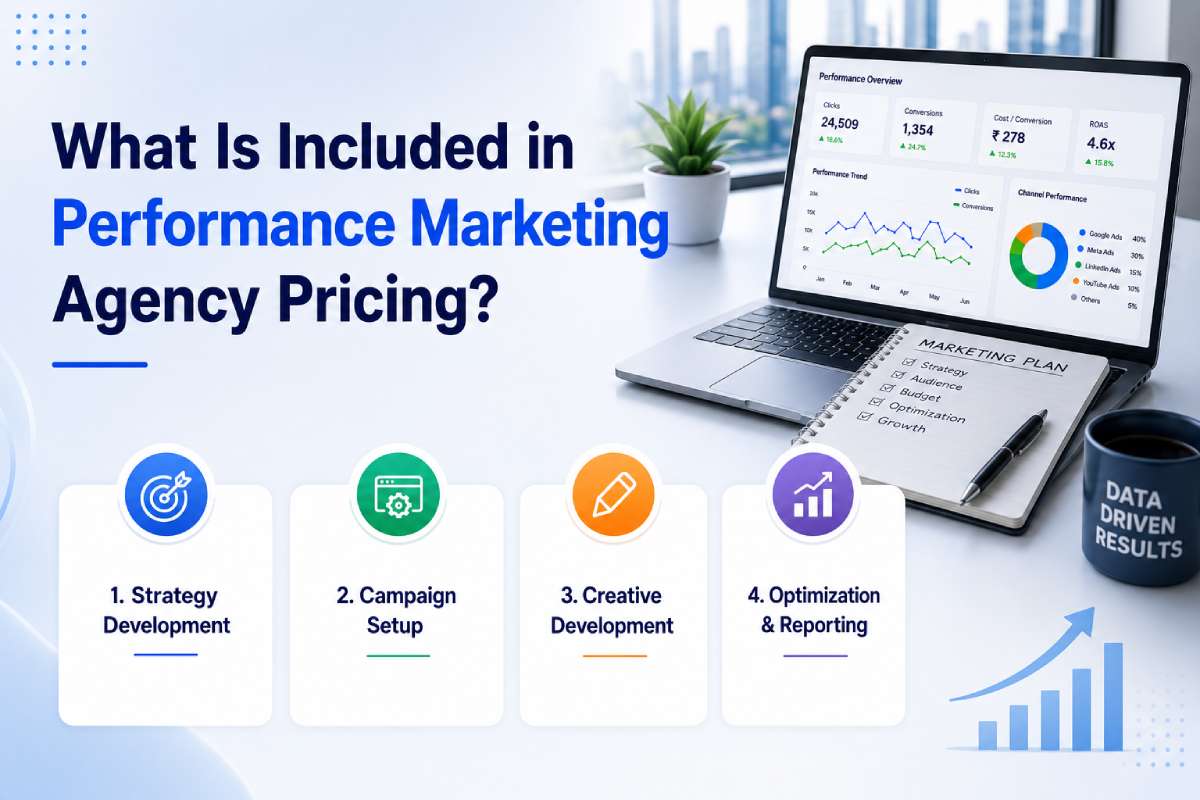
What Is Included in Performance Marketing Agency Pricing?
Many businesses compare agencies without understanding what is actually included. Two agencies charging the same fee may provide completely different services. A professional performance marketing agency in Mumbai should be evaluated based on deliverables rather than price alone.
Strategy Development
Campaign planning should include:
- audience research
- competitor analysis
- funnel planning
- budget allocation
Strong strategy often determines campaign success.
Campaign Setup
Includes:
- account structure
- tracking implementation
- audience creation
- conversion tracking
- platform configuration
Proper setup creates the foundation for future optimization.
Creative Development
Depending on scope:
- ad copy
- banners
- video creatives
- landing page messaging
Creative quality significantly influences performance.
Optimization & Reporting
Performance marketing requires continuous improvement.
This includes:
- bid adjustments
- audience refinement
- creative testing
- budget optimization
- reporting
Optimization often determines whether campaigns become profitable.
Why Cheap Performance Marketing Usually Fails
Businesses frequently choose agencies based solely on monthly retainers. This often creates problems.
Low-cost providers typically struggle to invest in:
- strategy
- analytics
- creative testing
- advanced optimization
As a result:
- campaigns stagnate
- acquisition costs increase
- growth slows
The cheapest agency frequently becomes the most expensive option due to poor performance.
Key Takeaway Before Discussing Pricing
Performance marketing cost is influenced by:
- industry
- competition
- platforms
- objectives
- geography
- funnel sophistication
Businesses should focus on:
Cost Per Acquisition
rather than simply:
Cost Per Click
or
Agency Fee
because profitability ultimately determines success.
Performance Marketing Agency Pricing Models Explained
One of the biggest sources of confusion in the industry is agency pricing.
Two agencies may quote:
- ₹30,000/month
- ₹1,50,000/month
for what appears to be the same service. However, the scope, expertise, resources, and optimization capabilities behind those fees can be dramatically different. Before comparing costs, businesses should understand how agencies structure their pricing.
Pricing Model 1: Fixed Monthly Retainer
This is the most common pricing model used by a professional performance marketing company in Mumbai. Businesses pay a fixed monthly fee for campaign management and optimization.
What Is Typically Included?
Most retainer models include:
- campaign strategy
- campaign setup
- audience targeting
- bid management
- optimization
- reporting
- consultation
Some agencies also include:
- landing page recommendations
- creative guidance
- conversion tracking
Typical Pricing Range
| Business Type | Monthly Fee |
| Small Business | ₹20,000 – ₹50,000 |
| Growing Business | ₹50,000 – ₹1,50,000 |
| Mid-Market Company | ₹1,50,000 – ₹5,00,000 |
| Enterprise Brand | ₹5,00,000+ |
Advantages
- Predictable monthly costs
- Easier budgeting
- Consistent optimization
- Long-term growth focus
Limitations
Campaign workload may increase without agency fees increasing proportionally. This can create capacity constraints if expectations are not clearly defined.
Pricing Model 2: Percentage of Ad Spend
Many agencies charge a percentage of advertising spend. This model aligns agency revenue with campaign scale.
Typical Percentage Range
10% – 20% of ad spend
Example
- Monthly Ad Spend: ₹5,00,000
- Agency Fee: 15%
- Agency Cost: ₹75,000/month
Why Agencies Use This Model
Larger advertising budgets typically require:
- more optimization
- more creative testing
- more audience segmentation
- more reporting
Management complexity increases as budgets grow.
Potential Concern
A poorly aligned agency may become more focused on increasing spend than improving efficiency.
Businesses should therefore track:
- ROAS
- CPL
- CAC
rather than ad spend alone.
Pricing Model 3: Hybrid Model
Many advanced agencies combine:
Fixed Fee
- Percentage of Spend
This approach balances stability with scalability.
Example
- Base Fee: ₹40,000/month 10% of Ad Spend
- If spend reaches: ₹5 Lakhs
- Agency Fee: ₹90,000
Why Enterprises Prefer This Model
Enterprise campaigns often require:
- dedicated resources
- advanced reporting
- multiple platforms
- conversion tracking infrastructure
Hybrid pricing allows agencies to allocate sufficient expertise.
Pricing Model 4: Performance-Based Pricing
This model is attractive in theory but often misunderstood. The agency earns compensation based on results.
Examples:
- leads generated
- sales achieved
- appointments booked
Why Pure Performance Models Are Rare
Marketing success depends on factors beyond ads:
- landing page quality
- sales team performance
- offer quality
- brand reputation
Agencies cannot fully control these variables. As a result, purely performance-based contracts are uncommon among established agencies.
Performance Marketing Cost by Industry
Industry competition significantly influences advertising costs. The same budget can produce dramatically different outcomes depending on the market.
Real Estate Performance Marketing Cost
Real estate remains one of the most competitive advertising categories in India. Developers, brokers, and property portals aggressively compete for leads.
Typical Monthly Budget
₹50,000 – ₹10,00,000+
Average Lead Cost
₹300 – ₹3,000+
per lead depending on location and property value.
Why Costs Are Higher
Property transactions have high customer value. A single conversion can generate substantial revenue. Advertisers are therefore willing to pay more.
Healthcare Performance Marketing Cost
Healthcare businesses increasingly rely on performance marketing.
Common sectors include:
- dental clinics
- dermatology
- cosmetic surgery
- hospitals
- fertility centers
Typical Monthly Budget
₹30,000 – ₹5,00,000+
Average Lead Cost
₹150 – ₹2,000+
depending on specialization.
Key Cost Driver
Highly specialized services often have higher acquisition costs but significantly higher customer value.
Education Performance Marketing Cost
Education remains a major digital advertising category.
Examples include:
- universities
- coaching institutes
- edtech platforms
- professional certifications
Typical Monthly Budget
₹25,000 – ₹10,00,000+
Average Lead Cost
₹50 – ₹1,000+
Seasonal Impact
Education advertising costs often increase during admission periods due to intensified competition.
Ecommerce Performance Marketing Cost
Ecommerce businesses often allocate larger budgets because advertising directly influences sales volume.
Typical Monthly Budget
₹50,000 – ₹50,00,000+
Common KPIs
- ROAS
- CAC
- Revenue
- AOV (Average Order Value)
Why Ecommerce Costs Are Complex
Success depends on:
- product margins
- repeat purchases
- inventory management
- customer lifetime value
Ad costs alone do not determine profitability.
SaaS & B2B Performance Marketing Cost
B2B campaigns generally have higher acquisition costs. However, customer lifetime value is often significantly higher.
Typical Monthly Budget
₹1,00,000 – ₹20,00,000+
Lead Cost Range
₹500 – ₹10,000+
depending on audience and deal size.
Example
A SaaS company acquiring:
₹10 lakh annual contracts can justify significantly higher acquisition costs than most consumer businesses.
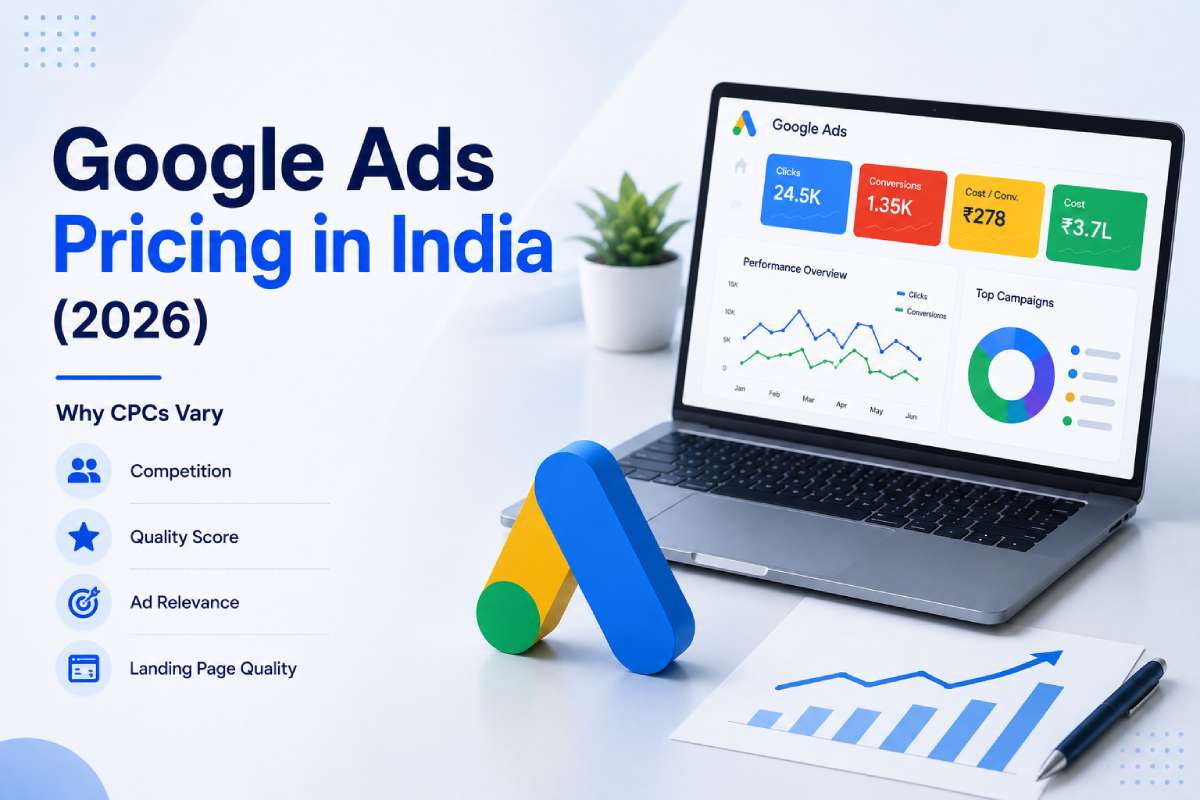
Google Ads Pricing in India (2026)
Google Ads remains one of the most effective performance marketing channels because it captures active demand. Users are already searching for solutions.
Average Google Ads Cost
| Industry | Avg CPC |
| Local Services | ₹10–₹100 |
| Healthcare | ₹30–₹250 |
| Real Estate | ₹50–₹500 |
| Finance | ₹100–₹1,500 |
| SaaS | ₹50–₹800 |
Why CPCs Vary
Google operates on an auction model.
Factors influencing cost include:
- competition
- Quality Score
- ad relevance
- landing page quality
Improved campaign quality can significantly reduce costs.
Meta Ads Pricing (Facebook & Instagram)
Meta remains one of the most powerful acquisition channels for:
- ecommerce
- D2C brands
- consumer services
Its strength lies in audience targeting and creative-driven performance.
Typical Meta Advertising Costs
CPM
₹50 – ₹500+
CPC
₹2 – ₹50+
Lead Cost
₹50 – ₹2,000+
depending on industry.
What Influences Costs?
Creative Quality
Poor creatives increase costs.
Audience Saturation
Repeated exposure reduces effectiveness.
Offer Strength
Strong offers improve conversion rates.
Key Insight
Meta success depends heavily on creative testing rather than keyword bidding.
LinkedIn Ads Pricing in India
LinkedIn is the most expensive major advertising platform. However, it often produces highly qualified B2B leads.
Typical Costs
CPC
₹50 – ₹500+
Lead Cost
₹500 – ₹15,000+
Why LinkedIn Costs More
The audience includes:
- decision-makers
- founders
- executives
- enterprise buyers
Lead quality often offsets higher costs.
Monthly Budget Recommendations
Many businesses ask:
What should we spend?
The answer depends on objectives.
Starter Budget
₹25K – ₹50K/month
Suitable for:
- local businesses
- clinics
- consultants
- startups
Focus:
- Testing and validation.
Growth Budget
₹50K – ₹2L/month
Suitable for:
- SMEs
- ecommerce brands
- professional services
Focus:
- Lead generation and scaling.
Scale Budget
₹2L – ₹10L+/month
Suitable for:
- funded startups
- SaaS companies
- enterprise businesses
Focus:
- Aggressive growth.
Key Takeaway: Before Hidden Costs
The most important lesson from these pricing benchmarks is:
Advertising cost alone does not determine success.
Businesses should evaluate:
- cost per acquisition
- customer lifetime value
- conversion rate
- return on ad spend
because these metrics ultimately determine profitability.
Hidden Costs in Performance Marketing That Most Businesses Ignore
One of the biggest reasons businesses underestimate performance marketing budgets is because they focus only on:
Agency Fee
or
Ad Spend
In reality, successful campaigns require an entire ecosystem. Ignoring hidden costs often leads to unrealistic expectations and underfunded campaigns.
Hidden Cost 1: Creative Production
Creative quality is becoming one of the biggest performance drivers across:
- YouTube
Many campaigns fail not because targeting is poor but because creative assets fail to attract attention.
What Creative Production Includes
Ad Creatives
- static banners
- carousel ads
- promotional graphics
Video Content
- reels
- short-form videos
- YouTube ads
UGC Content
- customer testimonials
- influencer content
- product demonstrations
Typical Cost
₹10,000 – ₹2,00,000+
per month, depending on volume.
Why It Matters
Modern advertising platforms increasingly prioritize creative quality.
Better creatives often reduce:
- CPC
- CPL
- CAC
while improving conversions.
Hidden Cost 2: Landing Page Development
Many businesses spend lakhs on ads but direct traffic to poorly optimized landing pages. This dramatically reduces campaign performance.
Why Landing Pages Matter
Advertising creates traffic. Landing pages create conversions.
Without optimized landing pages:
- lead quality suffers
- conversion rates decline
- acquisition costs increase
Landing Page Costs
Typical costs range from:
₹10,000 – ₹1,50,000+
depending on:
- complexity
- design requirements
- CRO features
Example
- Two businesses may spend: ₹1,00,000 on ads.
- One converts at: 2%
- The other converts at: 8%
The difference is often landing page quality.
Hidden Cost 3: Tracking & Analytics Infrastructure
Accurate measurement is essential. Without proper tracking, optimization becomes impossible.
Common Tracking Tools
- Google Analytics 4
- Google Tag Manager
- Meta Pixel
- LinkedIn Insight Tag
- Conversion APIs
- CRM Integrations
Why Tracking Matters
Without attribution data, businesses cannot identify:
- profitable campaigns
- profitable audiences
- profitable keywords
Decision-making becomes guesswork.
Hidden Cost 4: Marketing Automation
As lead volumes increase, automation becomes increasingly important.
Common Automation Investments
- Lead Routing
- Email Workflows
- CRM Integration
- WhatsApp Automation
- Lead Scoring Systems
Cost Range
₹5,000 – ₹2,00,000+
depending on sophistication.
Business Impact
Automation often improves:
- response times
- lead quality
- conversion rates
without increasing advertising spend.
Hidden Cost 5: Conversion Rate Optimization (CRO)
Many companies focus heavily on acquiring traffic while ignoring conversion performance. This creates inefficiency.
What CRO Includes
- User Experience Improvements
- Form Optimization
- A/B Testing
- Offer Testing
- Funnel Analysis
Why CRO Matters
Increasing conversion rate from:
2%
to
4%
effectively doubles performance without doubling ad spend.
Key Insight
The most profitable advertisers do not simply buy more traffic. They improve conversion efficiency.
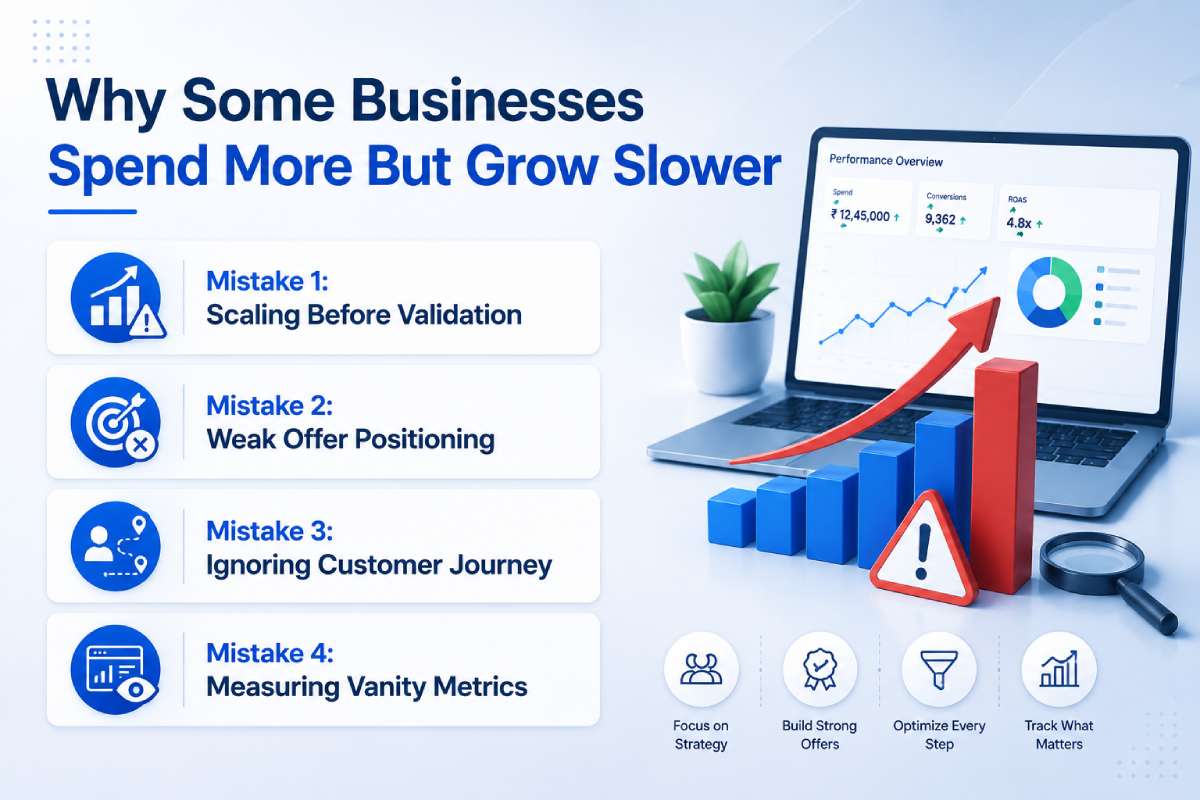
Why Some Businesses Spend More But Grow Slower
A common misconception is:
Higher Budget = Better Results
This is not always true. Many businesses spend aggressively while achieving poor returns.
Mistake 1: Scaling Before Validation
Some companies increase ad spend before identifying:
- winning audiences
- winning creatives
- winning offers
This amplifies inefficiencies.
Better Approach
- Validate first.
- Scale second.
Optimization should precede expansion.
Mistake 2: Weak Offer Positioning
Even perfectly optimized campaigns struggle when the offer lacks differentiation.
Examples include:
- generic messaging
- unclear value propositions
- weak pricing structures
Advertising cannot fix a poor offer.
Mistake 3: Ignoring Customer Journey
Modern buyers rarely convert immediately. Multiple touchpoints are often required.
Examples:
Ad
↓
Website Visit
↓
Retargeting
↓
Email
↓
Sales Call
↓
Purchase
Businesses that optimize only the first click often lose potential customers.
Mistake 4: Measuring Vanity Metrics
Many companies celebrate:
- impressions
- likes
- clicks
while revenue remains stagnant.
Real success should be measured through:
- leads
- customers
- revenue
- profitability
Performance Marketing ROI Framework
The purpose of performance marketing is not traffic. The purpose is profitable growth. Businesses should therefore track ROI systematically.
Understanding ROI
ROI measures:
Revenue Generated relative to Marketing Investment
Example Campaign
- Monthly Ad Spend: ₹1,00,000
- Agency Fee: ₹40,000
- Creative Cost: ₹20,000
- Total Investment: ₹1,60,000
Results
- Leads: 400
- Customers: 40
- Average Revenue: ₹10,000
- Total Revenue: ₹4,00,000
ROI Calculation
- Revenue: ₹4,00,000
- Investment: ₹1,60,000
- Profit: ₹2,40,000
- ROI: 150%
Key Insight
Campaign success should always be evaluated at the business level, not platform level.
Cost Per Lead (CPL) vs Cost Per Acquisition (CPA)
One of the most important distinctions in performance marketing is understanding the difference between CPL and CPA.
Cost Per Lead (CPL)
Measures:
Cost to generate an inquiry.
Formula:
Advertising Cost
÷
Number of Leads
Example
- Ad Spend: ₹50,000
- Leads: 250
- CPL: ₹200
Why CPL Matters
Useful for evaluating:
- campaign efficiency
- audience quality
- lead generation performance
Cost Per Acquisition (CPA)
Measures:
Cost to acquire a paying customer.
Formula:
Total Marketing Investment
÷
Customers Acquired
Example
- Marketing Cost: ₹1,00,000
- Customers: 20
- CPA: ₹5,000
Why CPA Matters More
Leads do not generate revenue. Customers do. Businesses should optimize for acquisition costs rather than lead costs alone.
Freelancer vs Performance Marketing Agency Pricing
Many businesses compare freelancers and agencies when planning campaigns. Understanding the differences helps avoid unrealistic expectations.
Freelancer Pricing
Typical Cost
₹10,000 – ₹50,000/month
Advantages
Lower Cost
Affordable entry point.
Direct Communication
Simple coordination.
Flexibility
Quick implementation.
Limitations
Most freelancers specialize in limited areas.
They may lack expertise in:
- creative production
- CRO
- analytics
- automation
- multi-platform management
Performance Marketing Agency Pricing
A professional performance marketing services in Mumbai provides access to specialists across multiple disciplines.
Typical Cost
₹30,000 – ₹5,00,000+/month
depending on scope.
Additional Expertise
Agencies often provide:
- strategists
- media buyers
- designers
- analysts
- CRO specialists
This broader expertise often produces stronger results.
Key Insight
Freelancers manage campaigns. Agencies build acquisition systems.
How to Choose the Right Performance Marketing Agency
Selecting an agency should involve more than comparing fees. The goal is identifying a partner capable of generating measurable business growth.
Evaluate Strategic Capability
Ask:
How do you approach:
- audience research
- funnel design
- budget allocation
- testing frameworks
Strong agencies discuss strategy before tactics.
Review Case Studies
Look for evidence of:
- lead growth
- revenue growth
- ROAS improvements
- customer acquisition efficiency
- Prioritize outcomes over impressions.
Assess Tracking Expertise
The best performance marketing company in Mumbai understands:
- attribution
- analytics
- CRM integration
- conversion tracking
Without measurement, optimization becomes impossible.
Evaluate Creative Capability
Creative quality increasingly determines campaign performance.
Ask:
How frequently do you test:
- ad creatives
- messaging
- offers
Continuous testing often separates high-performing agencies from average providers.
How Ideamagix Delivers Performance Marketing Growth
At Ideamagix, performance marketing is treated as a complete revenue-generation system rather than simply ad management. As a growth-focused performance marketing agency in Mumbai, our approach focuses on measurable business outcomes.
Our Performance Marketing Framework
Market Research
↓
Audience Analysis
↓
Campaign Strategy
↓
Creative Testing
↓
Landing Page Optimization
↓
Conversion Tracking
↓
Scaling
What We Focus On
Google Ads
Capturing high-intent demand.
Meta Advertising
Scalable customer acquisition.
LinkedIn Campaigns
B2B lead generation.
Conversion Optimization
Improving funnel performance.
AI-Powered Insights
Data-driven decision-making.
Goal
Traffic
↓
Leads
↓
Customers
↓
Revenue
↓
Profit
Businesses looking for a trusted performance marketing agency, performance marketing services in Mumbai, or an experienced performance marketing company in Mumbai should focus on partners capable of delivering sustainable growth rather than short-term metrics.
Conclusion
Performance marketing costs in India vary widely depending on:
- industry
- competition
- platforms
- objectives
- funnel complexity
The right budget is not necessarily the largest. It is the budget that produces profitable customer acquisition.
Businesses should focus on:
- Cost Per Acquisition
- Customer Lifetime Value
- Return on Ad Spend
- Revenue Growth
rather than vanity metrics alone. The companies that succeed in 2026 will be those that treat performance marketing as a business growth system rather than simply an advertising expense.
FAQs
1. How much does performance marketing cost in India?
Performance marketing costs vary based on industry, competition, and campaign goals. Small businesses typically spend between ₹25,000 and ₹1 lakh per month, while growing brands often invest ₹1 lakh to ₹10 lakhs+ monthly. Costs include both ad spend and agency management fees. Businesses should evaluate total acquisition costs rather than agency fees alone.
2. What is included in performance marketing agency pricing?
Most agency retainers include campaign strategy, account setup, audience targeting, optimization, reporting, and consultation. Some agencies also provide landing page recommendations, creative testing, and conversion tracking support. The exact scope depends on the engagement model and campaign complexity.
3. What is a good starting budget for paid ads in India?
For most local businesses and startups, a monthly budget of ₹25,000–₹50,000 is sufficient for initial testing. Growth-stage businesses often allocate ₹50,000–₹2 lakhs monthly. The goal during the first few months should be validating audiences, offers, and channels before scaling aggressively.
4. Which platform is better: Google Ads or Meta Ads?
The answer depends on business objectives. Google Ads captures users actively searching for solutions and often delivers higher intent traffic. Meta Ads excel at audience targeting, awareness building, and ecommerce growth. Many businesses achieve the strongest results by combining both platforms.
5. How do agencies charge for performance marketing?
Common pricing models include fixed monthly retainers, percentage of ad spend, hybrid models, and performance-based agreements. Most established agencies use retainers or hybrid models because they provide predictable resource allocation and campaign support.
6. What is a good Cost Per Lead (CPL)?
There is no universal benchmark because CPL varies significantly by industry. Local services may achieve leads below ₹200, while healthcare, finance, real estate, and SaaS campaigns may see CPLs exceeding ₹1,000–₹5,000. CPL should always be evaluated alongside lead quality and conversion rates.
7. What is more important: CPL or CPA?
CPA (Cost Per Acquisition) is generally more important because it measures the cost of acquiring paying customers. CPL only measures inquiries. A campaign with a higher CPL but stronger conversion rates may ultimately deliver better profitability than one with a lower CPL.
8. How long does it take to see results from performance marketing?
Initial campaign data is often available within days, but meaningful optimization typically requires 30–90 days. During this period, agencies test audiences, creatives, landing pages, and bidding strategies. Consistent improvements usually occur over multiple optimization cycles.
9. Should I hire a freelancer or a performance marketing agency?
Freelancers can be effective for smaller campaigns with limited complexity. Agencies provide access to broader expertise, including strategy, creative production, analytics, CRO, and multi-platform management. Businesses focused on scaling often benefit from agency support.
10. How do I choose the best performance marketing agency in Mumbai?
Evaluate strategic thinking, technical expertise, reporting processes, case studies, creative capabilities, and industry experience. Focus on agencies that discuss business outcomes, profitability, and customer acquisition rather than only impressions and clicks.